
 Worksheets
Seasons
Total questions: 50
Worksheet time: 1hrs 13mins




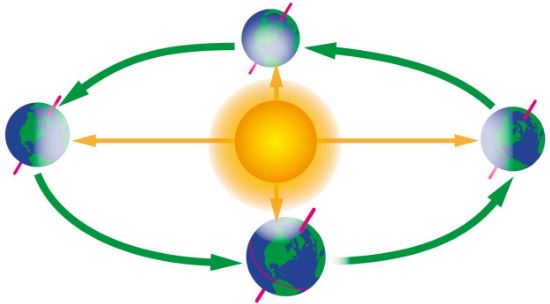




Halfway between the solstices, day and night are about 12 hours each.
Prime Meridian
Solstice
Equinox
Equator
Which way does the Earth rotate
North
East
South
West
How many solstices are there?
12
6
8
2
When is the Autumn Equinox?
September 22
March 21
June 21
October 21

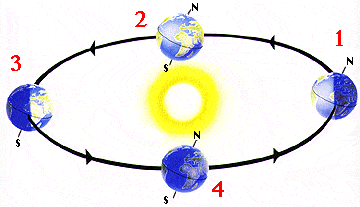
An illustration is provided showing the the relative motions of Earth and the Sun. Seasonal variations on Earth would be significantly changed if which of the following were changed?
The speed of rotation of Earth.
The direction of orbit of Earth.
The angle of tilt of Earth’s axis.
The speed of rotation of the Sun.

At which point on the diagram is the number of hours of daylight shortest in North America?
Point A
Point B
Point C
Point D

Which of the following BEST describes the length of days in Australia when the Earth and sun are positioned as shown in January in the diagram above?
Short days
Long days
continuous daylight
continuous darkness

Students are modeling the Earth, the Sun, and their relative motions. A basketball is used to represent the Sun, and a tennis ball is used to represent Earth. In order to accurately model the cause of day and night on the Earth, the students must –
lift the tennis ball off the table.
move the tennis ball around the basketball.
rotate the tennis ball on an axis
rotate the basketball on an axis

How long does it take the Earth to move from Point A to Point B?
3 months
6 months
9 months
12 months
All of the following affect the seasonal variation in weather on the Earth EXCEPT -
the time it takes for the Earth to orbit the Sun.
the varying amounts of daylight during the year.
the tilt of the Earth on its axis of rotation.
the distance between the moon and the Earth.
If Earth’s orbital path were to change so that it would take more time to revolve around the sun, Earth would -
rotate on its axis at a faster rate.
have seasons that last longer.
have a greater tilt on its axis
have longer days and nights.
Which of the following would cause the length of a day on the Earth to be shorter?
Increasing the length of Earth’s orbit around the Sun.
Decreasing the rate at which the moon orbits the Earth.
Decreasing the total radiation output produced by the Sun.
Increasing the speed of the Earth’s rotation on its axis.
Saturn rotates on its axis once approximately every 10.5 hours. From this information it can be concluded that Saturn will have which difference compared to Earth?
On average, less than half the hours of daytime as Earth.
More extreme seasonal temperature changes than Earth.
A shorter path when orbiting around the Sun compared to Earth’s orbital path.
A smaller mass that allows it to rotate faster than Earth.

The axis on which Earth now rotates is tilted at an angle. If the axis was to be changed so that it was perfectly upright, which change would be expected on Earth?
There would no longer be periods of light and darkness.
It would always be winter in the Southern Hemisphere.
There would not be the same pattern of seasonal changes in weather.
For every season, the length of the day would be shorter.
The path that an object takes as it travels around another object
Rotation
Revolution
Orbit
Axis

