wayground logo

Free Printable Worksheets

Font size

S
M
L
XL
Worksheets

Atomic Structure Review-Physical Science

Total questions: 50

Worksheet time: 3610secs

Name
Class
Date
1.
What is atomic number?
a)
Number of protons in an atoms 
b)
Number of neutrons in an atom
c)
Mass of an atom
d)
Charge on an atom
2.
Which subatomic particles are found in the nucleus of an atom?
a)
Protons and Electrons
b)
Protons and Neutrons
c)
Neutrons and Electrons
d)
Protons, Neutrons and Electrons
3.
What electrical charge does a proton have?
a)
+1
b)
0
c)
-1
d)
+2
4.
Bonus question: What element is this an atom of?
a)
nitrogen
b)
lithium
c)
beryllium
d)
carbon
5.
The three main subatomic particles are electrons, protons and ____________.
a)
photons
b)
neurons
c)
neutrons
d)
quarks
6.
Mass Number is--
a)
the number of protons + neutrons
b)
the number of protons
c)
the number of electrons +protons +electrons
d)
the same as atomic number
7.
How many protons does He have?
a)
4
b)
2
c)
6
d)
0
8.
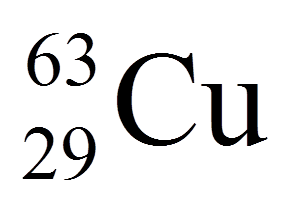
The top number in this isotope notation is
a)
the mass number
b)
the atomic number
c)
the atomic mass
d)
the neutron number
9.
The bottom number in this isotope notation is
a)
the mass number
b)
the atomic number
c)
the atomic mass
d)
the neutron number
10.
According to the isotopic notation for copper-63, how many neutrons are present in this type of atom?
a)
29
b)
34
c)
63
d)
92
11.
How many protons does an atom with an atomic number of 28 and a mass number of 40 have?
a)
28
b)
68
c)
12
d)
40
12.
The following element has _____________ electrons.
a)
114
b)
289
c)
175
d)
403
13.
Discovered the electron within the atom
a)
Thomson
b)
Chadwick 
c)
Schrodinger & Heisenberg
d)
Dalton
14.
Calculation used to find the number of neutrons in an atom
a)
Atomic Mass - Atomic Number
b)
Atomic Number - Atomic Mass
c)
Atomic Mass - Electrons
d)
none of these
15.

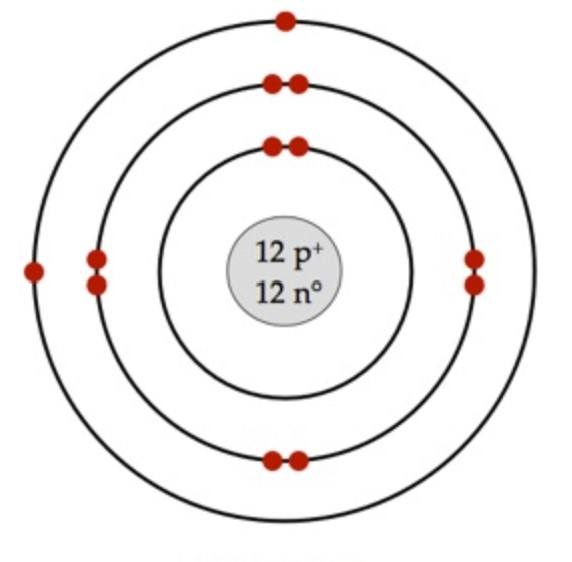
What element does this Bohr model represent?

a)

Chromium

b)

Magnesium

c)

Carbon

d)

Krypton

16.
What group does this element belong to?
a)
Group 1: Alkali metals
b)
Group 18: Noble Gases
c)
Group 2: Alkaline-Earth Metals
d)
Group 17: Halogens
17.
How many valence electrons?
a)
2
b)
3
c)
5
d)
10
18.
What's a valence electron?
a)
electrons in the second energy level
b)
electrons in the outermost energy level
c)
the atomic number
d)
electrons in the first level
19.

How many Valence electrons are there?

a)

4

b)

3

c)

2

d)

1

20.
What is an isotope? 
a)
A charged atom
b)
An atom with different amounts of neutrons
c)
An atom with different amounts of protons
d)
A neutral atom
21.
What is the name of the pictured isotope?
a)
Chlorine-Schmorine
b)
Chlorine-17
c)
Chlorine-35
d)
Chlorine-18
22.
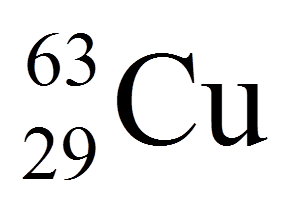
What is the name of the pictured isotope?
a)
Copper-29
b)
Copper-63
c)
Copper-34
d)
CopperWopperHopperBopper
23.

Potassium-39 has how many neutrons?

a)

19

b)

18

c)

20

d)

21

24.

12 protons and 13 neutrons

a)

Mg-12

b)

Mg-13

c)

Mg-25

d)

Mg-24.305

25.

In an atom, the number of protons is equal to the number of ____________.

a)

energy levels

b)

neutrons

c)

neurons

d)

electrons

26.
In the Bohr model of the atom, what is the maximum number of electrons in the first shell?
a)
1
b)
2
c)
6
d)
8
27.
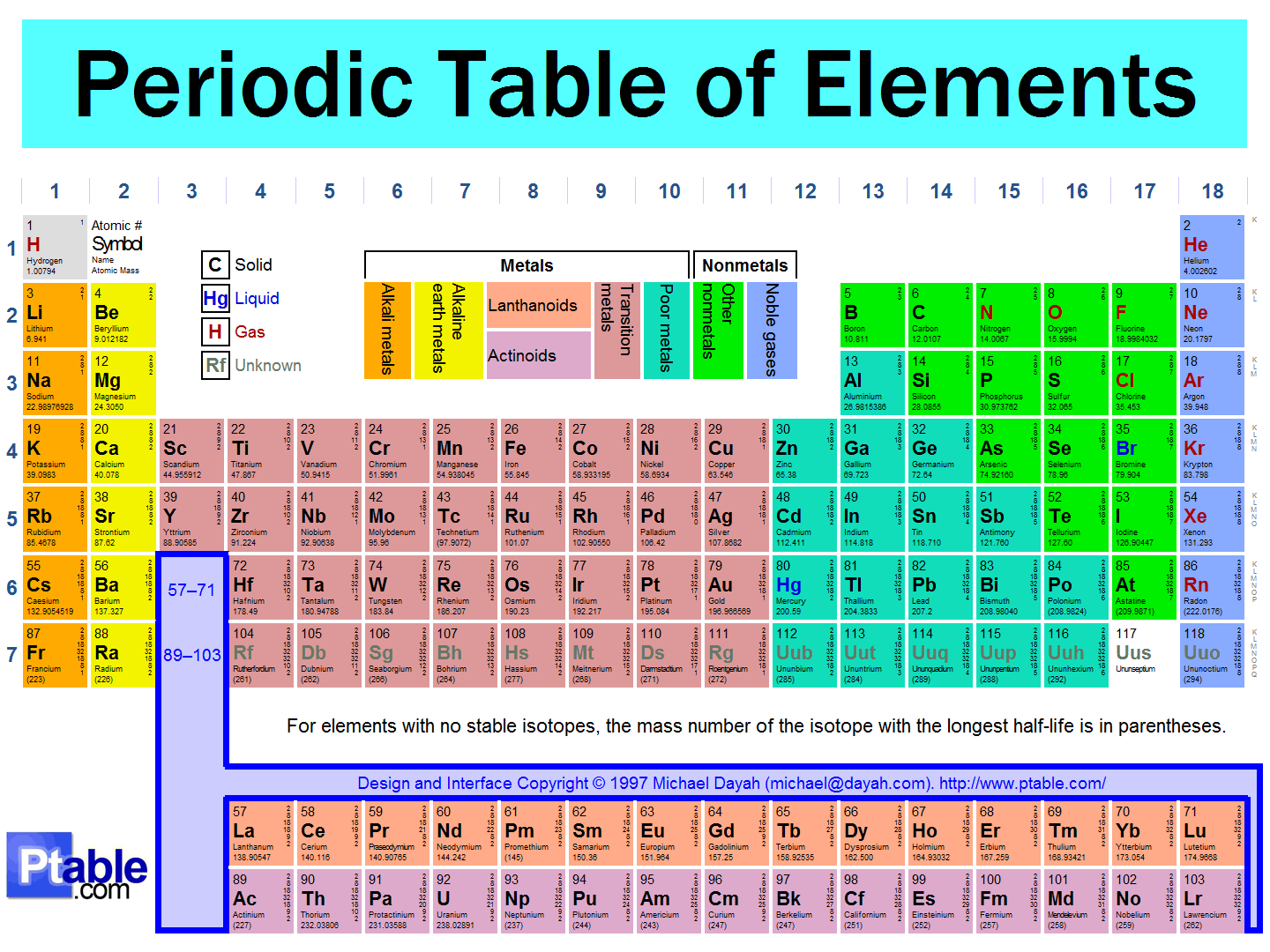
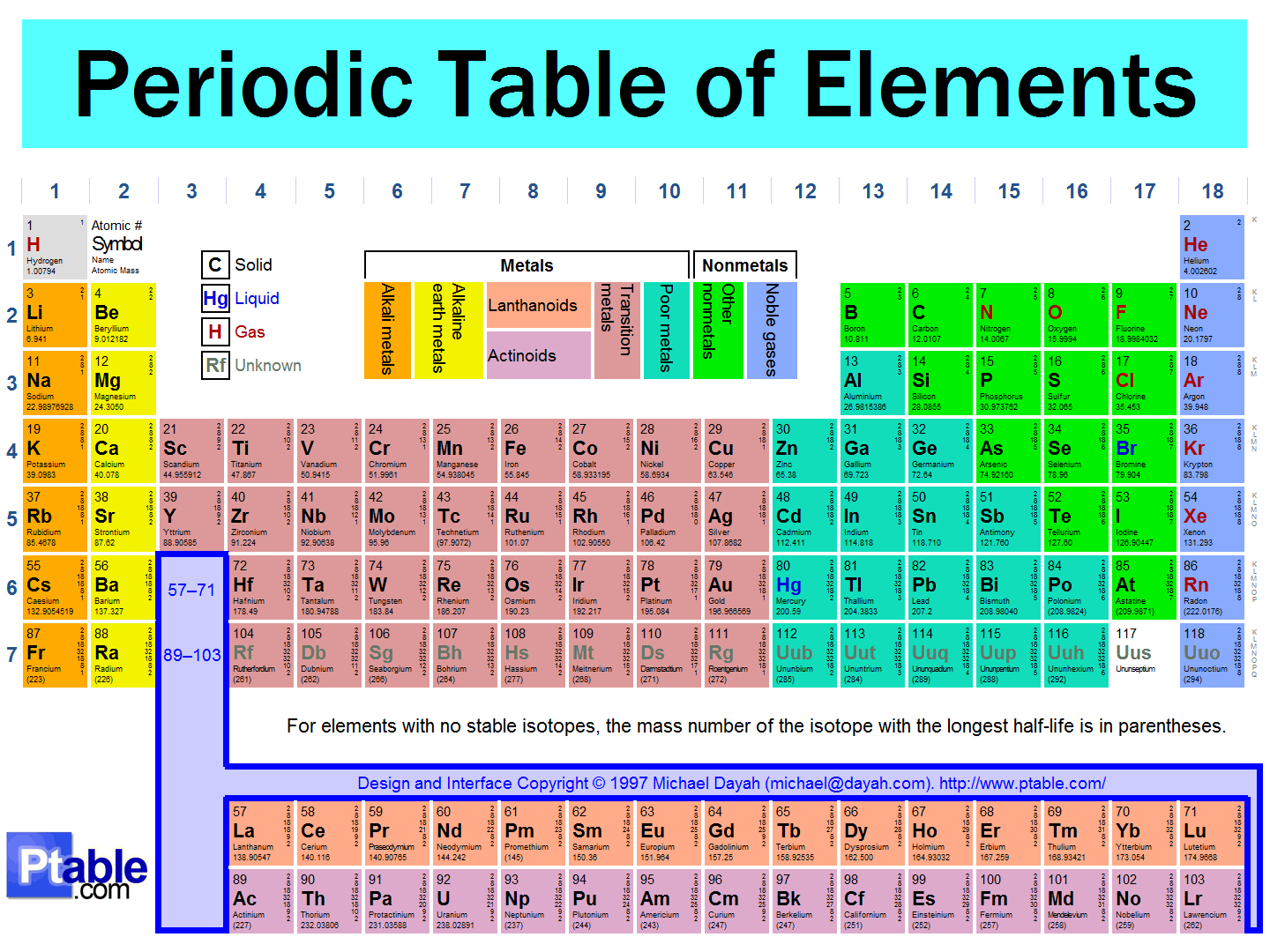
Look at the periodic table that is provided. Where would nonmetals be located? 
a)
to the left of the table in blue
b)
to the right of the table in pink
c)
in the zigzag line in yellow
28.
Look at the periodic table that is provided. Where would metals be located? 
a)
to the left of the table in blue
b)
to the right of the table in pink
c)
in the zigzag line in yellow
29.
Silicon is a semiconductor and has properties of both metals and nonmetals. What type of element is Silicon? 
a)
Metal
b)
Nonmetal
c)
Metalloid
d)
Pretty
30.
Which of the following is a good conductor of heat?
a)
Metal
b)
Nonmetal
c)
Metalloid
31.

What family is highlighted in the picture?

a)

Alkali Metals

b)

Alkaline Earth Metals

c)

Halogens

d)

Noble Gases

32.

What family is highlighted in the picture?

a)

Alkali Metals

b)

Alkaline Earth Metals

c)

Halogens

d)

Noble Gases

33.

What family is highlighted in the picture?

a)

Boron Group

b)

Alkaline Earth Metals

c)

Transition Metals

d)

Lanthanides

34.

The horizontal rows on the periodic table are called

a)

groups

b)

families

c)

periods

d)

atomic numbers

35.

These elements located on the "stair-step" line are sometimes called "semiconductors."

a)

Metals

b)

Nonmetals

c)

Metalloids

d)

Groups

36.
In the modern periodic table elements are arranged by:
a)
atomic mass
b)
atomic number
c)
valence electrons
d)
number of isotopes
37.
Which of the following is a halogen?
a)
Krypton
b)
Bromine
c)
Potassium
d)
Bismuth
38.

Which scientist discovered the electrons?

a)

Dalton

b)

Thomson

c)

Atristotle

d)

Bohr

39.

What is the center of an atom called?

a)

nucleus

b)

electron cloud

c)

proton center

d)

photon center

40.

Who was the Greek philosopher who called the smallest particle of matter an "atom"?

a)

Democritus

b)

Aristotle

c)

J.J Thompson

d)

Einstein

41.

Who created the plum pudding model?

a)

JJ Thomson

b)

Ernest Rutherford

c)

Niels Bohr

d)

John Dalton

42.

Moseley organized the Periodic table by atomic _________, and Mendeleev organized it by atomic ___________

a)

Mass, Number

b)

Number, Mass

c)

Structure, Mass

d)

Number, Isotope

43.

Which of the following is NOT a property of nonmetals?

a)

Good electrical conductivity

b)

Poor thermal conductivity

c)

Dullness

d)

Brittleness

44.

Which of the following is NOT a property of metals?

a)

Luster

b)

Conductivity

c)

Brittle

d)

Ductility

45.
In the modern periodic table elements are arranged by:
a)
atomic mass
b)
atomic number
c)
valence electrons
d)
number of isotopes
46.
_______________ developed the first periodic table and arranged the elements in order of increasing atomic mass.
a)
Stevie Wonder
b)
Sasha Vujacic
c)
Dmitri Mendeleev
d)
James Mosely
47.

How many electron energy levels does this element have?

a)

1

b)

2

c)

3

d)

0

48.

What is the mass of this atom?

a)

13

b)

14

c)

27

d)

1

49.

Chlorine is an example of a

a)

Halogen

b)

Inner Transition metal

c)

Transition metal

d)

Noble gases

50.
a)
Nucleus, positive
b)
Nucleus, negative
c)
Nucleus, neutral
d)
Electron Cloud, positive