Wayground logo

Free Printable Worksheets

Font size

S
M
L
XL
Worksheets

2nd Review for Chemistry of Life Unit Exam

Total questions: 44

Worksheet time: 51mins

Name
Class
Date
1.

This macromolecule is used to make energy for our cells. The simplest is glucose, a monosaccharide.

a)

Carbohydrates

b)

Lipids

c)

Nucleic Acids

d)

Proteins

2.

These macromolecules are fats, oils, waxes and sex steroids. They are also a result if we eat too many carbohydrates and why we don't melt in water.

a)

Carbohydrates

b)

Lipids

c)

Nucleic Acids

d)

Enzymes

3.

Examples of these macromolecules are DNA and RNA...

a)

Nucleic Acids

b)

Carbohydrates

c)

Lipids

d)

Proteins

4.

These macromolecules are the main building blocks of you. They are large and complex and special ones do jobs all over your body as catalysts.

a)

Proteins

b)

Carbohydrates

c)

Lipids

d)

Nucleic Acids

5.
What are special types of proteins that act as catalysts?
a)
Enzymes
b)
Lipids
c)
Polysaccharides
d)
DNA
6.
Where an enzyme joins with a substrate is called its...
a)
Active Site
b)
Mouth
c)
Substrate
d)
pH
7.
Enzymes make chemical reactions go faster by doing what?
a)
Lowering the activation energy of a reaction
b)
Making energy
c)
Absorbing energy
d)
Having a dance off with other enzymes
8.
The Hydrogen atoms in H2O are positively charged
a)
True
b)
False
9.
The ability of water to move through and around substances is called?  (Examples:  Water moving through a paper towel; water being transported from the roots to the top leaves of a tree.)
a)
Capillary action
b)
Cohesion action
c)
Concave action
d)
None of the above
10.
Which is NOT a unique property of water?
a)
Frozen water floats on liquid water.
b)
Water covers most of the Earth’s surface and retains a large amount of heat.
c)
Water molecules stick to each other through hydrogen bonds.
d)
Water cools very rapidly.
11.
Why does ice float?
a)
As water freezes, it expands and its density decreases.
b)
As water freezes, it takes up more hydrogen from the atmosphere, causing it to have a greater buoyancy.
c)
As water freezes, air becomes trapped between the hydrogen bonds of water molecules.
d)
As water freezes, it takes up more oxygen from the atmosphere, causing it to have a greater buoyancy.
12.
Which characteristic of water will allow a paperclip to remain floating on water when the paperclip is gently placed on top of the water?
a)
adhesion
b)
surface tension
c)
solvent properties
d)
nonpolar
13.
Water is a universal solvent because it...
a)
It can be found anywhere
b)
It freezes when it gets cold
c)
floats when frozen
d)
Dissolves most substances
14.
Enzymes are capable of increasing the rate of a chemical reaction within a living cell.  Enzymes accomplish this through which of the following means?
a)
reducing the number of products   
b)
reducing the activation energy
c)
increasing the temperature of the cell
d)
increasing the concentration of reactants 
15.
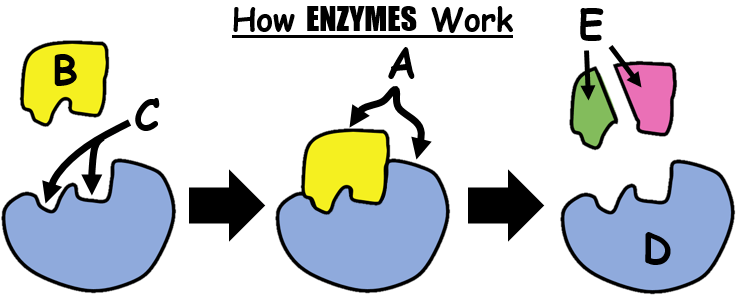
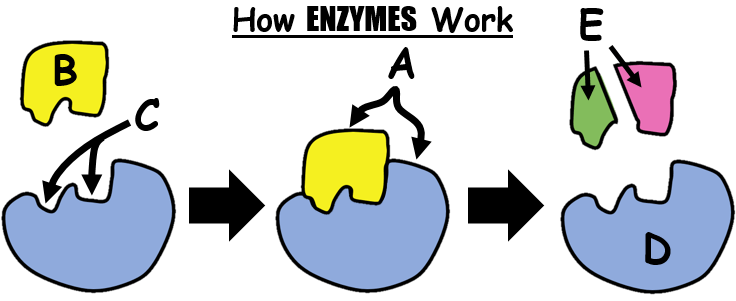
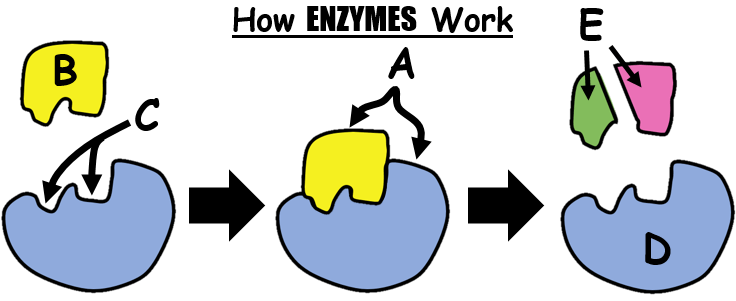
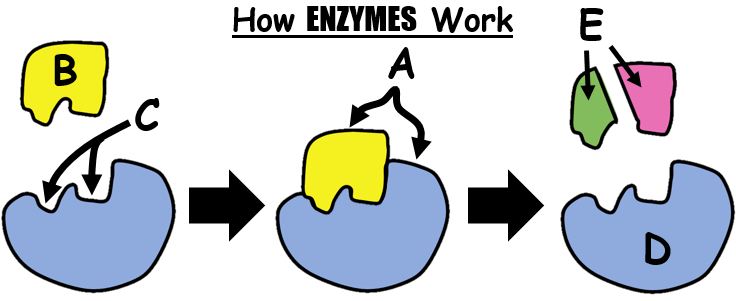
Letter D...
a)
active site
b)
enzyme
c)
substrate
d)
products
16.
Letter B...
a)
active site
b)
enzyme
c)
substrate
d)
products
17.
Letter E...
a)
active site
b)
enzyme
c)
substrate
d)
products
18.
In the diagram, what is letter A? 
a)
product
b)
substrate
c)
enzyme-substrate complex
d)
active site
19.
An enzyme speeds up a reaction by
a)
lowering the activation energy.
b)
raising the activation energy.
c)
releasing energy.
d)
absorbing energy.
20.
Proteins are composed of... 
a)
Carbon
Hydrogen
Oxygen
b)
Carbon
Hydrogen
Oxygen
Nitrogen
c)
Carbon
Hydrogen
Oxygen
Nitrogen
Phosporus
d)
Carbon
Hydrogen
Oxygen
Sulfer
21.
Most biological macromolecules contain carbon, hydrogen and oxygen atoms. Which of these has the carbon, hydrogen and oxygen in a 1:2:1 ratio?
a)
Carbohydrates
b)
Protien
c)
Lipid
d)
Nucleic Acid
22.
What is the function of nucleic acids?
a)
store genetic information
b)
store energy (long-term)
c)
store energy (short-term)
d)
build skin, hair, nails, muscles
23.
Nucleotides are monomers of
a)
Carbohydrates
b)
Lipids
c)
Proteins
d)
Nucleic Acids
24.
Monosaccharides are monomers of
a)
Carbohydrates
b)
Lipids
c)
Proteins
d)
Nucleic Acids
25.
Living things require specific organic molecules in order to survive. The picture above represents some specific examples of foods that are mainly composed of one of these necessary organic molecules. The organic molecules found in these types of food are
a)
Lipids-Fats
b)
Carbohydrates-Starch
c)
Nucleic Acid-RNA
d)
Protien
26.
Identify the macromolecule in the picture
*GLUCOSE
a)
lipid
b)
protein
c)
nucleic acid
d)
carbohydrate
27.
What type of macromolecule is being represented in this image? 
a)
carbohydrate
b)
lipid
c)
protein
d)
nucleic acid
28.
Name the class of macromolecule.
a)
protein
b)
nucleic acid
c)
carbohydrate
d)
lipid
29.

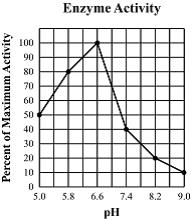
Which of the following conclusions can be drawn from this graph? (Optimum mean BEST)

a)

The optimum pH of the enzyme is 6.6.

b)

The optimum pH of the enzyme is 5.8

c)

The enzyme’s activity increases as pH increases 5.0 to 9.0

d)

The enzyme’s activity is greater around pH of 8.0 .
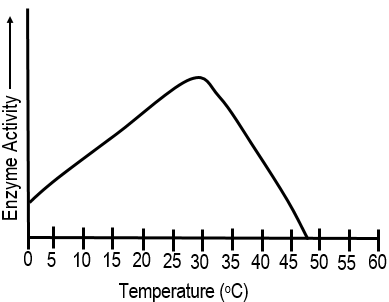
30.
Based on the graph, what is the optimal temperature for this enzyme? 
a)
15oC
b)
40oC
c)
30oC
d)
35oC
31.
When a piece of liver is dropped into hydrogen peroxide, the peroxide bubbles vigorously as the hydrogen peroxide (H2O2) decomposes into water (H2O) and oxygen (O2). This rapid change in reaction rate suggests 
a)
that liver contains lots of germs
b)
 the liver contains an enzyme that breaks down hydrogen peroxide
c)
 that liver is a substrate for hydrogen peroxide
d)
that hydrogen peroxide is a powerful enzyme
32.

Which 2 factors can affect the rate of enzyme activity?

a)

Light intensity

b)

Temperature

c)

pH

d)

Oxygen concentration

33.

What do you call a mean, grumpy protein? (The monomer of proteins)

a)

A Monossacchride

b)

An Amino Acid

c)

A Nucleic Acid

d)

LOL

34.

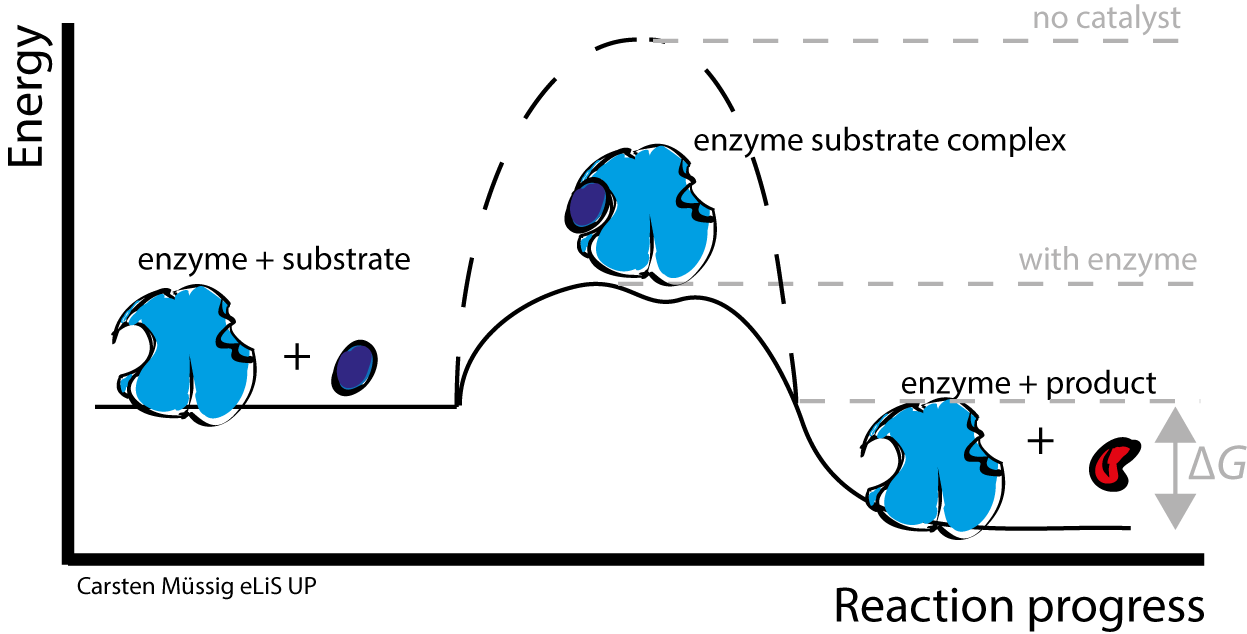
Which labeled part of the graph represents a reaction that took place with the addition of an enzyme?

a)

A

b)

B

c)

C

d)

D

35.
Which substrate would this enzyme catalyze?
a)
Δ
b)
σ
c)
∅
d)
Π
36.

When the temperature or pH causes the enzyme to change so it no longer works, this is called ....

a)

Allosteric inhibition

b)

Substrate concentration

c)

Denaturation

d)

Active Site transference

37.
What word describes when water is attracted to other substances?
a)
cohesion
b)
adhesion
c)
capillary action
d)
surface tension
38.
A water strider can skate along the top of a pond because:
a)
covalent bonds result in water cohesion
b)
hydrogen bonds result in water cohesion (surface tension)
c)
water striders have adapted to take advantage of water cohesion
d)
low surface tension of water
39.
Why does ice float?
a)
As water freezes, it expands and its density decreases.
b)
As water freezes, it takes up more hydrogen from the atmosphere, causing it to have a greater buoyancy.
c)
As water freezes, air becomes trapped between the hydrogen bonds of water molecules.
d)
As water freezes, it takes up more oxygen from the atmosphere, causing it to have a greater buoyancy.
40.
The attraction that causes water and other liquids to form drops on thin films is called ________________. This is also water’s ability to be attraction to other water molecules.
a)
adhesion
b)
capillary action
c)
cohesion
d)
surface tension
41.
Why does water move from the roots to the leaves of plants?
a)
Water is pushed by solutes
b)
Capillary action pulls the water molecules like a chain
c)
Water is pulled by gravity
d)
Water’s cohesion causes it to “pull” towards the leaves
42.
The fact that ice floats on liquid water is due to the fact that water's solid is ___________ than it's liquid form
a)
less polar
b)
more polar
c)
less dense
d)
more dense
43.
The tightness across the surface of water that enables paper clips to float is ____________.
a)
adhesion
b)
capillary action
c)
surface tension
d)
polarity
44.

Large bodies of water do not quickly fluctuate(change) in temperature. Why?

a)

Water is a solvent.

b)

Water has a high heat capacity.

c)

Water acts as a buffer.

d)

Water is non-polar.