
 Worksheets
Unit 3: Heat
Total questions: 24
Worksheet time: 26mins

If the specific heat of water is 4.18 J/g∙°C, how much heat is required to increase the temperature of 1.2 g of water from 23 °C to 39 °C?
-80.3 J
44.9 J
80.3 J
112.5 J

What unit do you use to measure Thermal Energy?
J/g ºC
g
ºC
J
When is your answer negative?
When the sample is cooled or loses heat energy.
When the sample heats up or gains heat energy.
When the sample absorbs heat energy.
How many joules of heat are needed to raise the temperature of 10.0 g of aluminum from 22°C to 55°C, if the specific heat of aluminum is 0.90 J/g°C?
297 Joules
0.003 Joules
297 J/gx°C
0.003 J/gx°C
The heat absorbed by melting a solid is known as
heat of fusion
heat of solid
heat of liquid
heat of vaporization

How many Joules of energy are required to change 10 gram of liquid water from 20°C to 90°C?
1400 J
2800 J
210,000 J
1,400,000 J
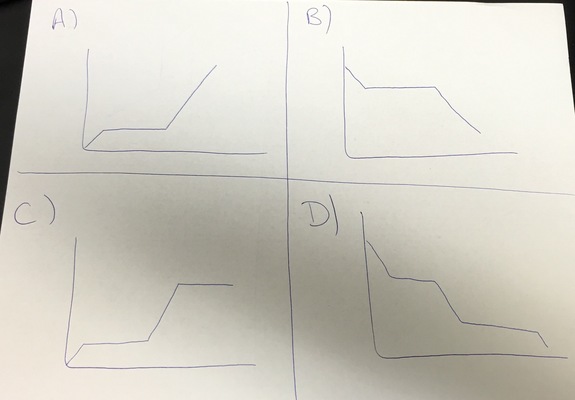
The specific heat of aluminum is 0.21 cal/g°C. How much heat(Q) is released when a 10 g piece of aluminum foil is taken out of the oven and cools from 100° to 50°?
105 J
10.5 J
1.05 J

How many Joules of energy are required to make 100 grams of ice at 0 οC completely melt? The heat of fusion of ice is 334 J/g
200 J
400 J
33,400 J
2,000,000 J

How many bars of phase energy would a liquid have?
1
2
3
4

How many bars of energy are being absorbed by the ice?
1
2
3
4

