
Font size
 Worksheets
Environmental Science #2
Total questions: 56
Worksheet time: 30mins
One reason the world is growing so quickly is because...
The world has infinite resources for everyone
Birth rate is higher than death rate
There are more and more places for people to live
Death rate is higher than birth rate
The average number of people per square mile is...
Birth rate
Land area
Population density
too many
People leaving a country is called
Immigration
Emigration
Mass migration
Urbanization
A person forced to flee their country due to war, violence, or natural disaster is called a...
Immigrant
A runner
Refugee
An illegal alien
Things that attract people to a new place are called
Push factors
Pull factors
An example of a pull factor is...
A natural disaster
Lack of access to education
Lack of resources
A new job opportunity
Something that makes people want to leave where they are is called a...
Push factor
Pull factor
An example of a push factor is...
A new job
A better school
Natural disaster
Better health care

This population pyramid shows...
Rapid growth
Slow growth
Negative growth

This population pyramid shows...
Rapid growth
Slow growth
Negative growth

This population pyramid shows...
Rapid growth
Slow growth
Negative growth
All of the following are characteristics of a developing countries EXCEPT...
A large rural population
A low life expectancy
Lack of access to education
Advanced technology

Which type of population is illustrated by this population pyramid?
Fast growing
Slow growing
Stationary (not growing or shrinking)
Negative growth (shrinking)
Which of the following is/are NOT shown on a population pyramid?
Ethnicity
Age
Gender
Race
True or False: On a population pyramid, the youngest age groups are at the top and the oldest age groups are at the bottom.
True
False
The term for age and gender groups on a population pyramid:
Population compositions
Population structures
Cohorts


Literacy rate is -
not related to the population growth rate of a nation.
related to the level of education in a country.
the number of different languages spoken in a country.
the GNP/GDP of a nation.
Country X has an infant mortality rate of 88 per 1,000. This means that -
on average, 88 mothers per 1,000 living in Country X will not survive childbirth.
women in a rural community will have 88 children per 1,000 born in Country X.
Country X has 88 live births per 1,000.
on average, 88 infants per 1,000 die before they reach the age of two.
A country’s population will grow if its -
birth rate is greater than its death rate.
death rate is greater than its birth rate.
infant mortality rate is greater than its fertility rate.
birth rate is less than its infant mortality rate.
Over the last 100 years, the number of people in the world has -
decreased due to birth control.
grown very little.
grown rapidly.
remained the same.
Which of the following is NOT a characteristic of human populations?
age distribution
availability of natural resources
education
GNP/GDP
Which of the following is true about population distribution patterns?
In today’s global market, the availability of natural resources has little effect on population distribution.
Areas with limited oil and fresh water supplies always have very small populations.
Extreme climates may discourage people from living in certain areas.
Government policies seldom affect population distribution patterns.
The population growth rate of a nation is most greatly affected by -
the music and art of its people.
its proximity to the ocean.
the use of reliable means of birth control.
being in a mountainous region.
Which of the following factors is least likely to influence population distribution?
availability of natural resources
natural scenery
economic development
conflict among religious and/or ethnic groups
Most countries with slow population growth rates have -
communist governments.
low gross national products.
high literacy rates.
large rural populations.
Life expectancy refers to the -
average number of expectant woman in a country.
average number of years a person is expected to live.
number of males and females living in a country.
quality of life people in a particular country can expect.
Death rates in many developed nations have declined because -
of free market economies.
of advances in medicine and nutrition.
birth rates are low.
people no longer die from AIDS.

Which generalization is best illustrated by the world map above?
Climate is the primary factor influencing population distribution.
People are spread out evenly throughout the world.
The majority of the world's population lives between 20°N and 60°N latitude.
More people live in the Western Hemisphere than in the Eastern Hemisphere.
People have preserved fertile land for farming by choosing to settle heavily in areas with poor farmland.

Based on the map, which area is most densely populated?
eastern Asia
northern Europe
western North America
central South America
southern Africa

Which statement about birth is best supported by the pyramid?
More births occurred in 1956 than in 1966
more births occurred in 1986 than in 2006
the number steadily increased between 1956 and 2016
the number steadily decreased between 1956 and 2016
fewer births occurred in 2016 and 2011


Which correctly describes the term demographic transition?
The transition from low birth rates and death rates to high birth rates and death rates as a country develops.
The transition from high birth rates and death rates to low birth rates and death rates as a country develops.
The transition from high birth rates to low death rates as a country develops.
The transition from low birth rates to high death rates as a country develops.

VOCAB: The average number of children a female member of a population has during her lifetime
total fertility rate
replacement fertility rate
growth rate
death rate

Which of the following leads to a decrease in birthrates among women?
Higher Education
High Infant Mortality Rate
No Prenatal Care
No contraceptives

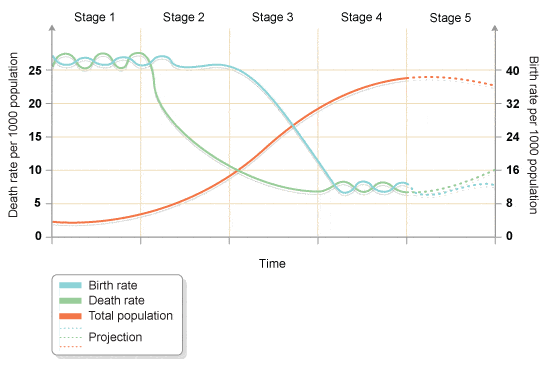


This country most likely is in which stage of the Demographic Transition Model?
stage 1
stage 2
stage 3
stage 5

When women in developing countries become educated...
The death rate increases
the country enters stage 5 of the Epidemiological Transition Model
the agricultural density increases
Fertility rates decrease

