wayground logo

Free Printable Worksheets

NEW

Font size

S
M
L
XL
Worksheets

Earth Science MidTerm Review

Total questions: 60

Worksheet time: 55mins
Name
Class
Date
1.
Which of the following causes Earth's tectonic plates to move?
a)
Energy from the Sun
b)
Magnetic Pole Reversal
c)
Convection currents in the mantle
d)
Faults in Mountain Ranges
2.
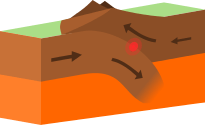
What type of plate boundary is this?
a)
Plate
b)
Divergent
c)
Convergent
d)
Transform
3.

Which of the following is the name of the ancient supercontinent formed millions of years ago.

a)

Pangea

b)

Gondwanda

c)

Laurasia

d)

Neverland

4.
Which of the following is NOT evidence to support the theory of plate tectonics?
a)
Fossils
b)
Mountains
c)
Glaciers
d)
Sand Erosion
5.

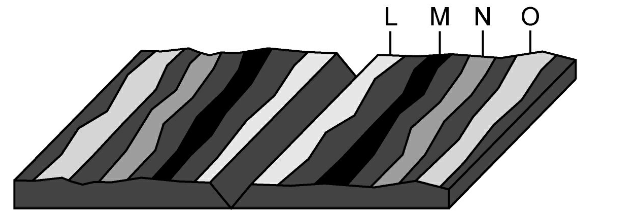
Where would the oldest rock be found?

a)

L

b)

M

c)

N

d)

O

6.
Where is the point at which the first movement occurs during an earthquake?
a)
Epicenter
b)
Focus
c)
Fault
d)
Plate
7.
Where is the point on the Earth’s surface directly above the focus of an earthquake?
a)
Epicenter
b)
Fault
c)
Hypocenter
d)
Tremor
8.
Which type of wave is the first to arrive after an earthquake occurs?
a)
P Wave
b)
Rayleigh Wave
c)
S Wave
d)
Shear Wave
9.
P Waves can move through which of the following?
a)
Gas
b)
Liquid
c)
Solid
d)
All of these
10.
What is an instrument that detects and records waves produced by earthquakes? (This piece of equipment can measure the magnitude of an earthquake.)
a)
Epicenter
b)
Fault
c)
Seismogram
d)
Seismograph
11.
What is the measure of the amount of energy released in an earthquake?
a)
Earthquake
b)
Epicenter
c)
Magnitude
d)
Seismogram
12.
Which scale rates earthquakes based on the amount of damage done?
a)
Mercalli Scale
b)
Richter Scale
c)
Seismogram Scale
d)
Bernoulli Scale
13.
Which scale measures the intensity of the ground movement?
a)
Mercalli Scale
b)
Richter Scale
c)
Seismogram Scale
d)
Bernoulli Scale
14.
What is the temporary state in which loose soil and rock materials take on the property of a liquid?
a)
Aftershock
b)
Liquefaction
c)
Seismic Gap
d)
Tsunami
15.
What is a large ocean wave that results from an underwater earthquake, landslide, or volcanic eruption?
a)
Aftershock
b)
Liquefaction
c)
Seismic Gap
d)
Tsunami
16.
Which travels fastest, always being the first detected by seismic stations?
a)
P waves
b)
S waves
17.
A rock which contains a useful mineral is call a/an
a)
gem
b)
quarry
c)
ore
d)
alloy
18.
The color of a mineral in powder form is called the mineral's 
a)
hardness
b)
specific gravity
c)
luster
d)
streak
19.
How light reflects off of a mineral is called the mineral's 
a)
luster
b)
streak
c)
cleavage
d)
fracture
20.
Why is coal not a mineral?
a)
It's not a solid
b)
It is man-made
c)
It is not inorganic
d)
It is made of carbon
21.
By definition, a mineral has which of the following characteristic(s)?
a)
definite chemical composition
b)
crystal structure
c)
naturally occuring
d)
all of the above
22.
How do you test the hardness of a mineral? 
a)
Throw it against a wall
b)
Step on it
c)
Scratch Test
d)
Kick it until it breaks
23.
What does the Mohs Scale measure?
a)
Streak
b)
Luster
c)
Hardness
d)
Cleavage
24.
When a mineral breaks in an uneven, rough, or jagged way
a)
Luster
b)
Cleavage
c)
Hardness
d)
Fracture
25.

When a mineral breaks smoothly and evenly it shows ________.

a)

Luster

b)

Cleavage

c)

Hardness

d)

Fracture

26.
If I shine a UV light over a mineral and it glows, it means the mineral has this special property:
a)
Magnetism
b)
Fluorescence
c)
Double Refraction
d)
Luster
27.
What is the hardest mineral on the Moh's Hardness Scale?
a)
Talc
b)
Gypsum
c)
Diamond
d)
Calcite
28.
What are the two most useful tests when identifying a mineral
a)
streak and color
b)
color and luster
c)
cleavage and fracture
d)
streak and hardness
29.
What is the LEAST useful way to identify a mineral?
a)
luster
b)
streak
c)
color
d)
density
30.
How do Intrusive Igneous rocks cool?
a)
quickly
b)
slowly
c)
really fast
31.
Where can we find Basalt?
a)
mountains
b)
valleys
c)
deserts
d)
ocean floor
32.

Igneous rock forms from.....

a)

sediments

b)

cooled and hardened magma

c)

cooled fossils

d)

molten magma

33.

When magma reaches Earth's surface and flows from volcanoes it is called...

a)

magma

b)

cooled lava

c)

lava

d)

fossil

34.

Igneous rocks that are formed beneath the Earth's surface.

a)

Extrusive igneous rocks

b)

Intrusive igneous rocks

c)

Volcanic rocks

d)

Volcanic glass

35.

Igneous rocks that are dense and dark-colored.

a)

Basaltic

b)

Granitic

c)

Andesitic

d)

Volcanic

36.
Igneous rock that forms from lava on Earth's surface
a)
Organic Rock
b)
Intrusive Rock
c)
Clastic Rock
d)
Extrusive Rock
37.

What factors can lead to the formation of a sedimentary rock?

a)

melting and solidification

b)

extreme heat and pressure

c)

compaction and cementation

38.
The breakdown of rock into smaller particles from the effects of wind, water and ice
a)
erosion
b)
cementation 
c)
pressure
d)
weathering
39.
Wind, water, ice and gravity carry sediments away
a)
weathering
b)
deposition
c)
erosion
d)
cementation
40.

The placing of sediment in a new location after erosion is what?

a)

weathering

b)

compaction

c)

cementation

d)

deposition

41.
This rock is made of salts left behind when a shallow sea evaporated. What type of sedimentary rock is it?
a)
Clastic
b)
Chemical
c)
Organic
42.
This rock is made of large bits of gravel cemented together. What type of sedimentary rock is it?
a)
Clastic
b)
Chemical
c)
Organic
43.
This rock is made of the remains of dead sea creatures (which have turned into oil). What type of sedimentary rock is it?
a)
Clastic
b)
Chemical
c)
Organic
44.
Metamorphic rocks that have grains arranged in parallel layers or bands are called...
a)
Foliated
b)
Nonfoliated
45.
How do metamorphic rocks form? 
a)
Heat and Pressure
b)
Compaction & Cementation
c)
Cooling of Magma
d)
Sediments & Glue
46.
Which texture best describes the rock above?
a)
porphyritic 
b)
nonfoliated
c)
foliated
d)
clastic
47.
__________ metamorphism occurs when magma heats the surrounding rock and changes it.
a)
Regional
b)
Forced
c)
Igneotrophic
d)
Contact
48.
__________  metamorphic rocks have mineral grains that are not arranged in distinct bands.
a)
Conglomerate
b)
Non-foliated
c)
Foliated
d)
Permeated
49.
__________ metamorphism occurs when rock formations in the crust collide and build pressure
a)
Regional
b)
Forced
c)
Igneotrophic
d)
Contact
50.
The volcanoes on the Hawaiian Islands form due to which of the following?
a)
Divergent Boundary
b)
Hot Spot
c)
Subduction Boundary
d)
Transform Boundary
51.
What is the principal ingredient to all types of magma?
a)
Iron
b)
Magnesium
c)
Silica
d)
Water
52.
What is the resistance of a liquid, such as lava, to flow?
a)
Elasticity
b)
Pyroclasticity
c)
Silica
d)
Viscosity
53.
Where are most volcanoes found?
a)
Southern Hemisphere
b)
Ring of Fire
c)
Mid-Atlantic Ridge
d)
Hot Spots
54.
What do you call a large crater formed by the collapse of a volcano?
a)
Caldera
b)
Cinder Cone
c)
Composite Volcano
d)
Shield Volcano
55.
Where do volcanoes come from?
a)
Places where plates move apart
b)
Places where plates are moving together
c)
Hot Spots
d)
All of these options
56.

A small, steep sided volcano that erupts gas-rich, basaltic lava.

a)

composite volcano

b)

cinder cone

c)

volcanic volcano

d)

shield volcano

57.

A large volcano with gentle slopes located along divergent plate boundaries and hot spots.

a)

composite volcano

b)

volcano

c)

hot spot

d)

shield volcano

58.

What type of volcano is this?

a)

cinder cone

b)

composite volcano

c)

hot spot

d)

shield volcano

59.

Most volcanoes occur at ________________, areas where huge slabs of rock meet in the Earth's lithosphere.

a)

plate boundaries

b)

hot spots

c)

northern hemisphere

d)

10:00 am

60.

Igneous Rocks are classified by ________ and _________.

a)

foliated and non-foliated

b)

texture and composition

c)

luster and color

d)

clastic and vesicular