
 Worksheets
2020 Unit 4 & 5: Work, Power, Energy
Total questions: 38
Worksheet time: 58mins
What is energy?
moving energy
stored energy
renewable energy
The ability to do work.
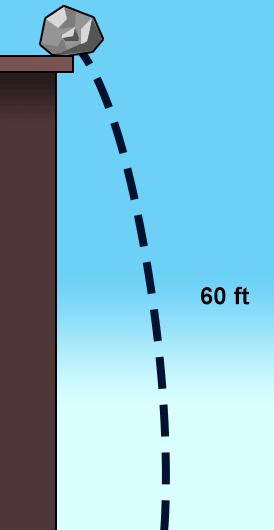
The rock in the picture is pushed over the edge and it begins to fall. Which type of energy conversion is taking place?
mechanical to heat
sound to mechanical
potential to kinetic
kinetic to potential

A ball is projected into the air. Where is potential energy the greatest?


How does the mass of a bowling ball that has been rolled down the lane affect the kinetic energy?
The kinetic energy does not depend on the mass of the bowling ball.
The kinetic energy is increasing proportional to the mass of the bowling ball.
The kinetic energy is decreasing proportional to the mass of the bowling ball.
The kinetic energy is increasing proportional to the square of the mass of the bowling ball.

Which point on the roller coaster's path represents the maximum potential energy?


As a roller coaster goes downhill
kinetic energy is converted into potential energy.
potential energy is converted into kinetic energy.
electrical energy is converted into potential energy.
potential energy is converted into electrical energy.
When gasoline is burned in a car engine, ________ energy is converted into _________ energy.
heat, chemical
chemical, potential
mechanical, chemical
chemical, mechanical

Within the alarm clock seen here, energy is transformed. It is time to get up! The alarm clock goes off. What are the energy transformations taking place in your alarm clock?
electrical to magnetic to sound
electrical to mechanical to sound
electrical to mechanical to light
chemical to electrical to mechanical
Maria’s father started a fire in the fireplace. He crumpled some paper, lit a match, and soon the logs in the fireplace were burning. In this case, the stored chemical energy in the logs was changed into
electrical energy.
mechanical motion.
heat and light energy.
electrical and heat energy.

The light bulb converts electrical energy into light and _________.
chemical
electromagnetic
heat
nuclear
Electromagnetic waves vary in
the speed they travel in a vacuum.
wavelength and frequency.
the way they reflect.
the orientation of their electric and magnetic fields.
To calculate the frequency of an electromagnetic wave, you need to know the speed of the wave and its
wavelength.
intensity.
refraction.
amplitude.
The full range of frequencies of electromagnetic radiation is called
visible light.
radio waves.
the electromagnetic spectrum.
invisible radiation.
The waves with the longest wavelengths in the electromagnetic spectrum are
Infrared rays.
radio waves
gamma rays
X-rays

Base your answer(s) to the following question on the graph below which represents the relationship between vertical height and gravitational potential energy for an object near Earth's surface.
55
2.25
50
2.5

Base your answer to the following question on the diagram shown. A planet, P, moves around the Sun, S in an elliptical orbit. The amount of time required for the planet to travel from point A to B is equal to the amount of time required to travel from point C to point D.
As the planet moves from point B to point C, how does its kinetic energy and potential energy change?
Both potential energy and kinetic energy increase
Both potential energy and kinetic energy decrease.
Potential energy increases and kinetic energy decreases.
Potential energy decreases and kinetic energy increases.
Mohammad’s teacher gives him an aluminum spring and asks him how he would increase the potential energy of the spring. Which of these answers does NOT increase the spring’s potential energy?
compressing the spring
putting the spring on the floor
stretching the spring
tossing the spring up into the air

