wayground logo

Free Printable Worksheets

Font size

S
M
L
XL
Worksheets

Weather Unit

Total questions: 126

Worksheet time: 3hrs 29mins

Name
Class
Date
1.
In what layer of the atmosphere would you find clouds and weather?
a)
troposphere
b)
stratosphere
c)
mesosphere
d)
thermosphere
2.

The gas that makes up most of Earth’s atmosphere

a)

lifting

b)

troposphere

c)

wind funnel

d)

nitrogen

3.

Lowest layer of the atmosphere

a)

lifting

b)

troposphere

c)

wind funnel

d)

nitrogen

4.

Weather happens in the

a)

troposhphere

b)

mesosphere

c)

stratosphere

d)

exosphere

5.

Which layer of the atmosphere do we live in?

a)

troposhphere

b)

mesosphere

c)

stratosphere

d)

exosphere

6.
What is the energy source for the water cycle?
a)
the sun
b)
the earth
c)
water
d)
the moon
7.
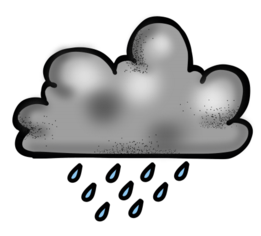
What part of the water cycle does this picture show?
a)
condensation
b)
precipitation
c)
evaporation
8.
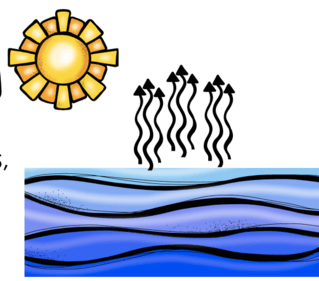
What part of the water cycle does this picture show?
a)
condensation
b)
precipitation
c)
evaporation
9.
What is evaporation?
a)
The part of the water cycle when the sun heats up water, turning it from a liquid into water vapor or steam. It rises from the ground into the air.
b)
The part of the water cycle when the water vapor in the air gets cold. The water turns back into a liquid and forms clouds.
c)
The part of the water cycle when clouds get heavy and can no longer hold the liquid water. This causes the water to fall from the sky to the earth as rain, snow, sleet, or hail.
10.
What is precipitation?
a)
The part of the water cycle when the sun heats up water, turning it from a liquid into water vapor or steam. It rises from the ground into the air.
b)
The part of the water cycle when the water vapor in the air gets cold. The water turns back into a liquid and forms clouds.
c)
The part of the water cycle when clouds get heavy and can no longer hold the liquid water. This causes the water to fall from the sky to the earth as rain, snow, sleet, or hail.
11.
Which is the opposite of condensation?
a)
runoff
b)
evaporation
c)
precipitation
d)
transpiration
12.
Which best explains why runoff is important?
a)
It returns water to other locations on Earth
b)
It increases the chance of flooding
c)
It makes evaporation occur faster
d)
It increases condensation
13.
What is it called when plants give off water vapor as a waste product?
a)
condensation
b)
evaporation
c)
sublimation
d)
transpiration
14.
If a rain drop lands in the ocean, it will eventually _______, and return to the clouds.
a)
condense
b)
evaporate
15.
Any form of water that falls from clouds and reaches Earth's surface as rain, snow, sleet, or hail is called...
a)
surface water
b)
precipitation 
c)
ground water
d)
runoff
16.
The energy that drives the water cycle comes from the...
a)
Sun
b)
Moon
c)
Clouds
17.
The continuous movement of water from Earth's surface to the atmosphere and back again.
a)
water cycle
b)
weather
c)
rock cycle
18.
The mass of air surrounding the Earth.
a)
atmosphere
b)
clouds
c)
water cycle
d)
weather
19.
The mass of air surrounding the Earth.
a)
atmosphere
b)
clouds
c)
water cycle
d)
weather
20.

In what layer of the atmosphere would you find clouds and weather?

a)

troposphere

b)

stratosphere

c)

mesosphere

d)

thermosphere

21.
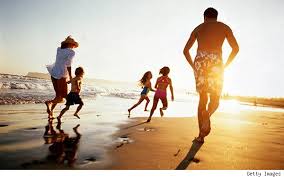
The sun shines down on this family as the play on the beach.
a)
conduction
b)
convection
c)
radiation
22.
The sun shines down on this family as the play on the beach.
a)
conduction
b)
convection
c)
radiation
24.
A group of friends gather around a fire to stay warm.
a)
conduction
b)
convection
c)
radiation
24.
A group of friends gather around a fire to stay warm.
a)
conduction
b)
convection
c)
radiation
25.
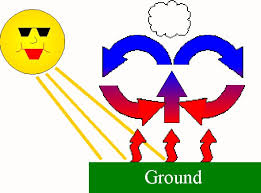
Warm air rises and the cool air sinks.
a)
conduction
b)
convection
c)
radiation
26.
In this experiment, the WARM red dye and the COLD blue dye was placed in the water at the same time. The warm red dye rose to the top while the cold blue dye sank to the bottom.
a)
conduction
b)
convection
c)
radiation
27.
In this experiment, the WARM red dye and the COLD blue dye was placed in the water at the same time. The warm red dye rose to the top while the cold blue dye sank to the bottom.
a)
conduction
b)
convection
c)
radiation
28.
Heat transfers from an area of ____temperature to an area of ___ temperature.
a)
high to low
b)
low to high
c)
high to high
29.
Heat transfers from an area of ____temperature to an area of ___ temperature.
a)
high to low
b)
low to high
c)
high to high
30.

A Ceiling fan forcing the warm air downward.

a)

Conduction

b)

Convection

c)

Radiation

31.

A Ceiling fan forcing the warm air downward.

a)

Conduction

b)

Convection

c)

Radiation

32.

What is another name for thermal energy?

a)

thermal equilibrium

b)

heat transfer

c)

heat energy

33.

What is another name for thermal energy?

a)

thermal equilibrium

b)

heat transfer

c)

heat energy

34.
Clouds are made up of tiny drops of ______ or ice. The moisture in the cloud affects the weather.
a)
dust
b)
water
c)
cloud particles
d)
precipitation
35.
Clouds are made up of tiny drops of ______ or ice. The moisture in the cloud affects the weather.
a)
dust
b)
water
c)
cloud particles
d)
precipitation
36.
They are highest clouds in the sky. They look curly, white and feathery. Usually mean good weather.
a)
Cumulus
b)
Cumulonimbus
c)
Cirrus
d)
Stratus
37.
They are highest clouds in the sky. They look curly, white and feathery. Usually mean good weather.
a)
Cumulus
b)
Cumulonimbus
c)
Cirrus
d)
Stratus
38.
They are low in the sky and look soft and fluffy. 
a)
Cirrus
b)
Cumulonimbus
c)
Cumulus 
d)
Stratus
39.
They are low in the sky and look soft and fluffy. 
a)
Cirrus
b)
Cumulonimbus
c)
Cumulus 
d)
Stratus
40.
Which cloud brings nice weather?
a)
Cumulonimbus
b)
Cumulus
c)
Stratus
41.
Which cloud brings nice weather?
a)
Cumulonimbus
b)
Cumulus
c)
Stratus
42.
Which cloud brings nice weather?
a)
Cumulonimbus
b)
Cumulus
c)
Stratus
43.
Low clouds (like fog), that are thick, cover the sky, and block the sun.  Usually bring continuous precipitation (rain or snow).
a)
stratus
b)
cumulus
c)
cirrus
d)
nimbo
44.
Low clouds (like fog), that are thick, cover the sky, and block the sun.  Usually bring continuous precipitation (rain or snow).
a)
stratus
b)
cumulus
c)
cirrus
d)
nimbo
45.
what type of cloud is shown?
a)
cumulus
b)
cirrus
c)
stratus
46.
what type of cloud is shown?
a)
cumulus
b)
cirrus
c)
stratus
47.
what type of cloud is shown?
a)
cumulus
b)
cirrus
c)
stratus
48.
During which part of the water cycle does a cloud form?
a)
Evaporation
b)
Precipitation
c)
condensation
d)
Run off
49.
During which part of the water cycle does a cloud form?
a)
Evaporation
b)
Precipitation
c)
condensation
d)
Run off
50.
During which part of the water cycle does a cloud form?
a)
Evaporation
b)
Precipitation
c)
condensation
d)
Run off
51.
During which part of the water cycle does a cloud form?
a)
Evaporation
b)
Precipitation
c)
condensation
d)
Run off
52.
Clouds form when...
a)
liquid water is heated and evaporates to become water vapor in the atmosphere.
b)
water vapor in the atmosphere cools and condenses becoming water droplets in the atmosphere
c)
water droplets float upwards and gather together in the atmosphere to form a cloud.
53.
Clouds form when...
a)
liquid water is heated and evaporates to become water vapor in the atmosphere.
b)
water vapor in the atmosphere cools and condenses becoming water droplets in the atmosphere
c)
water droplets float upwards and gather together in the atmosphere to form a cloud.
54.

What is it called when plants give off water vapor as a waste product?

a)

condensation

b)

evaporation

c)

sublimation

d)

transpiration

55.

What is it called when plants give off water vapor as a waste product?

a)

condensation

b)

evaporation

c)

sublimation

d)

transpiration

56.

What is it called when plants give off water vapor as a waste product?

a)

condensation

b)

evaporation

c)

sublimation

d)

transpiration

57.
The main human activity that releases greenhouse gases is...
a)
using bottled water
b)
burning fossil fuels
c)
texting on cellphones
d)
eating meat
58.
T/F: Water vapor is a greenhouse gas
a)
True
b)
False
59.
T/F: Some greenhouse gases are naturally present in the Earth's atmosphere
a)
True
b)
False
60.
The warming of the atmosphere by the trapping of heat being radiated to space is called
a)
evaporation
b)
condensation
c)
the greenhouse effect
d)
radiation
61.
T/F: Water vapor is a greenhouse gas
a)
True
b)
False
62.
T/F: Water vapor is a greenhouse gas
a)
True
b)
False
63.
Without any greenhouse effect the Earth would be...
a)
Fine
b)
Too Cold to Support Life
c)
Very Hot
64.
Which layer in the atmosphere protects us form harmful UV radiation?
a)
Ozone
b)
Troposphere
c)
Ionosphere
d)
Exosphere
65.
Consequences of climate change include:
a)
Stronger hurricanes
b)
Increased flooding
c)
Frequent droughts
d)
All of the above
66.
Which layer of the atmosphere do we live in?
a)
troposphere
b)
mesosphere
c)
thermosphere
d)
exosphere
67.
Which layer is known as the weather layer?
a)
stratopshere
b)
thermosphere
c)
mesosphere
d)
troposphere
68.
Which layer of the atmosphere contains a special form of oxygen called the ozone layer?
a)
mesosphere
b)
stratosphere
c)
thermosphere
d)
ionosphere
69.
What happens to the density (thickness)/ air pressure of the air as you increase in altitude?
a)
density increases
b)
density decreases
c)
density stays the same
d)
density disappears
70.
What happens to the density (thickness)/ air pressure of the air as you increase in altitude?
a)
density increases
b)
density decreases
c)
density stays the same
d)
density disappears
71.
What is the third layer of the atmosphere from the ground called?
a)
thermosphere
b)
mesosphere
c)
troposphere
d)
stratosphere
72.
What are the two most abundant gases in earth's atmosphere?
a)
nitrogen & oxygen
b)
carbon dioxide & water vapor
c)
hydrogen & oxygen
d)
oxygen and ozone
73.
What are the two most abundant gases in earth's atmosphere?
a)
nitrogen & oxygen
b)
carbon dioxide & water vapor
c)
hydrogen & oxygen
d)
oxygen and ozone
74.
What is the coldest layer of the atmosphere?
a)
troposphere
b)
mesosphere
c)
stratosphere
d)
thermosphere
75.
Which layer is known to have "shooting stars"?
a)
mesosphere
b)
stratosphere
c)
thermosphere
d)
exosphere
76.
Which layer is considered space?
a)
thermosphere
b)
troposphere
c)
mesosphere
d)
exosphere
77.
What is the layer of gases that surrounds the planet and makes conditions on Earth suitable for living things?
a)
gravity
b)
density
c)
air pressure
d)
atmosphere
78.
What is the energy source for the water cycle?
a)
the sun
b)
the earth
c)
water
d)
the moon
79.
Snow, sleet, hail, and rain are all examples of  ________________. 
a)
evaporation
b)
condensation
c)
accumulation
d)
precipitation
80.
Which best explains why runoff is important?
a)
It returns water to other locations on Earth
b)
It increases the chance of flooding
c)
It makes evaporation occur faster
d)
It increases condensation
81.
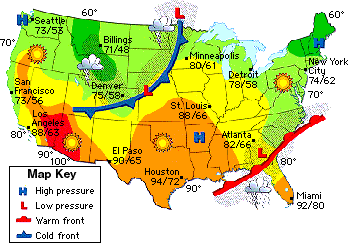
A cold front is approaching Minneapolis. What will happen to the air temperature?
a)
stay the same
b)
increase
c)
decrease
82.
The Earth's ____________ is the layer of gases that surround the planet and make it possible for living things to survive on Earth.
a)
atmosphere
b)
water cycle
c)
shell
d)
land
83.
A __________ is the lines between air masses.
a)
low pressure system
b)
high pressure system
c)
front
84.
An anemometer measurees
a)
wind direction
b)
wind speed
c)
air temperature
d)
rain fall
85.
A scientist who measures and predicts weather conditions is known as 
a)
an astronomer
b)
a geologist
c)
a meterologist
d)
a weatherologist
86.
Stratus clouds look like
a)
thin, wispy featherlike
b)
puffy and white
c)
layers of blankets low to the Earth
87.
These clouds are puffy white clouds with flat bottoms.
a)
Cirrus
b)
Cumulus
c)
Stratus
88.
A low pressure system is located over Georgia. What type of weather will they have?
a)
clear, sunny skies
b)
cloudy and rainy
89.
A high pressure system is located north of New York City. What type of weather will be experienced there?
a)
clear, sunny skies
b)
cloudy and rainy
90.
A low pressure system is located over Georgia. What type of weather will they have?
a)
clear, sunny skies
b)
cloudy and rainy
91.
___________is the result of the weight of a column of air pushing on an area.
a)
air pressure
b)
density
c)
volume
d)
none of the above
92.

The movement in the air caused by differences in air pressure ?

a)

Rain

b)

Wind

c)

Air

93.
A low pressure system usually causes 
a)
Clearing Weather 
b)
Wet Weather
c)
Fair Weather 
94.

_______ pressure systems are characterized by cloudy, rainy weather.

a)

High

b)

Low

95.

_______ pressure systems are characterized by cloudy, rainy weather.

a)

High

b)

Low

96.

_______ pressure systems are characterized by fair weather.

a)

High

b)

Low

97.

_______ pressure systems are characterized by fair weather.

a)

High

b)

Low

98.

This is when the rotation of the Earth deflects the direction of the wind.

a)

convergent effect

b)

marginal effect

c)

Coriolis effect

d)

Mariolis effect

99.

This is when the rotation of the Earth deflects the direction of the wind.

a)

convergent effect

b)

marginal effect

c)

Coriolis effect

d)

Mariolis effect

100.
The main reason land and sea breezes exist is because: 
a)
the earth revolves around the sun
b)
the earth is tilted on an axis
c)
of the temperature difference between land and water
d)
of global warming
101.
The main reason land and sea breezes exist is because: 
a)
the earth revolves around the sun
b)
the earth is tilted on an axis
c)
of the temperature difference between land and water
d)
of global warming
102.
This symbol represents
a)
a cold front
b)
an occluded front 
c)
a stationary front
d)
a warm front
103.
What direction is the cold front moving?
a)
Northwest
b)
Southeast
c)
Northeast
d)
Southwest
104.

What information do you not find on a weather map?

a)

cold front

b)

warm front

c)

high or low pressure

d)

seasons

105.

What information do you not find on a weather map?

a)

cold front

b)

warm front

c)

high or low pressure

d)

seasons

106.

The cold front is moving

a)

east and southeast

b)

west and northwest

c)

north

d)

south

107.
How do we name air masses?
a)
Water and temperature
b)
Air pressure
c)
Humidity and temperature
d)
Cold and warm
108.
How do we name air masses?
a)
Water and temperature
b)
Air pressure
c)
Humidity and temperature
d)
Cold and warm
109.
How do we characterize an air mass that forms over the ocean?
a)
Dry
b)
Wet
c)
Cold
d)
Warm
110.
How do we characterize an air mass that forms over near the equator?
a)
Dry
b)
Wet
c)
Cold
d)
Warm
111.
How do we characterize an air mass that forms near the poles?
a)
Dry
b)
Wet
c)
Warm
d)
Cold
112.
What types of air masses form over oceans?
a)
Maritime
b)
Continental
c)
Polar
d)
Tropical
113.
What's the humidity and temperature of a continental tropical air mass?
a)
Wet and cold
b)
Dry and warm
c)
Wet and warm
d)
Dry and cold
114.
What's the humidity and temperature of a continental tropical air mass?
a)
Wet and cold
b)
Dry and warm
c)
Wet and warm
d)
Dry and cold
115.
A wet and cold air mass would be a...
a)
Maritime polar
b)
Continental polar
c)
Maritime tropical
d)
Continental tropical
116.
A wet and cold air mass would be a...
a)
Maritime polar
b)
Continental polar
c)
Maritime tropical
d)
Continental tropical
117.
A dry and hot air mass would be...
a)
Maritime arctic
b)
Maritime tropical
c)
Continental tropical
d)
Continental polar
118.
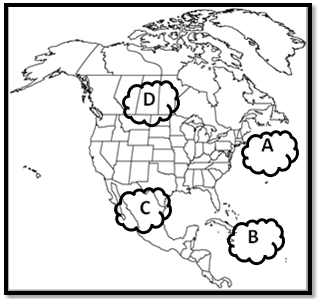
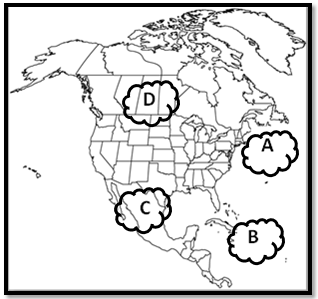
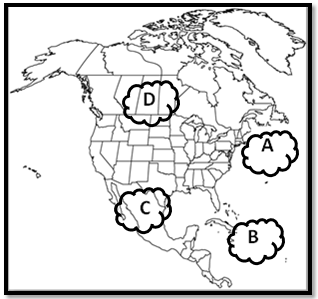
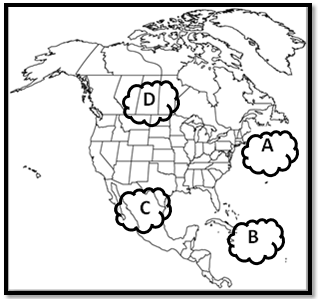
Which type of air would you find at air mass A?
a)
cold, dry
b)
warm, humid
c)
warm, dry
d)
cold, humid
119.
Which type of air would you find at air mass A?
a)
cold, dry
b)
warm, humid
c)
warm, dry
d)
cold, humid
120.
Which type of air would you find at air mass B?
a)
cold, dry
b)
warm, humid
c)
warm, dry
d)
cold, humid
121.
Which type of air would you find at air mass B?
a)
cold, dry
b)
warm, humid
c)
warm, dry
d)
cold, humid
122.
Which type of air would you find at air mass C?
a)
cold, dry
b)
warm, humid
c)
warm, dry
d)
cold, humid
123.
Which type of air would you find at air mass C?
a)
cold, dry
b)
warm, humid
c)
warm, dry
d)
cold, humid
124.
Which type of air would you find at air mass D?
a)
cold, dry
b)
warm, humid
c)
warm, dry
d)
cold, humid
125.
Which type of air would you find at air mass D?
a)
cold, dry
b)
warm, humid
c)
warm, dry
d)
cold, humid
126.
Air travels
a)
from high pressure to low pressure
b)
from low pressure to high pressue