
 Worksheets
Integrated Physical Science Unit 3 Review
Total questions: 38
Worksheet time: 53mins
What is defined as the ability to do work?
power
energy
force
momentum
What type of energy is the sum of kinetic and potential energy?
mechanical energy
chemical energy
thermal energy
sound energy
Which term describes stored energy?
Kinetic
Potential
Work
Power
What two quantities does potential energy depend on?
mass, velocity
mass, position
velocity, position
mass, weight
What two quantities does kinetic energy depend on?
mass, velocity
mass, position
mass, weight
velocity, distance

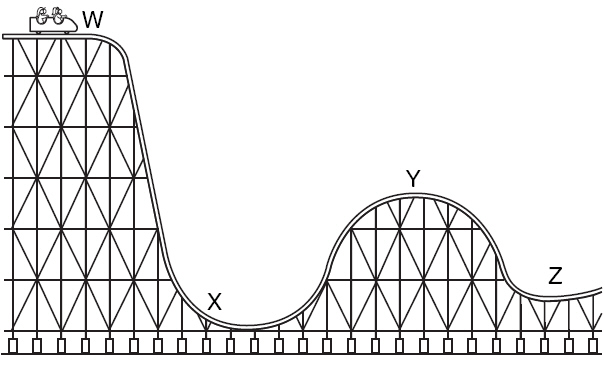
When is the potential energy the greatest in a roller coaster?
At the bottom of the first hill
At the top of the first hill
As the coaster enters a curve
At the end of the ride


At which of these positions does the ball have both the greatest kinetic energy and the least potential energy?
Position 1
Position 2
Position 3
Position 4
In which situation is work being done?
A UPS driver walks with a box under his arm at a constant speed.
A USPS mailman moves from a walk to a sprint when a dog starts to chase him.
A FedEx delivery driver slides a box across a shelf.
An Amazon delivery man sits anxiously in his truck at a red light.
What two quantities does elastic potential energy depend on?
the material & velocity at which it is stretched/compressed
mass of the substance & the position it is held
mass of the substance & velocity at which it is stretched/compressed
The material & the distance stretched/compressed

Where would this tossed baseball have the least amount of kinetic energy?
point W
point X
point y
point z
Where would this tossed baseball have the greatest amount of kinetic energy?
point W
point X
point y
point z

A cheetah can run briefly with a speed of 31.0 m/s. Suppose a cheetah with a mass of 47.0 kg runs at this speed. What is the cheetah’s kinetic energy?
KE = 1/2 mv2
1457 Joules
22,584 Joules
15 Joules
45,167Joules


A spring stretched 0.42 m has an elastic potential energy of 35 J. Calculate the spring constant. k =x22 EPE
8.6 N⋅m−1
83 N⋅m−1
166 N⋅m−1
397 N⋅m−1
If a green golf ball is dropped from a height of 7 feet and a yellow golf ball is dropped from a height of 12 feet, which ball has greater potential energy before it is released?
yellow
green
Both have the same amount of potential energy.
Neither will have more potential energy than the other.

Calculate the elastic potential energy Leo puts into the trampoline mat when he stretches the mat (k= 473 Nm-1) by 0.35 m. EPE = 1/2 kx2
165.6 J
82.8 J
29 J
675.7 J
Does the person in this picture do work on the rock?
No, the energy of the rock does not change.
No, the person does not accelerate the rock.
Yes, the person changes the potential energy of the rock.
Yes, the person applies a balanced force to the rock at the top of the hill.
What is the SI unit of work and energy?
Watt
Hertz
Joule
Newton
What is the SI unit for power?
What
Watt
Joule
Newton
A basketball that is dropped bounces back up to its original height. Pick the correct energy transformation from the point when it was dropped until it returns to the original height.
KE --> PE --> Elastic
PE --> KE --> Elastic --> KE --> PE
KE --> PE --> Elastic --> PE --> KE
Elastic --> PE --> KE --> Elastic
How much work is done on a 2540 N crate that is hoisted 3.2 m into the air?
W = Fd
794 J
1104 J
5842 J
8128 J
Which term is defined as a change in energy?
Power
Work
Force
Momentum
Which term is defined as the rate of doing work?
Power
Energy
Force
Momentum
What is the value for the acceleration due to gravity (g) on Earth?
10 m/s/s
10 m/s
42 m*s
42 m/s/s
A 5 kg ball is lifted 12 m above the ground. What is the gravitational potential energy of the ball?
GPE = mgh
60 J
600 J
17 J
2.4 J

You drop a 5 kg ball from a height of 2 m. Just before it reaches the ground, how much kinetic energy does it have?
GPE = mgh
KE = 1/2 mv2
10 J
100 J
7 J
20 J
A crane lifting a steel beam does 3500 J of work in 15 seconds. Calculate the power of the crane.
P = tW
58 W
69 W
233 W
52500 W

What amount of mechanical energy does this rollercoaster have?
7,500 J
20,000 J
32, 500 J
40,000 J

The mechanical energy of the cannon ball in the picture above is 1500 J. What is the value of the kinetic energy at point B?
0 J
375 J
750 J
1500 J
The mechanical energy of the cannon ball in the picture above is 1500 J. At what point would all the mechanical energy be in the form of gravitational potential energy (GPE = 1500 J)?
A
B
C
E

