wayground logo

Free Printable Worksheets

Font size

S
M
L
XL
Worksheets

Genetics S.7.2.1 + S.7.2.2

Total questions: 50

Worksheet time: 1hrs 3mins

Name
Class
Date
1.

How many pairs of chromosomes are in a human being?

a)

23

b)

44

c)

89

d)

72

2.

Where are chromosomes found in a cell?

a)

In the neutron of the cell.

b)

In the nucleus of the cell.

c)

In the proton of the cell.

d)

In the cell membrane of the cell.

3.

A _______ is a segment of DNA that codes for a specific protein or RNA molecule.

a)

gene

b)

gamete

c)

chromosome

d)

chromatid

4.

A _________ is DNA tightly coiled around proteins.

a)

gene

b)

chromosome

c)

trait

d)

mutation

5.

How many chromosomes does a human body cell have, total?

a)

48

b)

46

c)

23

d)

47

6.

Chromosomes that are paired by size and content are called _______ chromosomes.

a)

homeostasis

b)

homologous

c)

matching

d)

sister

7.

The 2 female sex chromosomes are ___.

a)

XY

b)

XX

8.

The 2 male sex chromsomes are _____.

a)

XY

b)

XX

9.

A photo of the chromosomes in a dividing cell that are arranged by size is called a _________.

a)

mutation

b)

gene

c)

picture

d)

karyotype

10.
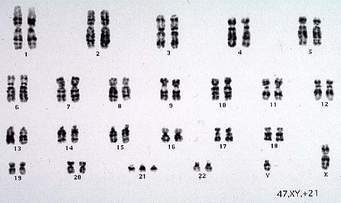
Based on the Karyotype shown, at which chromosome pair can we identify a genetic disorder? 
a)
Chromosome pair 5
b)
sex chromosomes
c)
Chromosome pair 21
d)
There are no chromosomal disorders
11.

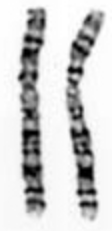
The structure in the image is called a:

a)

Chromosome

b)

Karyotype

c)

Gene

d)

Protein

12.

SELECT ALL THAT APPLY:

a)

Male

b)

Female

c)

No chromosomal abnormalities

d)

Trisomy 21

13.

SELECT ALL THAT APPLY:

a)

Male

b)

Female

c)

No chromosomal abnormalities

d)

Trisomy 21

14.

SELECT ALL THAT APPLY:

a)

Male

b)

Female

c)

No chromosomal abnormalities

d)

Trisomy 18

15.

You have 23 pairs of chromsomes. How many chromosomes do you have total?

a)

23

b)

46

c)

69

d)

12

16.
A pair of identical chromosomes shown in a karyotype, one inherited from mom, and one inherited from dad are called
a)
sister chromotids
b)
centromeres
c)
homologous chromosomes
d)
autosomes
17.
A change in DNA or chromosomes
a)
Mitosis
b)
Meiosis
c)
mutation
d)
Osmosis
18.
There is a segment of DNA that codes for every trait that a person has. These segments of DNA are found on
chromosomes and are called ________.
a)
Deoxyribonucleic acid
b)
Genes
c)
Heredity
d)
Recessive Traits
19.
What is the relationship between DNA and chromosomes?
a)
Chromosomes are made of DNA
b)
DNA is made of chromosomes
c)
DNA and chromosomes are the same thing.
d)
All of the above are correct
20.

Which of the following base pairings is correct?

a)

T-T, C-A

b)

A-T, C-C

c)

A-T, C-G

d)

C-G, C-C

21.
Which sequence of DNA bases would pair with this partial strand
ATG TGA CAG
a)
ATG TGA CAG
b)
TAC ACT GTC
c)
GTA AGT GAC
d)
CAT TCA CTG
22.
Adenine bonds with ______________.
a)
Guanine
b)
Thymine
c)
Cytosine
d)
Adenine
23.

What is the correct complimentary strand for the following DNA? ATCGAG

a)

TACGAG

b)

ATCGAG

c)

TAGCTG

d)

TAGCTC

24.
What is the difference between DNA and RNA in terms of bases?
a)
RNA contains uracil in place of thymine
b)
RNA contains uracil in place of adenine
c)
RNA contains uracil in place of guanine
d)
RNA contains uracil in place of  cytosine
25.
How many nucleotides make a codon?
a)
1
b)
2
c)
3
d)
6
26.
How would the DNA sequence GCTATA be transcribed to mRNA?
a)
GCUAUA
b)
CGATAT
c)
CGAUAU
d)
GCUTUT
27.
What happens to the RNA code when it leaves the nucleus?
a)
It remains as RNA forever
b)
It finds a ribosome and is read
c)
It leaves the cell
d)
It returns to the nucleus
28.
Why do we care so much about making proteins in our cells?
a)
Proteins compose almost EVERYTHING in our cells
b)
If a protein is made incorrectly it will not work
c)
Proteins determine our physical traits
d)
All of these are correct
29.
Which of the following is true about RNA?
a)
It is temporary
b)
It can leave the nucleus
c)
It is single stranded and less stable than DNA
d)
All of these
30.
I include the bases Guanine, Cytosine, Adenine and Thymine.
a)
DNA
b)
RNA
31.
I am arranged as a double helix or "twisted ladder".
a)
DNA
b)
RNA
32.
I am a single strand.
a)
DNA
b)
RNA
33.
I include the bases Guanine, Cytosine, Adenine and Uracil .
a)
DNA
b)
RNA
34.
I travel outside of the nucleus.
a)
DNA
b)
RNA
35.
The results of mutation are 
a)
can be bad.
b)
can be good. 
c)
cannot show.
d)
 can be good, bad or neutral. 
36.
A portion of DNA reads GAG. The corresponding mRNA would be
a)
GUG
b)
GTG
c)
CTC
d)
CUC
37.

A mutation can occur if a base pair is ____________, deleted, or substituted for another.

a)

modified

b)

added

c)

transferred

38.

ATTTGAGCC- Original

ATTGAGCC - Mutated

The example above is an example of a

a)

Insertion

b)

Point mutation

c)

Deletion

d)

Substitution

39.
What mutation has occurred here? 
T-G-A-C-C-A
T-G-A-G-C-A
a)
Substitution
b)
Deletion
c)
Insertion
d)
Frameshift 
40.
Which of the following would result in a frameshift mutation?
a)
Insertions only
b)
Substitution only
c)
Deletion only
d)
Insertions and Deletions
41.

Which Karyotype displays a female with Down syndrome?

a)
b)
c)
d)
42.
ATTTGAGCC- Original
ATTGAGCC - Mutated
The example above is an example of a 
a)
Insertion- Frameshift
b)
Deletion- Substitution
c)
Deletion -Frameshift
d)
All of the above
43.
Identify the SUBSTITUTION mutation form the following: 
ATG CCA AAT
a)
ATG TCA AAT
b)
ATG CCT AAA T
c)
ATC CA  AT
d)
ATG CCA AAT
44.

What type of mutation is shown in the diagram?

a)

Point mutation - missense

b)

Frameshift Mutation - deletion

c)

Frameshift Mutation - addition

d)

Point mutation - nonsense

45.
What pairs with Guanine (G)?
a)
Adenine (A)
b)
Thymine (T)
c)
Cytosine (C)
d)
Guanine (G)
46.
What pairs with Adenine (A)? 
a)
Guanine (G)
b)
Cytosine (C)
c)
Adenine (A)
d)
Thymine (T)
47.
What pairs with Thymine (T)?
a)
Adenine (A)
b)
Thymine (T)
c)
Guanine (G)
d)
Cytosine (C) 
48.
What pairs with Cytosine (C)?
a)
Guanine (G)
b)
Cytosine (C)
c)
Adenine (A)
d)
Thymine
49.
What are the three types of mutation? 
a)
Insertion, Deletion, Subsitution
b)
Deletion, Newstion, Subsitution 
c)
Newstion, Deletion, Insertion 
d)
Insertion, Newstion, Substitution 
50.

A frameshift mutation where a nucleotide base is added

to the DNA sequence

a)

Insertion Mutation

b)

Deletion Mutation

c)

Substitution Mutation

d)

Chromosomal Mutation