wayground logo

Free Printable Worksheets

NEW

Font size

S
M
L
XL
Worksheets

Evolution Extravaganza Part II

Total questions: 50

Worksheet time: 4hrs 10mins

Name
Class
Date
1.

How do most fossils form?

a)

An insect becomes trapped in amber.

b)

An entire organism becomes frozen in ice.

c)

A dead organism becomes buried in sediment.

d)

A dead organism becomes buried in tar.

2.

How does the fossil record help to support the theory of evolution?

a)

the fossil record shows that organisms slowly change over time

b)

The fossil record shows that species evolve very quickly

c)

The fossil record does not support the theory of evolution

3.

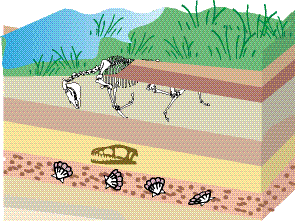
Which rock layer most likely contains fossils of the oldest organisms?

a)

1

b)

2

c)

3

d)

4

4.

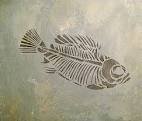
If scientists found this fossil, what could they infer?

a)

what fish are like today

b)

that this fish lacked oxygen

c)

that water once covered the area where this fossil was found
5.

According to the law of superposition, the oldest fossils are found

a)

At the top of the rock layers

b)

Near the bottom of the rock layers

c)

Somewhat near the surface

6.

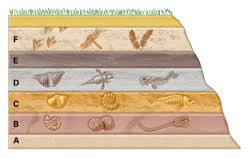
Which rock layer contains the newest fossils?

a)

B

b)

C

c)

D

d)

E

e)

F

7.
Finding the fossils of trees in an area that is currently a desert without much life might tell us that the area, millions of years ago - 
a)
was heavily eroded by strong winds
b)
received enough rain to support a forest
c)
suffered very powerful earthquakes
d)
was destroyed by the impact of meteorites
8.

What are the oldest fossils and why?

a)

B, C- because they are closest to the top

b)

A, B- because they are closest to the bottom

c)

They are all the same age- because they are all found on layer 2

d)

A, B- because they are found closest to the top

9.

When did fossil A become extinct?

a)

Layer 1

b)

Layer 2

c)

Layer 3

d)

Layer 4

10.

Fossil A is an ancient mollusk, an organism that needs water to survive. Why do you think that the mollusk went extinct in this particular sample of the fossil record?

a)

When the ocean levels rose in layer 4, the mollusk went extinct because they cannot live in water

b)

For some reason, the ocean disappeared causing the mollusk to thrive

c)

For some reason, the ocean disappeared causing the mollusk to go extinct

d)

When the ocean level rose in layer 4, the mollusk thrived because they need water

11.

In which layer did fossil C come into existence? How do you know this?

a)

Layer 1-Because that is the layer it is first seen

b)

Layer 1- Because that is the last layer it is seen in

c)

Layer 2- Because that is the layer it is first seen

d)

Layer 2- Because that is the last layer it is seen in

12.

The evolution of the horse is the most complete fossil record we have of a single organism. Using the picture, what can you conclude happened to the horse over time?

a)

The horse grew larger and lost its toes

b)

The horse shrank and lost its toes

c)

The horse grew larger and gained toes

d)

The horse shrank and gained toes

13.
By determining the age of fossils, scientists can reconstruct the history of life on Earth
a)
True
b)
False
14.
In layers of sedimentary rock, the _________ layer is usually at the bottom. Each higher layer is _________ than the layers below it.
a)
oldest, younger
b)
youngest, older
c)
youngest, younger
d)
oldest, older
15.
The millions of fossils that scientists have collected are called
a)
The Geologic Time Scale
b)
The Origin of Species
c)
The Fossil Record
d)
A really neat fossil collection
16.
How do fossils provide evidence that evolution has happened on Earth?
a)
Fossils show how the sizes of certain animals has changed drastically over millions of years
b)
Fossils show that some species have gone extinct
c)
Fossils show how life forms present today are different than those from the past
d)
Different sedimentary rock layers provide evidence for how the environment has changed over time
17.
Which statement best describes a relationship between these organisms?
a)
Organism A was probably more primitive than Organisms B and C
b)
Organism A was probably more complex than organism B and C
c)
All of these organisms probably lived at the same time
18.
Which species’ DNA is most similar to the DNA of the toothed whale? 
a)
Hippopotamus 
b)
Baleen Whale
c)
Grazing Mammals
d)
Camels
19.
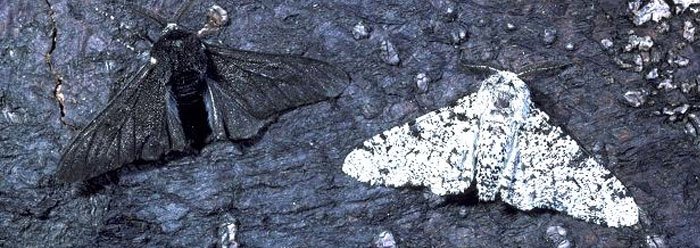
The environment around Manchester, England, changed during the Industrial Revolution.  How did this change affect peppered moths living in the area?
a)
Natural selection favored moths with dark wings because predators could not see them on the soot-colored trees.
b)
Natural selection favored moths with white wings that were easy for predators to see.
c)
Natural selection favored moths with white wings because predators could not see them on the soot-colored trees.
d)
Natural selection caused moths with white wings to become extinct.
20.

How do whales benefit from a nostril at the top of the head?

a)

It doesn’t interfere with the eyesight of the whale.

b)

The whale can eat under water without choking.

c)

The whale doesn’t need to breathe air because it has gills like fish.

d)

The whale can use the nostril to snell prey so that it will not starve.

21.

What is common ancestry?

a)

When a species no longer exists

b)

When organisms are descended from a single ancestor

22.

The earliest organisms were ___________; the more recent organisms are ____________.

a)

simple; more complex

b)

complex; more simple

23.

Which of the following terms describes when a new species evolves or develops?

a)

Unifornitarianism

b)

Speciation

24.

_______________, or selective breeding, is one way that humans impact evolution. One example is how the Belgian Blue cow has been bred to have greater muscle mass.

a)

Artificial selection

b)

Homologous

25.
Groups of organisms with similar characteristics may be descended from a _________________.
a)
surfer
b)
skater
c)
common ancestor
d)
different ancestors
26.

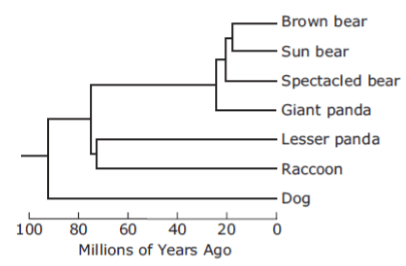
Who is the closest relative to the brown bear?

a)

Giant panda

b)

Dog

c)

Lesser panda

d)

Sun bear

27.

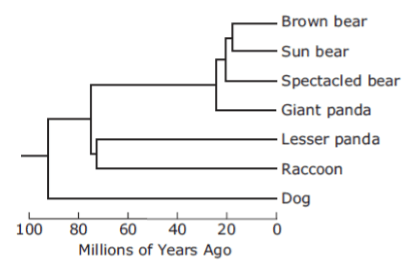
Based on this phylogenetic tree, which statement is true?

a)

Lesser pandas are more genetically similar to giant pandas than they are to raccoons

b)

Brown bears are more genetically similar to giant pandas than they are to sun bears

c)

Lesser pandas are more genetically similar to raccoons than they are to giant pandas

d)

The bear species are all more genetically similar to dogs than they are to giant pandas

28.

Which organism is the most distantly related to all the others?

a)

Raccoon

b)

Dog

c)

Giant Panda

d)

Sun Bear

29.

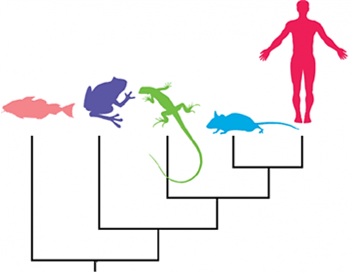
According to this phylogenetic tree, which creature is the least related out of all pictured?

a)

Fish

b)

Frog

c)

Salamander

d)

Human

30.

What number is the common ancestor of C and D

a)

1

b)

2

c)

3

d)

4

31.

What is the common ancestor of Letters A, B, C, D, E?

a)

1

b)

2

c)

3

d)

4

32.

Who is most closely related to Taxidea taxus?

a)

Lutra lutra

b)

Panthera pardus

c)

Canis latrans

d)

Canis lupus

33.
Which option is the best example of environmental pressures that cause natural selection?
a)
Ranchers breeding cows
b)
Farmers creating bigger corn
c)
Climate and Predators 
d)
Artificial Selection 
34.

A German Shepard would probably not survive in the wild because...

a)

the dog is mixed

b)

the dog is a product of artificial selection and not adapted for the wild.

c)

the dog is a product of natural selection and is not well fit for the environment

35.

The Aztecs and Maya Tribes of Mexico where some of the first humans to slowly change wild corn to the corn we know today. What process did these tribes use?

a)

Natural Selection

b)

Artificial Selection

c)

Mitosis

d)

adaptive radiation

36.

The trees these moths used to live on were white, but have been covered in soot from coal factories. Which moth will be more successful in this new, darker environment?

a)

Dark moth

b)

Light moth

c)

Both will be equally successful

d)

Neither will be successful

37.
Artificial selection is...
a)
the process by which humans select who lives and dies based on traits of animal or plant.
b)
the process by which natures selects who lives and dies.
c)
the process by which animals adapt to their surroundings.
d)
the process by which people take over ecosystems.
38.

A mutation causes a new fur color variation to appear in a mouse population. In which of the situations described below would the new fur color become more common than the old color in the mouse population?

a)

If plenty of food is available in the mouse habitat.

b)

If the new fur color gene is a recessive allele.

c)

If the amount of reproduction in the mouse population stays the same.

d)

If the new fur color gene is helpful in the survival of mice and their offspring.

39.

The formation of a new species is called

a)

Natural selection

b)

Struggle for existence

c)

Speciation

d)

Darwinism

40.
When reproductive barriers separate a population of a species in nature, the species no longer share a... 
a)
taxa
b)
gene pool 
c)
phylogenetic tree
d)
species 
41.
What is a species? 
a)
A group of organisms that can mate with each other and produce fertile offspring. 
b)
A group of organisms that can mate and produce offspring even if those offspring are infertile.
c)
A group of organisms that genetically are very different from each other. 
d)
Indivual organisms that live in the same environment. 
42.
What evidence does speciation provide for the theory of evolution by natural selection?
a)
Speciation can show us that new species don't choose to adapt, but have changed due to diverging from an original species due to reproductive barriers.
b)
Speciation can show us that new biological species can come from divergence (separating) due to reproductive barriers.
c)
Speciation can show us that environmental changes & genetic variation play a role in the process of a new species diverging from an original species due to reproductive barriers. 
d)
All of the above fit!
43.
In terms of evolution, survival is the most important thing.
a)
True
b)
False
44.
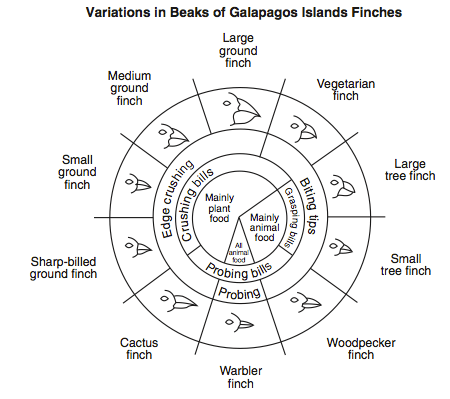
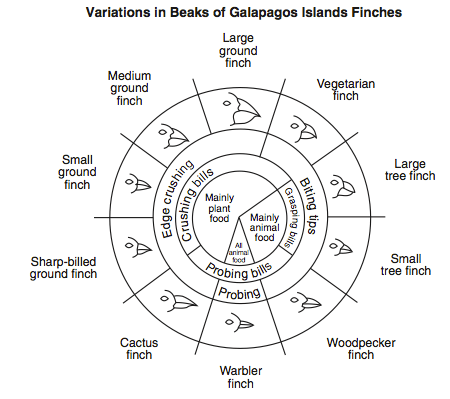
Base your answer(s) to the following question(s) on the diagram below and on your knowledge of biology.
Which two finches would compete the least for food? 
a)
small ground finch and large ground finch 
b)
large ground finch and sharp-billed ground finch 
c)
small tree finch and medium ground finch 
d)
vegetarian finch and small ground finch 
45.
Base your answer(s) to the following question(s) on the information below and on your knowledge of biology. The diagram below represents the relationship between beak structure and food in several species of finches in the Galapagos Islands. 
Which factor most directly influenced the evolution of the diverse types of beaks of these finches? 
a)
predation by humans 
b)
available food sources 
c)
oceanic storms 
d)
lack of available niches 
46.

What is an adaptation?

a)

A variation that helps an animal survive.

b)

The food that an animal eats.

c)

How energy moves in a food web.

d)

How animals evolve throughout time.

47.
How do adaptations help animals?
a)
to hide from predators
b)
to hunt for food
c)
to survive in their habitats
d)
All of these are correct
48.
Which is necessary for speciation to occur?
a)
adaptation
b)
mass extinction
c)
isolation
d)
acquired traits
49.
What is this an example of?
a)
diversity of species
b)
variation
c)
vestigial structures
d)
DNA studies
50.
Darwin wrote that organisms with traits that are best suited to the environment will ________________
a)
increase in number
b)
become extinct