wayground logo

Free Printable Worksheets

NEW

Font size

S
M
L
XL
Worksheets

Kasem Benchmark Review

Total questions: 75

Worksheet time: 1hrs 8mins

Name
Class
Date
1.
How many different elements are in this chemical formula: C2H2ClK3
a)
6
b)
8
c)
2
d)
4
2.
Which of the following atomic symbols is written correctly?
a)
ee
b)
hE
c)
C
d)
CL
3.
Which of the following is a pure substance?
a)
CO
b)
C02
c)
Co
d)
H2O
4.
Which of the following is a pure substance?
a)
O2
b)
Al2CO5
c)
C6H12O6
d)
SiO2
5.
Can be found on the periodic table
a)
Element
b)
Compound
c)
MIxture
6.
What is sugar?
a)
element
b)
compound
c)
mixture
7.

Which item on this element square is the chemical symbol?

a)

Copper

b)

29

c)

Cu

d)

63.546

8.
Which of the following is not a compound?
a)
HCl
b)
Cl
c)
NaCl
d)
CO2
9.
What is made up two or more elements that are chemically combined?
a)
Element
b)
Mixture
c)
Compound
d)
Solids
10.
How many elements are represented in the compound?
Na2CO3
a)
1
b)
2
c)
3
d)
4
11.
Classify the picture with the correct label.
a)
Element
b)
Compound
c)
Mixture of Elements
d)
Mixture of Compounds
12.
Classify the picture with the correct label.
a)
Element
b)
Compound
c)
Mixture of Elements and Compounds
d)
Mixture of Elements
13.
Classify the picture with the correct label.
a)
Element
b)
Compound
c)
Mixture of Elements & Compounds
d)
Mixture of Compounds
14.
Classify the picture with the correct label.
a)
Compounds
b)
Mixture of Elements
c)
Mixture of Compounds
d)
Mixture of Elements & Compounds
15.

Water (H2O), is not found on the periodic table because water is a...

a)

atom

b)

liquid

c)

mixture

d)

compound

16.
Which of the following is a sign that a chemical reaction has occurred?
a)
change in shape
b)
melting
c)
formation of a gas
d)
dissolving
17.
Is melting butter for popcorn a chemical or physical change?
a)
chemical
b)
physical
18.
Is burning wood a chemical or physical change?
a)
chemical
b)
physical
19.
A change in the size, shape, or state of matter.
a)
chemical change
b)
physical change
c)
chemical reaction
d)
electron change
20.
Which of the following is NOT an example of a physical change?
a)
crumpled paper
b)
pencil sharpening
c)
shrunken clothing
d)
sour milk
21.
Photosynthesis is an example of a
a)
physical change
b)
chemical change
22.
What happens in ALL chemical changes?
a)
Change in state of matter
b)
A new substance is formed
c)
Bubbles are produced
d)
An explosion
23.
Is mold growing on cheese a physical or chemical change?
a)
Physical 
b)
Chemical
24.
Is copper tarnishing a physical or chemical change?
a)
Physical 
b)
Chemical
25.
Which of these grouping of elements could have the characteristic of brittle?
a)
Metal
b)
Nonmetal
26.
Iron is a good conductor, malleable and magnetic. What type of element is Iron? 
a)
Metal
b)
Nonmetal
c)
Metalloid
d)
Pretty
27.
Which element is a metalloid?
a)
Titanium
b)
Selenium
c)
Potassium
d)
Polonium
28.
What does brittle mean?
a)
shiny
b)
able to be hammered into different shapes
c)
able to be drawn into a wire
d)
breaks or shatters easily
29.
What does it mean to be ductile?
a)
able to be hammered into different shapes
b)
able to be drawn into a wire
c)
heavy for their size
d)
break or shatter easily
30.
A substance that is dull, brittle, and a nonconductor would be classified as a
a)
metal
b)
nonnmetal
c)
metalloid
d)
metallica
31.
Metals are located on the 
a)
right side of the zig-zag line
b)
left side of the zig-zag line
c)
along the zig-zag line
32.
Green color represents
a)
metals
b)
nonmetals
c)
metalloids
33.
Purple color represents
a)
metals
b)
nonmetals
c)
metalloids
34.
Peach or orange color represents
a)
metals
b)
nonmetals
c)
metalloids
35.
Metalloids are well known for being 
a)
dense
b)
poor conductor
c)
good conductor
d)
semiconductor
36.
Students test an object. Its shiny, bends easily and conduct electricity. The object is a _________.
a)
metal
b)
nonmetal
c)
metalloid
d)
atom
37.
The law of conservation of matter states that
a)
chemical reactions change matter.
b)
in chemical reactions, the identity of reactants and products is conserved.
c)
atoms are neither created nor destroyed in chemical reactions.
d)
a chemical equation must be balanced.
38.
Gravitational potential energy depends on the ________ and ________ of the object. 
a)
Height and mass
b)
Friction and movement
c)
Mass and Movement
d)
Height and Friction 
39.
When you stretch a rubber band, you are storing __________ energy. 
a)
kinetic 
b)
potential
c)
none of the above
d)
all of the above 
40.
Which 2 letters have the most kinetic energy
a)
W & Y
b)
X & Z
41.
Can energy be destroyed
a)
no
b)
yes
42.
At which point is potential energy greatest?
a)
W
b)
X
c)
Y
d)
Z
43.
As a pendulum swings from its highest to lowest position, what happens to its kinetic and potential energy? 
a)
Both the potential energy and kinetic energy decrease
b)
The potential energy decreases while the kinetic energy increases 
c)
The kinetic energy decreases while the potential energy increases 
d)
Bothe the potential energy and kinetic energy increase 
44.
When a pendulum swings, at which point is kinetic energy highest?
a)
1
b)
2
c)
3
d)
4
45.
When a pendulum swings, at which point is potential energy at its greatest?
a)
1
b)
2
c)
3
d)
4
46.
Energy can be _____________ or changed from one type to another.
a)
destroyed
b)
transferred
c)
created
d)
ignored
47.
A stretched object, such as a rubber band, has _____________
potential energy.
a)
electrical
b)
gravitational
c)
kinetic
d)
elastic
48.
Chemical energy is ........
a)
Energy related to the position of an object
b)
The energy an objected has from motion
c)
Energy stored in bonds of matter
d)
Energy flowing in a circuit
49.

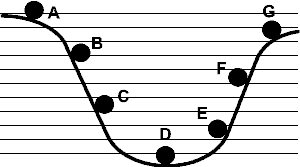
At which point does the ball has the greatest gravitational potential energy (GPE)?

a)

A

b)

F

c)

D

d)

C

e)

B

50.

Which would have the LEAST gravitational potential energy (GPE)?

a)

A ball sitting on the ground

b)

Moon viewed from the Earth

c)

An airplane flying 30,000 feet above the ground

d)

A rock sitting on top of Mt. Everest

51.
What does the conservation of energy law state?
a)
Energy is never created nor destroyed.  It simply moves from one state to another.
b)
Energy is always created.  It does not move from one state to another.
c)
Energy is created when it goes from potential energy to kinetic energy.
d)
Energy is destroyed when it goes from kinetic energy to potential energy.
52.
Wood, batteries, gasoline, and  food are all examples of ________________________.
a)
gravitational potential energy
b)
elastic potential energy
c)
chemical potential energy
d)
None of the above
53.
Potential energy is related to 
a)
position or height of an object
b)
speed of an object
54.
How can I gain potential energy? (choose the best answer)
a)
Run a mile
b)
Walk up the stairs
c)
Climb a mountain
d)
Go down the stairs
55.
Which items would have this energy transformation: chemical energy -> mechanical energy?
a)
person running
b)
candle burning
c)
windmill turning
d)
playing a violin
56.
A hairdryer converts -- 
a)
electrical energy into chemical
b)
electrical energy into thermal
c)
chemical energy into mechanical
d)
thermal energy into mechanical
57.
The diagram shows a complete circuit with a battery and a buzzer making noise. This circuit works by transforming -
a)
chemical energy to electrical to sound.
b)
electrical energy to thermal to light.
c)
sound energy to electrical to chemical.
d)
mechanical energy to electrical to sound.
58.
What machine changes electrical energy into light and sound energy?
a)
battery
b)
lightbulb
c)
alarm clock
d)
apple
59.
Which of these is not a source of chemical energy?
a)
Spaghetti
b)
The Sun
c)
Battery
d)
Petroleum
60.
A television works by transforming electrical energy into what other kinds of energy? 
a)
light, thermal and sound 
b)
thermal, chemical and solar 
c)
sound, mechanical and electrical 
d)
light, chemical and mechanical 
61.
Which of the following shows an energy transformation from chemical energy to electrical to light energy?
a)
A bolt of lightning lights the night sky.
b)
A candle glows brightly in the dark.
c)
A fire in a fireplace lights up a room.
d)
A battery causes a flashlight to shine.
62.
Mechanical Energy is transferred to _____ Energy.
a)
Solar
b)
Mechanical
c)
Electrical
d)
Potential
63.
A hot rock is dropped into a pail of cool water. Heat energy transferred from the rock to the water by
a)
Boiling
b)
Evaporation
c)
Conduction
d)
Radiation
64.
Emily made a cup of tea and stirred it with a spoon. The spoon became warm, How was the heat from the tea transferred to the spoon?
a)
Convection
b)
Radiation
c)
Conduction
d)
Evaporation
65.
Eggs cooking in a frying pan.
a)
Conduction
b)
Convection
c)
Radiation
66.
Warmth from the fireplace circulating through the house.
a)
Conduction
b)
Convection
c)
Radiation
67.

Egg boiling in a hot pot.

a)

Conduction

b)

Convection

c)

Radiation

68.
What is the definition of CONDUCTION?
a)
When heat is transferred from objects like rays of light or electromagnetically.
b)
a  hot liquid or air that  expands, becomes less dense, and rises or becomes more dense, and sinks.
c)
When heat transfers from objects that are touching.
d)
When heat transfers through the heater or AC in your house.
69.
What is the definition of CONVECTION
a)
When heat transfers through waves.
b)
When heat transfers from objects that are touching.
c)
a  hot liquid or air that  expands, becomes less dense, and rises or becomes more dense, and sinks.
d)
Heat traveling from the sun
70.

In heat transfer, heat always flows from the _______________ substance to the _______________ substance.

a)

Hotter to colder

b)

Colder to hotter

c)

Hotter to hotter

d)

Colder to colder

71.

When you use a microwave, what is the main way that heat is transferred?

a)

Convection

b)

Conduction

c)

Radiation

d)

insulation.

72.

You get sunburned due to __________ from the sun.

a)

conduction

b)

convection

c)

radiation

73.

Near the ceiling of a room the air is warmer. The warm air rises because of

a)

conduction

b)

convection

c)

radiation

74.
Two objects at different temperatures are in contact. Which of the following happens to their thermal energy?
a)
Their thermal energies remain the same.
b)
Thermal energy passes from the cooler object to the warmer object
c)
Thermal energy passes from the warmer object to the cooler object.
d)
Thermal energy passes back and forth equally between the two objects.
75.
a)

Conduction

b)

Convection

c)

Radiation