wayground logo

Free Printable Worksheets

Font size

S
M
L
XL
Worksheets

Science Review 1 4th Grade

Total questions: 51

Worksheet time: 41mins
Name
Class
Date
1.
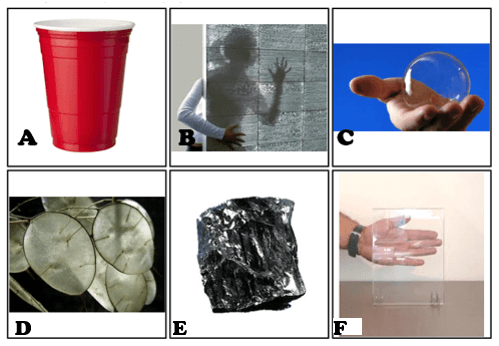
Which images are opaque?
a)
A & C
b)
A,C,E, & F
c)
D, E, & F
d)
A & E
2.
Another name for light bending is ....
a)
Reflaction
b)
Absorbing
c)
Refraction
d)
mirror
3.
Opaque means...
a)
No light passes through it
b)
All light passes through it
c)
Some light passes through it
4.
The color you see is the color that is ___.
a)
reflected
b)
absorbed
5.
___________ is a from of energy that we can see with our eyes.
a)
shadow
b)
light
c)
energy
d)
reflection 
6.
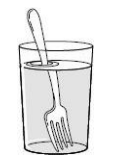
Which explains why the fork looks different under water?
a)
light can't pass through the glass
b)
the wavelength of light lengthens
c)
the amount of light increases when going through water
d)
light is refracted at an angle
7.

Sound reflection is commonly known as ________________.

a)

an echo

b)

a vibration

c)

a pitch

d)

loudness or softness

8.

Which of these does NOT reflect sound?

a)

cave

b)

mountain

c)

empty space

d)

carpet

9.

Which of these would BEST absorb sound?

a)

bell

b)

cave

c)

pillow

d)

empty room

10.

Sound waves _______________________.

a)

do not travel through matter.

b)

are louder the further away you are from the source of the sound.

c)

travel in all directions.

d)

only travel in a straight line.

11.

The high or low of a sound is an example of _____________.

a)

matter

b)

sound waves

c)

pitch

d)

volume

12.

Vibrations travel through ____________.

a)

sound waves

b)

straight lines

c)

volume

d)

pitch

13.

An organized plan for gathering, organizing, and communicating information.

a)

hypothesis

b)

question

c)

scientific method

d)

observation

14.
Information you obtain through your senses, such as touch, sound and sight.
a)
observation
b)
hypothesis
c)
question
d)
conclusion
15.
A prediction or guess based on observations.
a)
data
b)
scientific process
c)
hypothesis
d)
question
16.
What do you want to know, understand or figure out?
a)
hypothesis
b)
conclusion
c)
question
d)
data
17.
A test used to discover something unknown.
a)
data
b)
variable
c)
conclusion
d)
experiment
18.
All factors that can change in an experiment.
a)
variable
b)
data
c)
conclusion
d)
result
19.
The outcome of your test.
a)
variable
b)
results
c)
experiment
d)
question
20.
Information gathered from your experiment. 
a)
observation
b)
variable
c)
hypothesis
d)
data
21.
Which one is an example of Qualitative Data?
a)
25 Pounds
b)
30 Seconds 
c)
2 Meters
d)
Soft
22.
Which is an example of Quantitative Data?
a)
42 grams
b)
Hard
c)
Squishy
d)
Blue
23.
The independent variable is what you _______ during an experiment.
a)
change
b)
do not change 
c)
measure
d)
count
24.
The dependent variable in an experiment is what you ________________. 
a)
Change
b)
Measure
25.
After you write your conclusion, it is important to share your results with others. 
a)
True
b)
False 
26.

The loudness or softness of a sound are examples of ______________.

a)

matter

b)

pitch

c)

sound waves

d)

volume

27.

The back and forth movement of matter is known as _______________.

a)

volume

b)

vibrations

c)

pitch

d)

matter

28.

Which two processes cause clouds to form?

a)

precipitation and runoff

b)

transpiration and precipitation

c)

evaporation and condensation

d)

evaporation and ground water

29.

Air _____ influences the weather by determining what type of precipitation will fall to the ground.

a)

pressure

b)

speed

c)

humidity

d)

temperature

30.

When spilled water seems to disappear, it actually just ________.

a)

evaporated

b)

dissolved

c)

turned into precipitation

d)

condensed

31.
What does this tool do?
a)
Tells how hot it is
b)
Measures wind direction
c)
Measures wind speed
d)
Measures rain
32.
What does this tool do?
a)
Measures wind speed
b)
Measures rain
c)
Measures temperature
d)
Tells wind direction
33.
What type of weather usually goes with this symbol?
a)
Clear, sunny skies
b)
Cloudy skies
c)
Hot temperature
d)
Thunderstorms
34.
This is the symbol for a... 
a)
Cold Front
b)
Warm Front
c)
Stationary Front
d)
Occluded Front 
35.
This is the symbol for a... 
a)
Occluded Front
b)
Stationary Front
c)
Warm Front
d)
Cold Front 
36.

What type of weather is the western United States likely experiencing in this image?

a)

Clear, sunny skies

b)

High winds and thunderstorms

c)

Hot weather with a warm front

d)

Cloudy skies with high winds

37.
A hurricane forms over the Atlantic Ocean. When it hits land and comes ashore, its wind speed decrease significantly.  This happens because the hurricane:
a)
gains more water from the flooded land than the ocean
b)
meets a land breeze
c)
meets a stronger hurricane moving from land
d)
no longer gains energy from warm ocean water
38.
Which of the following is most likely a cause of hurricanes?
a)
Cooler ocean temperatures
b)
Warmer ocean temperatures
c)
Large ocean waves
d)
Strong ocean currents
39.
All energy on earth begins
a)
with the heat produced by pressure inside the earth
b)
photosynthesis by producers
c)
with the sun
d)
with the magma inside the earth
40.

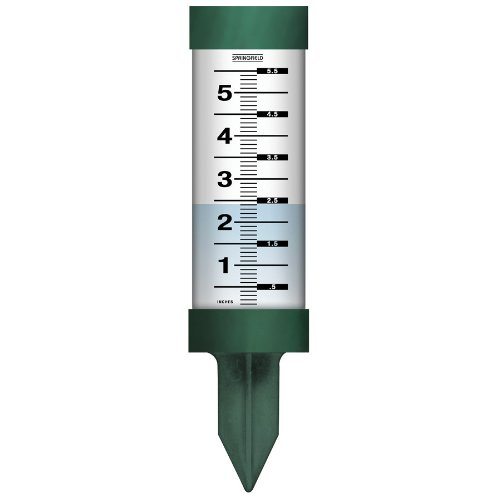
What does a rain gauge measure?

a)

a change in temperature

b)

a change in humidity

c)

wind speed

d)

the amount of rainfall

41.

A person that studies, reports and forecast weather conditions is a

a)

radiologist

b)

geologist

c)

astronomer

d)

meteorologist

42.
_______ is the apparent changing shapes of the Moon 
a)
New Moon
b)
Crescent Moon
c)
Full Moon
d)
Moon Phases
43.
A ______ is when the side of the Moon facing Earth appears lite. 
a)
New Moon
b)
Crescent Moon
c)
Full Moon 
d)
Moon Phases
44.
A ______ is when the side of the Moon facing Earth appears to be not lit. 
a)
New Moon
b)
Crescent Moon
c)
Full Moon
d)
Moon Phases
45.
A ________ is when a small section of the Moon facing Earth is lighted. 
a)
New Moon
b)
Crescent Moon
c)
Full Moon
d)
Moon Phases
46.
How long does it take for the Moon to make one full revolution around the Earth? 
a)
one day
b)
one month
c)
one year
d)
never
47.
If the last full moon was on April 4th, when can you expect to see the next full moon? 
a)
April 29th
b)
July 4th
c)
May 4th
d)
September 12th
48.
How would you describe the Moon? 
a)
Smooth surface with an atmosphere but no water
b)
Surface filled with carters and water but no atmosphere
c)
Filled with carters and dust, no water or atmosphere 
d)
The same as Earth 
49.
Which of the following choices has the moon phases in the correct order? 
a)
Full moon, new moon, waxing gibbous, first quarter, waxing crescent, waning gibbous, waning cresent, last quarter
b)
waxing gibbous, new moon, first quarter, waxing crescent, full moon, waning crescent, third/last quarter, waning gibbous
c)
New Moon, Waxing Crescent, First Quarter, Waxing Gibbous, Full Moon, Waning Gibbous, Third/last quarter, Waning Crescent
d)
New Moon, Waning Crescent, First Quarter, Waning Gibbous, Full Moon, Waxing Gibbous, Third/Last Quarter, Waxing Cresecent 
50.
Why does the Moon have phases? 
a)
The moon reflects light from the sun. Sometimes there is a shadow on the moon and we only see part of it. 
b)
Only part of the moon is turned on and shining at a time. 
c)
The Earth is blocking the moon when we don't see it. 
d)
The moon moves out of sight. 
51.
Which phase of the Moon is pictured? 
a)
Full Moon
b)
New Moon 
c)
Cresecent 
d)
Gibbous