Wayground logo

Free Printable Worksheets

Font size

S
M
L
XL
Worksheets

PS Waves

Total questions: 61

Worksheet time: 40mins

Name
Class
Date
1.
A wave carries...?
a)
energy only
b)
matter only
c)
the matter carries the energy
d)
neither
2.
What kind of wave can travel through space?
a)
electromagnetic waves
b)
compressional waves
c)
transverse waves
d)
longitudinal waves
3.
The lowest part of the wave is?
a)
trough
b)
crest
c)
point of origin
d)
compression point
4.
The highest point of a wave is?
a)
crest
b)
trough
c)
point of origin
d)
comppression point
5.

In a transverse wave, particles move...?

a)

back and forth

b)

vertically

c)

up and down

d)

wherever the matter's going

6.
What is the measure of how many waves pass a point in a certain amount of time?
a)
frequency
b)
wavelength
c)
midpoint
d)
crest and trough
7.

In a longitudinal wave, the particles move...?

a)

back and forth

b)

up and down

c)

vertically

d)

in the direction of the hertz

8.
A _____________________ is the distance between a point on one wave and the identical point of the next wave.
a)
amplitude
b)
wavelength
c)
frequency
d)
compression
9.
The units for frequency are measured in _____________.
a)
hertz
b)
seconds
c)
m/s
d)
m
10.
All waves carry ________ as they travel from one place to another.
a)
matter
b)
space
c)
energy
d)
water
11.
Which is an example of a longitudinal wave?
a)
light wave
b)
sound wave
c)
visible wave
d)
radio wave
12.
Waves move ___ through vibrations
a)
Energy
b)
Matter
c)
Mass
d)
Weight
13.
What is the amplitude?
a)
length
b)
height
c)
# of waves
14.
Which is the wavelength?
a)
1
b)
2
c)
3
d)
4
15.
If the frequency gets higher, the wavelength gets 
a)
longer
b)
shorter
16.
If the wavelength gets longer, the frequency gets 
a)
higher
b)
lower
17.
The loudness of the sound depends on
a)
wavelength
b)
amplitude
c)
frequency
18.
Which electromagnetic wave is responsible for cell phones?
a)
gamma
b)
xray
c)
microwaves
d)
radio
19.
Is refracting light bending or bouncing?
a)
bending
b)
bouncing
20.
A blue tshirt looks blue because of ___.
a)
reflection
b)
refraction
c)
diffraction
21.
Rainbows are ______ light.
a)
Refracting
b)
Reflecting
c)
Diffracting
d)
Absorbing
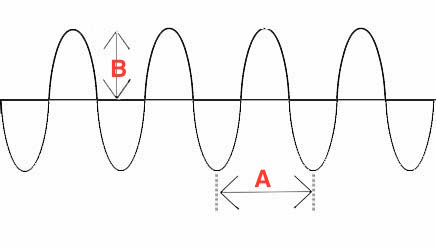
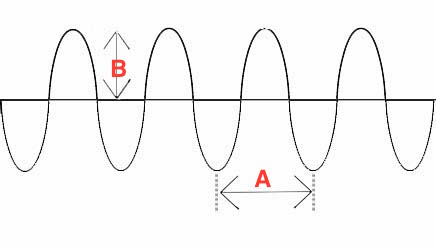
22.
What property of this wave is represented by the letter "A"
a)
amplitude
b)
crest
c)
trough
d)
wavelength
23.
What property of the wave is represented by the letter "B"?
a)
amplitude
b)
crest
c)
trough
d)
wavelength
24.
The highest point on a wave is:
a)
the crest
b)
the trough
c)
the top
d)
the coast 
25.
The lowest point on a wave is the:
a)
Amplitude
b)
Crest
c)
Trough
d)
Wavelength
26.
The number of wavelengths that pass a point each per second is:
a)
frequency
b)
period
c)
longitudinal 
d)
transverse wave 
27.
The type of waves that require medium to pass:
a)
Mechanical Waves
b)
Electromagnetic Waves
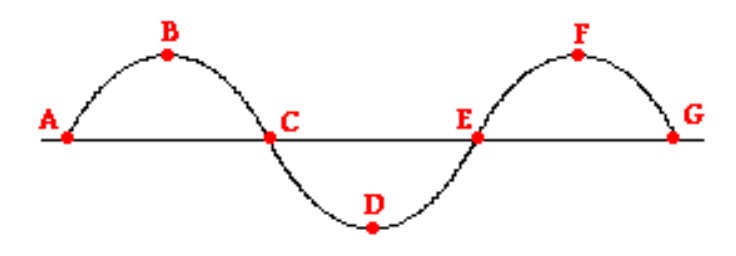
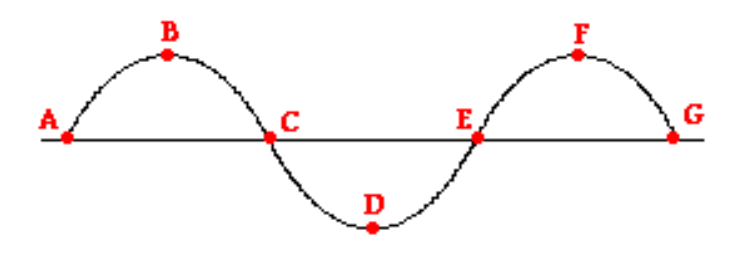
28.
Which vocabulary term is used to identify the distance between points C & G?
a)
Amplitude
b)
Crest
c)
Frequency
d)
Wavelength
29.
When the frequency of a wave increases, what happens to the wavelength?
a)
The wavelength is not directly affected by the frequency of a wave.
b)
The wavelength increases.
c)
The wavelength decreases.
d)
More specific information is needed to form a conclusion about the wavelength.
30.
A mechanical wave cannot travel through...
a)
a vacuum(empty space).
b)
water.
c)
air. 
d)
glass.
31.
Which letter(s) represent the trough of the wave?
a)
A
b)
B & D
c)
D
d)
C & G
32.
Which letter(s) represent the crest of the wave?
a)
A
b)
B & D
c)
B & F
d)
F
33.
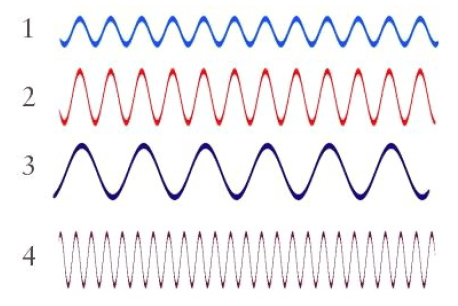
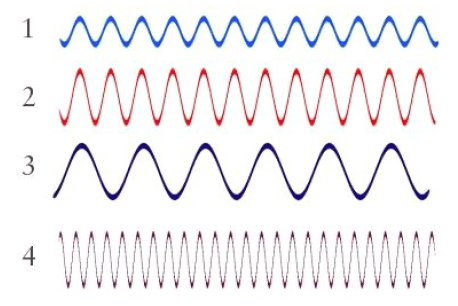
Which wave in the diagram has the greatest frequency?
a)
1
b)
2
c)
3
d)
4
34.
Which wave in the diagram has the greatest wavelength?
a)
1
b)
2
c)
3
d)
4
35.
Which of the following can sound travel through?
a)
solid
b)
liquid
c)
gas
d)
all of the above
36.
regular disturbances that carry energy through matter or space
a)
crest
b)
energy
c)
wave
d)
trough
37.
which material does sound travel the fastest?
a)
solid 
b)
liquid 
c)
gases
38.
When a wave strikes and object and bounces off. (example echo)
a)
medium
b)
refraction
c)
reflection
d)
interference
39.
When a wave bends as it passes through at an angle from one medium to another.(example: pencil in a glass of water-)
a)
medium
b)
refraction
c)
reflection
d)
interference
40.

The distance between two adjacent compressions of a longitudinal wave is its wavelength

a)

True

b)

False

41.

A wave caused by a disturbance with greater energy has greater amplitude.

a)

True

b)

False

42.

Waves generally travel most slowly in gases.

a)

True

b)

False

43.

Wave amplitude depends on

a)

wavelength

b)

wave speed

c)

wave energy

d)

wave frequency

e)

wave energy of the original disturbance

44.

The speed of waves depends on their

a)

wavelength

b)

frequency

c)

medium

d)

all of the above

45.

The angle of incidence is always greater than the angle of reflection.

a)

True

b)

False

46.

Diffraction is more pronounced with sound waves than light waves.

a)

True

b)

False

47.

Light waves refract when they pass from air to water.

a)

True

b)

False

48.

Interference occurs only when the crests of one wave overlap with the troughs of another wave

a)

True

b)

False

49.

Reflected waves differ from the original waves before they were reflected in their

a)

speed

b)

direction

c)

frequency

d)

wavelength

50.

Refraction occurs because waves

a)

cannot travel through an obstacle such as a wall.

b)

travel at different speeds in different media.

c)

interfere with their reflected waves

51.

A standing wave occurs because of a combination of

a)

incidence and reflection

b)

refraction and diffraction

c)

refraction and interference

d)

constructive and destructive interference

52.

Particles of matter actually travel along with a mechanical wave

a)

True

b)

False

53.

Transverse waves travel only through solid matter

a)

True

b)

False

54.

Ocean waves crash on shore when the bottoms of the waves slow down due to friction.

a)

True

b)

False

55.

All waves transfer energy from one place to another

a)

True

b)

False

56.

Some waves do not require a medium.

a)

True

b)

False

57.

A source of energy is needed to start a mechanical wave

a)

True

b)

False

58.

Types of mechanical waves include

a)

longitudinal waves

b)

transverse waves

c)

surface waves

59.

The crests of a transverse wave are like the

a)

crests of a primary wave

b)

troughs of a longitudinal wave

c)

rarefactions of a secondary wave

d)

compressions of a longitudinal wave

60.

Waves that an earthquake sends through rocks underground include

a)

tsunami waves

b)

transverse waves

c)

longitudinal waves

d)

two of the above

61.

You generate a longitudinal wave when you

a)

shake a spring up and down

b)

shake a rope up and down

c)

push and pull a spring