Wayground logo

Free Printable Worksheets

Font size

S
M
L
XL
Worksheets

Review

Total questions: 47

Worksheet time: 3600secs
Name
Class
Date
1.
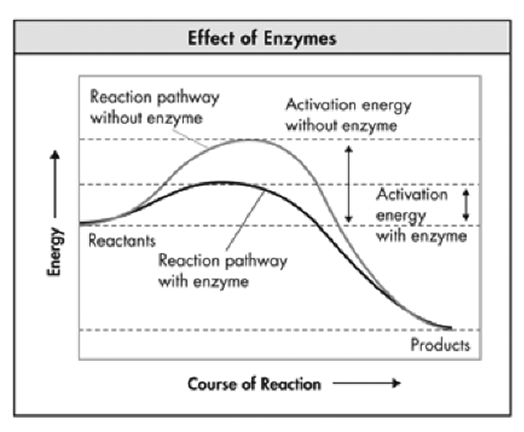
The graph shows how enzymes affect reactions in cells. Which statement best summarizes the information shown in the graph?
a)
Enzymes increase the energy of the reactants.
b)
Enzymes decrease the energy level of the products.
c)
Enzyme decrease the activation energy of the reaction.
d)
Enzymes reverse the direction of the reaction.
2.
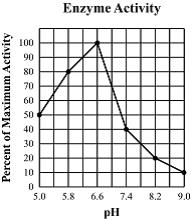
Which of the following conclusions can be drawn from this graph?
a)
The optimum pH of the enzyme is 6.6.
b)
The optimum pH of the enzyme is 5.8
c)
The enzyme’s activity increases as pH increases 5.0 to 9.0
d)
The enzyme’s activity is greater around pH of 8.0 .
3.
Enzymes are...
a)
nucleic acids
b)
proteins
c)
lipids
d)
carbohydrates
4.
An enzyme speeds up a chemical reaction in the cell but can only be used once.  True or False? 
a)
true
b)
false
5.
What happens when enzymes are heated to a high temperature?
a)
The enzymes die.
b)
The shapes of the enzyme are altered denature
c)
The enzymes' amino acid sequence changes.
d)
The enzymes remain the same
6.
Enzymes speed up reaction rates by changing...
a)
Activation Energy
b)
pH
c)
Hydrogen Bonds
d)
Kinetic Energy
7.
What factors affect an enzyme's reaction rate?
a)
temperature 
b)
pH
c)
neither pH nor temperature
d)
both pH and temperature
8.
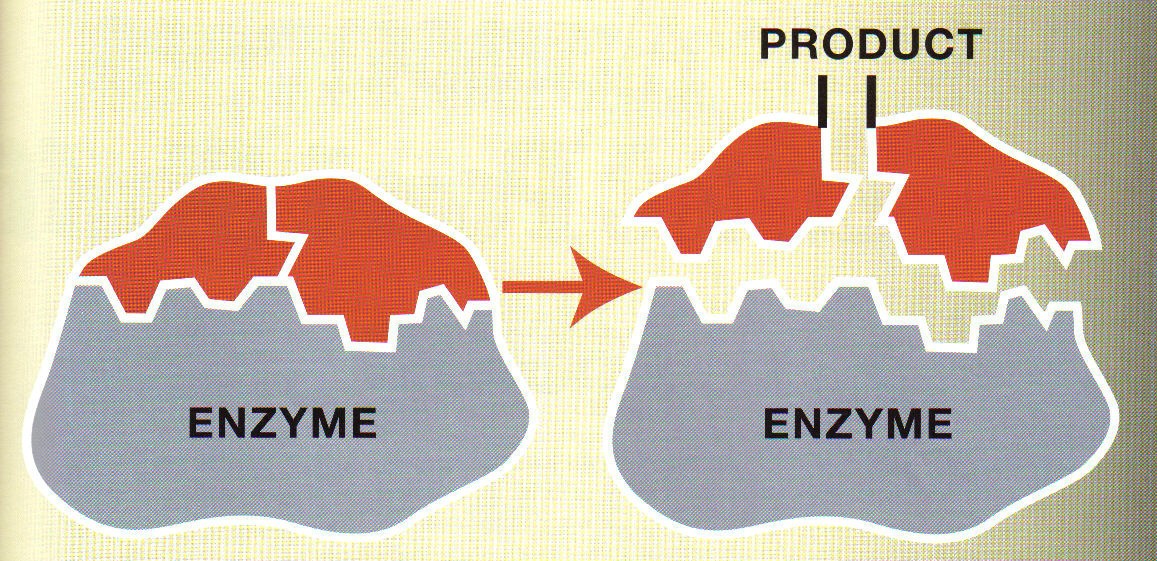
What is indicated by letter A?
a)
enzyme
b)
product
c)
substrate
d)
active site
9.
Lactose intolerance is most likely caused by -
a)
A lack of lactase enzyme to breakdown lactose
b)
Overproduction of glucose and galactose
c)
Excess lactase enzyme
d)
A lack of lactose sugar
10.
Any substance that speeds up a chemical reaction is called a ________?
a)
reusable
b)
catalyst
c)
specific
d)
fragile
11.

If I am lactose intolerant, which of the following enzymes do I lack?

a)

Lactase

b)

Lipase

c)

Amylase

d)

Sucrase

12.

What is the function of the enzyme?

a)

To break down substrates: sugar, lactose, lipids, etc.

b)

To bring substrates together

c)

To speed up reactions

d)

All of the above

13.
Venus flytraps produce chemicals that break down insects into usable compounds. These chemicals are most likely:
a)
Hormones
b)
Lipids
c)
Enzymes
d)
Carbohydrates
14.
Why is maintenance of a constant blood pH critical for body processes?
a)
Blood with a high pH helps prevent cancer.
b)
Enzymes work best within a narrow pH range.
c)
The production of vitamin C by skin cells requires low pH values.
d)
Some bacteria thrive in very acidic conditions.
15.

In what process is mRNA synthesized?

a)

Transcription

b)

Translation

c)

DNA Replication

d)

Mitosis

16.

Where does TRANSCRIPTION occur?

a)

Nucleus

b)

Ribosome

c)

Cytoplasm

d)

Mitochondria

17.

How many codons equals 1 amino acid?

a)

1

b)

2

c)

3

d)

4

18.

How many nucleotides equal 1 amino acid?

a)

1

b)

2

c)

3

d)

4

19.

TRANSCRIBE this DNA sequence: TACGTTACT

a)

AUGCAAUGA

b)

ATGCAATGA

c)

AUGGATUGA

d)

TACGTTACT

20.

TRANSLATE this RNA sequence: AUGCAAUGA

a)

Met-Glu-Stop

b)

Met-His-Stop

c)

Thr-Glu-Stop

d)

Thr-Pro-Stop

21.
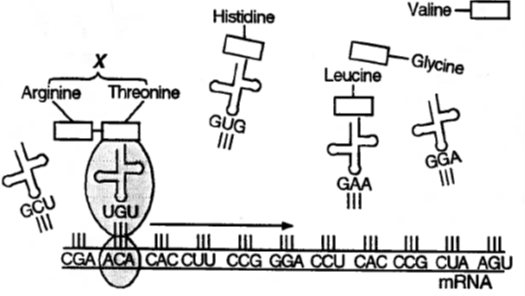
What process is going on in this photo? 
a)
Transcription 
b)
Translation 
c)
Replication 
d)
All the above 
22.

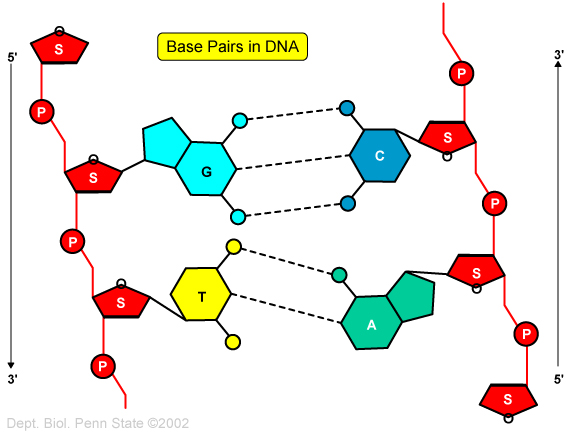
A DNA nucleotide may be made up of a phosphate group, along with

a)

deoxyribose sugar and uracil

b)

ribose sugar and cytosine

c)

deoxyribose sugar and thymine

d)

ribose sugar and adenine

23.

Which of the following units are repeatedly joined together to form a strand of DNA? (This is the MONOMER of DNA.)

a)

amino acids

b)

nucleotides

c)

fatty acids

d)

polysaccharides

24.

Which organelle is the location where protein is made?

a)

Ribosome

b)

Nucleus

c)

Cytoplasm

d)

Nucleotide

25.

Which of the following are differences in the structure between RNA and DNA

a)

DNA uses deoxyribose sugar, RNA uses sugar ribose

b)

DNA pairs Adenine with Uracil, RNA pairs Adenine with Thymine

c)

DNA is a double helix, RNA is a single helix

d)

DNA pairs Adenine with Thymine, RNA pairs Adenine with Uracil

26.

When these bond together, they form a protein

a)

Amino Acids

b)

Peptide Bonds

c)

Ribose

d)

Nucleotides

27.

These building blocks consist of a sugar, phosphate, and nitrogen base.

a)

Ribose

b)

Nucleotide

c)

Gene

d)

Protein

28.

Which of the following is the complementary mRNA sequence to this DNA strand: AACTGAA

a)

UUGACUU

b)

TTGACTT

c)

AACTGAA

d)

AACUGAA

29.
Adenine bonds with ______________.
a)
Guanine
b)
Thymine
c)
Cytosine
d)
Adenine
30.
Guanine bonds with ______________.
a)
Adenine
b)
Guanine
c)
Cytosine
d)
Thymine
31.
Which 2 molecules form the sides (backbone) of the DNA ladder?
a)
deoxyribose sugar and adenine
b)
deoxyribose sugar and a hydrogen bond
c)
deoxyribose sugar and the nucleus
d)
deoxyribose sugar and phosphate
32.
Nitrogenous bases are joined by which type of bond?
a)
polar bonds
b)
ionic bonds
c)
covalent bonds
d)
hydrogen bonds
33.
The enzyme that unzips the DNA to prepare for replication
a)
helicase
b)
replicase
c)
polymerase
d)
synthase
34.
A process in which DNA has the unique ability to make an exact copy of itself.
a)
Replication
b)
Translation
c)
Transcription
35.
What is the shape of DNA?
a)
Double helix
b)
Triple helix
c)
Flat, bilayer
d)
Three-pronged rigid ladder
36.
If the percentage of DNA is made of 30% Thymine, what is the correct percentage of Guanine?
a)
30
b)
15
c)
20
d)
60
37.
These are the "smaller", single ringed bases such as thymine and cytosine
a)
complementary
b)
 cytosine
c)
purine
d)
pyrimidine
38.
These are the "larger", double-ringed bases such as adenine and guanine.
a)
complementary
b)
 cytosine
c)
purine
d)
pyrimidine
39.
Which enzyme is responsible for adding nucleotides?
a)
Topoisomerase
b)
DNA Polymerase
c)
Ligase
d)
Primase
40.

Which enzyme is responsible for adding the RNA primer to the template strand?

a)

Helicase

b)

DNA Polymerase

c)

Ligase

d)

Primase

41.

where is the site of translation ?

a)

ribosomes

b)

telomerase

c)

helicase

d)

primase

42.
Which diagram best shows the end result of diffusion?
a)
F
b)
G
c)
H
d)
J
43.
When particles move from areas of high concentration to areas less concentrated, this has taken place.
a)
diffusion
b)
mitosis
c)
endocytosis
d)
photosynthesis
44.
A student put a few drops of lemon juice into an uninflated balloon.The student tied a knot in the balloon, placed it in a shoe box, and covered it with a lid. The following day, the student opened the box and was able to smell lemon in the box. Through what process were molecules able to pass through the balloon?
a)
respiration
b)
fermentation
c)
osmosis
d)
diffusion
45.
Cell membranes are said to be selectively permeable. Which statement best explains what selectively permeable means?
a)
The cell membrane prevents any harmful substance from entering the cell.
b)
The cell membrane lets certain substances enter the cell and keeps certain substances out of the cell.
c)
The cell membrane allows only large molecules to diffuse into the cell.
d)
The cell membrane has pores that let only water and glucose into the cell and carbon dioxide out.
46.
A substance is most likely to diffuse into a cell when
a)
it is a large organic food molecule such as protein or starch
b)
it is enclosed in an organelle such as a vacuole
c)
the concentration of the substance is greater outside the cell than inside
d)
the pH of the substance is greater than the pH of the cellListen
47.
Base your answer to the question on the diagram below and on your knowledge of biology. The diagram represents two solutions, A and B, separated by a selectively permeable membrane. Which statement best describes the outcome after 20 minutes?
a)
Solution A will contain approximately the same number of glucose molecules as solution B.
b)
Solution A will contain all of the water molecules.
c)
Solution B will remain unchanged.
d)
Solution B will lose all of the glucose molecules to solution A.