Wayground logo

Free Printable Worksheets

Font size

S
M
L
XL
Worksheets

Oceans

Total questions: 53

Worksheet time: 51mins

Name
Class
Date
1.

What is an Ocean?

a)

small body of water

b)

large body of water

2.

What type of water is in the Ocean?

a)

regular water

b)

salt water

c)

fresh water

d)

spring water

3.
Review the graph showing marine fishing rates.If the fishing rate in Asia continues to grow, what will most likely happen as a result?
a)
The fish population will continue to rise.
b)
The U.S. human population will decline.
c)
A wide range in ocean temperatures will be seen worldwide.
d)
The overfishing will cause an imbalance in marine ecosystems.
4.
The diagram shows a boat using sonar to gather information in the ocean. What is most likely being measured with this technology?
a)
ocean depth
b)
ocean temperature
c)
pH level
d)
turbidity level
5.
What are the three motions of the ocean?
a)
continental shelf, continental rise, continental slope
b)
waves, tides, currents
6.
Surface currents are caused by ___________.
a)
temperature and salinity
b)
wind
7.
The Gulf Stream is a ______________ current.
a)
surface
b)
deep ocean
8.
a)
continental rise
b)
continental slope
9.
a)
trench
b)
seamount
10.
Where can a lot of the animals in the ocean be found?
a)
continental shelf
b)
abyssal plain
11.
a)
tides
b)
currents
12.
TRUE or FALSE
As depth increases temperature also increases.
a)
TRUE
b)
FALSE
13.
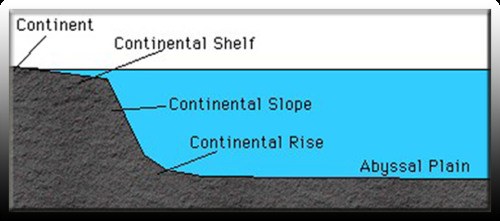
Describe the continental slope.
a)
gently sloping, connected to the continent,covered with sediment
b)
steeply sloping, covered with sediment, located after the continental shelf
14.
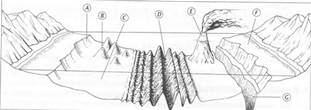
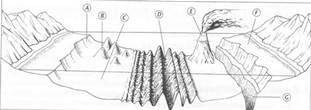
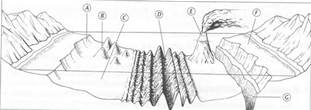
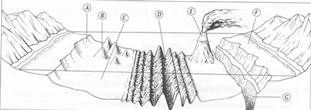
What is letter C?
a)
Mid-Ocean Ridge
b)
Cont. Shelf
c)
Cont. Slope
d)
Abyssal Plain
15.
What is letter D?
a)
Cont. Shelf
b)
Mid-Ocean Ridge
c)
Volcanic Island
d)
Seamount
16.
What is letter E?
a)
Volcanic Island
b)
Seamount
c)
Mid-Ocean Ridge
d)
Abyssal Plain
17.
What is letter A?
a)
Cont. Shelf
b)
Cont. Slope
c)
Seamount
d)
Abyssal Plain
18.
The gradually sloping part of a continent that extends under the ocean is the...
a)
continental slope
b)
continental shelf
c)
abyssal plain
d)
trench
19.
The continental slope is located at the end of the...
a)
shoreline
b)
continental shelf
c)
mid ocean ridge
d)
abyssal plain
20.
the deepest part of the ocean
a)
trenches
b)
abyssal plain
c)
ocean basin
d)
rift
21.
Which process adds more crust to the ocean floor?
a)
earthquakes
b)
sea floor spreading 
c)
subduction
d)
convection
22.

A shallow area of sediment near the shore...

a)

Continental Shelf

b)

Ocean Trench

c)

Continental Slope

d)

Abyssal Plain

23.

Which ocean floor feature is the steep cliff-like drop beyond the continental shelf?

a)

Continental Shelf

b)

Continental Slope

c)

Abyssal Plain

d)

Ocean Trench

24.

Which part of the ocean floor is labeled "D"?

a)

Mid-Ocean Ridge

b)

Continental Slope

c)

Blue-Ridge Mountains

d)

Abyssal Plain

25.

"C" on the Ocean Floor diagram represents the...

a)

Continental Slope

b)

Abyssal Plain

c)

Continental Rise

d)

Ocean Trench

26.

Where are you walking when you are wading in the ocean?

a)

Ocean Trench

b)

Abyssal Plain

c)

Continental Slope

d)

Continental Shelf

27.

What do the arrows on the map represent?

a)

Size of waves

b)

Water density

c)

Ocean currents

d)

Time between tides

28.
Salt has a chemical formula of NaCl.  Salt is a...
a)
Compound
b)
Element
c)
Mixture
d)
None of the Above
29.
What cannot be broken down into other substances?
a)
Compound
b)
Mixture
c)
Solids
d)
Element
30.
What is made up two or more elements that are chemically combined?
a)
Element
b)
Mixture
c)
Compound
d)
Solids
31.

Water (H2O), is not found on the periodic table because water is a...

a)

atom

b)

liquid

c)

mixture

d)

compound

32.

Oxygen and iron combine chemically to form rust. Rust is classified as which of the following?

a)

an atom.

b)

an element.

c)

a compound.

d)

a mixture.

33.

This image is a model of...

a)

an element

b)

a compound

c)

a homogenous mixture

d)

a heterogeneous mixture

34.

This picture is a model of...

a)

an element

b)

a compound

c)

a homogenious mixture

d)

a heterogeneous mixture.

35.
In what zone does approximately 90% of all ocean life live?
a)
sunlight
b)
twilight
c)
midnight
36.
The sunlight zone is also known as the __________________________ zone.
a)
hot
b)
bright
c)
happy
d)
euphotic
37.
Animals that can use their bodies to make light are called _______________.
a)
magic
b)
shiny
c)
amazing
d)
bioluminescent
38.
As oceans become deeper, the water pressure ___________________.
a)
increases
b)
decreases
c)
stays the same
39.
Which layer of the ocean starts at 600 feet and extends to 3000 feet?
a)
sunlight
b)
twilight
c)
midnight
40.
90% of the ocean belongs in this ocean layer.  What is it?
a)
sunlight
b)
twilight
c)
midnight
41.
Which zone has the warmest water temperature?
a)
sunlight
b)
twilight
c)
midnight
42.
Which zone is completely dark and near freezing in temperature?
a)
sunlight
b)
twilight
c)
midnight
43.
The ocean layers are divided by the amount of __________________ in each layer.
a)
animals
b)
salt
c)
light
d)
people
44.
As you move deeper into the water temperature, pressure and salt content change.
a)
true
b)
false
45.
Sunlight allows ________________ to occur in the sunlight zone.
a)
bioluminesence
b)
transpiration
c)
photosynthesis
d)
voting
46.
Another word for a living thing is a:
a)
animal
b)
organism
c)
plant
d)
community
47.
Which of the following best describes the blue bird's (in the middle) role in this ecosystem?
a)
carnivore
b)
omnivore
c)
herbivore
d)
decomposer
48.
What is a producer?
a)
an organism that gets energy from eating other organisms
b)
an organisms that uses sunlight to make its own food
c)
an organism that gets energy from eating dead organisms, non-living material or waste
d)
an organism that uses chemical energy to make its own food
49.
The shrew provides energy for the _______?
a)
cricket
b)
grasshopper
c)
frog
d)
snake
50.
_________ cannot make their own food, so they need to consume (eat) plants or animals.
a)
consumers
b)
producers
c)
decomposers
51.
The  ____________ provides all the initial energy to plants.
a)
sun
b)
moon
c)
environment
d)
water
52.
What does a food chain contain? Choose ALL correct answers.
a)
consumer
b)
producer
c)
decomposer
d)
all of the above
53.
__________ eat decaying matter, dead plants and animals and in the process they break them down. 
a)
consumer
b)
producer
c)
decomposer