
 Worksheets
TNPLH Final Assessment
Total questions: 47
Worksheet time: 2hrs 21mins
A covalent bond is a bond between a _____ and a ______
metal, nonmetal
metal, metal
nonmetal, nonmetal
A covalent bond is formed when two atoms ____ electrons
share
lose
transfer
gain
Which two elements are in the compound NaCl?
Carbon and Nitrogen
Sodium and Chlorine
Sodium and Carbon
Nitrogen and Chlorine
Which type of bond results from a complete transfer of electrons from one atom to the other?
Covalent bond
Ionic bond
Metalic bond
Hydrogen bond
What bond is formed between a metal and a nonmetal?
Covalent bond
Ionic bond
Potassium (K) is a(n)...
Alkali Metal
Nonmetal
Alkaline Earth Metal
Noble Gas
Transition Metal
How many valence electrons does Lithium have?
1
2
3
4
How many valence electrons does Carbon have?
4
12
6
14
Cadmium (Cd) is a(n)...
Alkali Metal
Nonmetal
Alkaline Earth Metal
Noble Gas
Transition Metal
What ion does Sulfur (S) usually make?
S+1
S+2
S-1
S-2
What type of ion is negatively charged?
Cation
Anion
Lion
negion
How many valence electrons do most elements want in order to be stable?
2
10
6
8
What element most likely will bond with calcium (Ca) to form an IONIC bond?
Lithium (Li)
Iron (Fe)
Fluorine (F)
Neon (Ne)
How many electrons does Magnesium need to gain or lose to become stable?
Gain 1 electron
Gain 2 electrons
Lose 1 electron
Lose 2 electrons
What type of bond is keeping Posphorus and Iodine (PI3) together?
Ionic Bond
Covalent Bond
Hydrogen Bond
Metalic Bond
How many protons & Electrons does N-3 Have?
7 Protons & 10 Electrons
7 Protons & 4 Electrons
10 Protons & 7 Electrons
4 Protons & 7 Electrons

Carrier proteins aid in movement without the need for energy during-
osmosis
diffusion
facilitated diffusion
active transport

This cell burst, or was in a-
hypotonic solution
hypertonic solution
isotonic solution
energized by ATP

How do you know that this requires energy?
The red and blue colors
It goes up the gradient
It is at equilibrium
Energy is required for high to low
What does "bilayer" mean?
one layer
two layers
laminated
old and new
What forms the channels and pumps in the phospholipid bilayer?
carbohydrates
proteins
hydrophilic heads
lipids

What type of solution caused this cell to shrivel?
Hypotonic
Hypertonic
Isotonic

Diffusion continues until this has been reached...
Equilibrium
Equestrian
Equinox
Equipment

Which of these DOES NOT require energy to travel through the membrane?
Oxygen passing through
Going up the gradient
Bulk transport

The sodium-potassium pumps requires energy so it is a type of-
active transport
osmosis
diffusion
facilitated diffusion
This is referred to as the energy currency of the cell
ADP
ATP
Mitochondria
Nucleus
This is the first step of cellular respiration
Glycolysis
Lactic Acid Fermentation
Alcoholic Fermentation
Aerobic Respiration
This means that oxygen is needed
anaerobic
aerobic
Anaerobic respiration.....
doesn't require CO2
requires CO2
doesn't require oxygen
requires oxygen
______________ produces the most ATP.
photosnthesis
aerobic respiration
anaerobic respiration
glycolysis
What is cellular respiration?
the breakdown of glucose to release ATP
the breakdown of glucose to release NADH
the breakdown of glucose to release FADH
the breakdown of glucose to release carbon
What is another word that can be used to describe "homeostasis"?
STABLE
TRANSPORT
COMPLETE
CORRECT
Specific levels that trigger feedback loops for body temperature, blood sugar, and blood pH are called _______________.
positive feedback mechanisms
set points
simulated diffusion
regulatory proteins
If the environment gets cold, we will often shiver in order to:
keep body temperature the same as the external temperature
decrease body temperature
increase body temperature
regulate blood pressure
Homeostasis in the human body is MOST often maintained by a:
neutral feedback loop
solar feedback loop
positive feedback loop
negative feedback loop
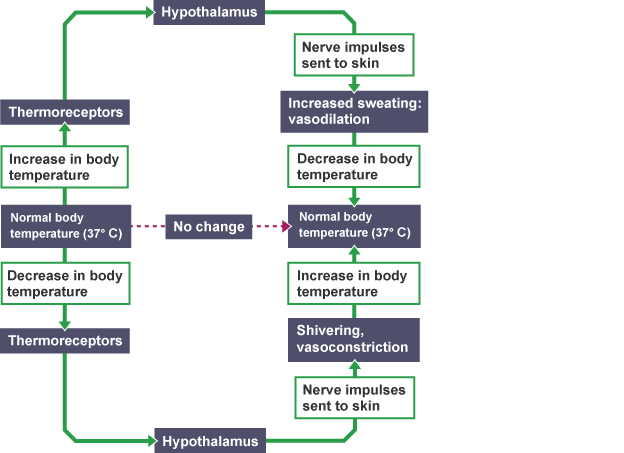
What type of feedback loop is shown?
Positive
Neutral
Negative

What type of feedback loop is shown?
negative
neutral
positive
As you get dehydrated, your blood becomes thicker and harder to pump. Your kidneys will respond by stopping urine production, sending the water from urine into your bloodstream to thin your blood back to normal level.
Positive Feedback Response
Negative Feedback Loop
Rapid growth during puberty causes your body to release more and more growth hormones. As you grow, more and more growth hormones are released until puberty is reached, and then the hormones stop.
Positive Feedback Response
Negative Feedback Loop
When you get cut, your skin cells release hormones that signal platelets to come and stop the bleeding. Platelets then release more and more hormones that signal even more platelets to help stop bleeding. The hormone signals continue until the cut is closed.
Positive Feedback Response
Negative Feedback Loop
When glucose levels in the blood rise, your brain sends a signal to your pancreas. The pancreas releases insulin, which opens channels in cell membranes to allow glucose to enter the cell, lowering blood sugar levels.
Positive Feedback Response
Negative Feedback Loop
The two types of feedback systems that help organisms maintain homeostasis are:
positive and negative
receptor and effector
static and dynamic
minor and major
Positive Feedback Loops:
amplify processes (make them even bigger)
prevent small changes from getting larger
are initiated during an illness with fever
are found only in plants
Negative Feedback Loops:
amplify processes
prevent small changes from getting larger
are initiated during blood clotting
are found only in plants
The overall goal of cellular respiration is to make:
Glucose
ATP
Oxygen
Water
Which is a product of Kreb's Cycle?
Carbon dioxide
Glucose
Pyruvate
Water
Which is a product of the ETC (electron transport chain??
Carbon dioxide
Glucose
Oxygen
ATP and water

