wayground logo

Free Printable Worksheets

NEW

Font size

S
M
L
XL
Worksheets

International Economics Review

Total questions: 65

Worksheet time: 1hrs 24mins

Name
Class
Date
1.
The ability of one person or nation to produce more of a good than another person or nation
a)
Comparative Advantage
b)
Absolute advantage
c)
exports
d)
protectionism 
2.
The use of trade barriers to protect a nation’s industries from foreign competition
a)
Balance of trade
b)
NAFTA
c)
Quotas
d)
Protectionism 
3.
Exports minus imports or how many goods a county exports versus imports
a)
Exports
b)
Subsidy
c)
Quotas
d)
Balance of Trade
4.
A regional trade organization made up of European nations
a)
NAFTA
b)
EU
c)
ASEAN
d)
CARICOM
5.
Agreement that will eliminate all tariffs and other trade barriers between Canada, Mexico, and the US
a)
NAFTA
b)
EU
c)
ASEAN
d)
CARICOM
6.
Limit of the amount of a good that can be imported
a)
Subsidy
b)
Quota
c)
Exports
d)
Appreciation 
7.
An increase in the value of a currency
a)
apprecation
b)
depreciation
c)
quota
d)
subsidy
8.
Government payments to a local supplier to reduce the supplier costs. This helps local businesses survive because it is getting direct aid from the government
a)
Balance of trade
b)
protectionism
c)
exchange rate
d)
subsidy
9.
Measure the price of one nation’s currency in terms of another nation’s currency 
a)
appreciation 
b)
depreciation
c)
exchange rate
d)
balance of trade
10.
When a nation imports more than it exports, economists say it has which of the following?
a)
A trade surplus
b)
A balance of trade
c)
A trade deficit
d)
A national difference
11.
What happens when a nation’s currency depreciates?
a)
Its products become more expensive to other nations
b)
Its products become cheaper to other nations and exports may increases
c)
Nothing
d)
It halts all trade
12.
 The US bans beef imports from Canada after a Mad Cow Disease outbreak there. This is an example of which type of barrier to trade?
a)
Standards
b)
Quota
c)
Subsidy
d)
Tariff
13.
According to the law of comparative advantage, a country should 
a)
Specialize and export goods with the lowest production cost
b)
Specialize and export goods with the lowest opportunity cost
c)
Specialize and export goods with the lowest average cost
d)
Specialize and export goods with the highest opportunity cost
14.
What is an official ban on trade or other commercial activity with a particular country?
a)
Tariff
b)
Product standard
c)
Embargo
d)
Quota
15.

According to the table, what is the Euro equivalent of 1 USD?

a)

1.32 Euros

b)

0.53 Euros

c)

.76 Euros

d)

1.59 Euros

16.

According to the table, what is the USD equivalent of 1 Australian?

a)

0.97 USD

b)

1.32 USD

c)

1.28 USD

d)

1.03 USD

17.

If the US $ were to appreciate in relation to the Euro, what effect would this have?

a)

European consumers would have more purchasing power in US

b)

US consumers can buy more European goods and services for fewer $$

c)

US consumers can buy more English goods and services for fewer $$

d)

European tourists to the US will spend more $$

18.

What is a decrease in the value of a currency?

a)

Appreciation

b)

Depreciation

c)

Inflation

d)

Absolute advantage

19.

What is the increase in the value of a currency?

a)

Exchange rate

b)

Recession

c)

Depreciation

d)

Appreciation

20.
A benefit, profit, or value of something that must be given up to acquire or achieve something else.
a)
Opportunity Cost
b)
Comparative Advantage
c)
Specialization
d)
Production
21.
The benefit or advantage of an economy to be able to produce a commodity at a lesser opportunity cost than other entities is referred to as
a)
Opportunity Cost
b)
Absolute Advantage
c)
Comparative Advantage
d)
Growth
22.
The nation's ability to produce general goods more efficiently than another entity is referred to as?
a)
Specialization
b)
Comparative Advantage
c)
Opportunity Cost
d)
Absolute Advantage
23.
If Japan and the United States can both produce cars, but Japan can produce cars of a higher quality at a faster rate, then it is said to have an _____________________ in the auto industry
a)
Comparative Advantage
b)
Absolute Advantage
c)
Opportunity Cost
d)
Specialization
24.

The U.S. can produce 50 cars and 25 tools. Peru can produce 20 cars and 15 tools. Who has the absolute advantage in tools?

a)

Peru

b)

U.S.

c)

neither

d)

not enough info

26.

Which of the following statements is true?

a)

William has an absolute advantage in making both cakes and pies.

b)

William has an absolute advantage in making both goods.

c)

For every 1 cake William makes, he gives up the chance to make 3 pies.

d)

David has an absolute advantage in making pies.

26.

Which of the following statements is true?

a)

William has an absolute advantage in making both cakes and pies.

b)

William has an absolute advantage in making both goods.

c)

For every 1 cake William makes, he gives up the chance to make 3 pies.

d)

David has an absolute advantage in making pies.

27.
In 1962, the United States prohibited all imports and exports to and from Cuba.
a)
Tariff
b)
Embargo
c)
Quota
28.
Japanese auto firms agree to limits set in Washington D.C., on the # of Japanese cars that may be sold in the U.S.
a)
Embargo
b)
Quota
c)
Tarriff
d)
Standard
29.
China’s most favored nation trading status will be taken away if congress and the President agree that the Chinese Government  is guilty of human rights abuses. All Chinese imports will experience a sharp increase in taxes if China is no longer considered a most favored nation.
a)
Tarriff
b)
Quota
c)
Embargo
d)
Subsidies
30.

A subsidy is

a)

a cash grant or loan from the government to support the business.

b)

a law that promotes safety.

c)

a tax on imports.

d)

a specific number of imports allowed.

31.
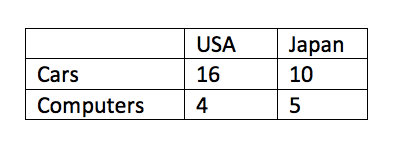
Based on the table provided, which one of the following statements is correct?
a)
Japan has the absolute advantage in producing cars
b)
Japan has the comparative advantage in producing cars
c)
The United States has the absolute advantage in producing both cars and computers
d)
The opportunity cost of producing a car in Japan is 1/2 a computer
32.

Who has the ABSOLUTE advantage in making earrings?

a)

Marie

b)

Isabella

33.

Who has the ABSOLUTE advantage in making bracelets?

a)

Marie

b)

Isabella

34.

Who has the COMPARATIVE advantage in making bracelets?

a)

Marie

b)

Isabella

35.

Who has the COMPARATIVE advantage in making earrings?

a)

Marie

b)

Isabella

36.

For Marie and Isabella to benefit the most, what should happen?

a)

Marie should make bracelets and Isabella should make earrings and they trade.

b)

Marie should make earrings and Isabella should make bracelets and they trade.

c)

They should both make their own bracelets and earrings and not trade.

37.

Who has the ABSOLUTE advantage in producing cotton?

a)

America

b)

Brazil

38.

Who has the ABSOLUTE advantage in producing sugar?

a)

America

b)

Brazil

39.

What is America's opportunity cost for producing cotton?

a)

2 pounds of sugar

b)

0.5 (1/2) pound of sugar

c)

2 pounds of cotton

d)

0.5 (1/2) pounds of sugar

40.

What is America's opportunity cost for producing sugar?

a)

2 pounds of sugar

b)

0.5 (1/2) pounds of sugar

c)

2 pounds of cotton

d)

0.5 (1/2) pounds of cotton

41.

What is Brazil's opportunity cost for producing cotton?

a)

3 pounds of cotton

b)

0.33 (1/3) pounds of cotton

c)

3 pounds of sugar

d)

0.33 (1/3) pounds of sugar

42.

What is Brazil's opportunity cost for producing sugar?

a)

3 pounds of cotton

b)

0.33 (1/3) pounds of cotton

c)

3 pounds of sugar

d)

0.33 (1/3) pounds of sugar

43.

Who has the COMPARATIVE advantage in producing cotton?

a)

America

b)

Brazil

44.

Who has the COMPARATIVE advantage in producing sugar?

a)

America

b)

Brazil

45.

For America and Brazil to benefit the most, what should happen?

a)

America should produce cotton and import sugar from Brazil.

b)

America should produce sugar and import cotton from Brazil.

c)

Both countries should produce their own cotton and sugar.

46.
An increase in the exchange value of one nation's currency in terms of currency of another nation's is called...
a)
Depreciation of currency
b)
Appreciation of currency
47.

Export means ...

a)

to get rid of the goods you don't need.

b)

sending a product to another country for sale.

c)

to get more goods to be able to make more money.

d)

bringing a product into a country to be sold.

48.
Import means
a)
buying goods from another country
b)
selling goods to another country
c)
only making one kind of product
49.

What is a trade deficit?

a)

When the value of exports exceeds the value of imports

b)

when the value of imports exceeds the value of exports

c)

when the values of imports and exports are equal

d)

when the value of imports for one nation is greater than the value of imports for another nation

50.

What is a trade surplus?

a)

when the value of exports exceeds the value of imports

b)

when the value of imports exceeds the value of exports

c)

when the values of imports and exports are equal to each other

d)

when the value of money greater than the amount of goods and services imported

51.

The country of Algonia produced and then shipped out $5 billion in goods and services to other nations. It brought in $4 billion in goods and services? What does this country have?

a)

A balanced budget

b)

A trade deficit

c)

A trade balance

d)

A trade surplus

52.

Carterville imported $10 billion in goods and services and exported $9 billion in goods and services. Which of the following does Carterville have?

a)

a trade deficit

b)

a balanced budget

c)

a trade surplus

d)

a trade balance

53.
Why does the United States need to import products?
a)
The US does not import products
b)
Some are easier and cheaper to make in other countries
c)
The US makes all of its own products
54.
What is a tariff?
a)
A government order to stop trade
b)
A limit placed on imports
c)
A tax placed on imports
55.
A tariff....
a)
Encourages people to buy goods made from their country.
b)
Increases trade between other countries.
c)
Stops trade completely.
d)
Only placed to encourage democracy.
56.
What is an embargo?
a)
A government order to stop trade.
b)
A limit placed on imports.
c)
A tax placed on imports.
57.
What is a quota?
a)
A government order to stop trade.
b)
A limit placed on imports.
c)
A tax placed on imports.
58.
Any activity which slows or outright blocks the free exchange of goods and services between nations.
a)
Voluntary Trade
b)
Specialization
c)
Currency Exchange
d)
Trade Barrier
59.
NAFTA caused trade barriers to be reduced resulting in-
a)
surge in immigration
b)
decline in factory production
c)
decrease in price of goods
d)
rise in taxes on products
60.
What is the primary purpose NAFTA?
a)
To reduce trade barriers among the US, Canada, and Mexico
b)
To reduce trade barriers among Central America and Mexico
c)
To reduce trade barriers among Brazil and Mexico
d)
To encourage free trade between the US, Europe, and Canada
61.

One argument against NAFTA

a)

Lower prices of goods

b)

Outsources jobs to outside countries

c)

Increase competition

d)

Economic growth

62.

refers to the unrestricted flow of goods, services, and productive resources between countries

a)

free trade

b)

balance of trade

c)

trade surplus

d)

trade deficit

63.

An argument against trade protectionism is that it will increase

a)

competition for domestic industries

b)

domestic price level

c)

the current account deficit

d)

opportunities for domestic infant industries

64.

Tariffs are used to protect “Infant Industries”

a)

True

b)

False

65.

Quotas are not popular with consumers because they limit consumer choice. This makes products more expensive.

a)

False

b)

True