wayground logo

Free Printable Worksheets

NEW

Font size

S
M
L
XL
Worksheets

Plants

Total questions: 53

Worksheet time: 28mins

Name
Class
Date
1.
What happens in the phloem?
a)
water moves up from the roots
b)
food moves down from the leaves
c)
food moves up from the roots
d)
water moves down to the roots
2.
Germination will not happen unless a seed
a)
is dispersed far from the plant that produced it
b)
absorbs water
c)
uses its stored food
d)
grows stamens and a pistil
3.
The energy that powers photosynthesis comes from
a)
water
b)
chemicals
c)
oxygen
d)
the sun
4.
Gases pass in and out of a leaf through the 
a)
stomata
b)
phloem
c)
xylem
d)
cuticle
5.
What part of a plant transports water and nutrients from the root to the plant's stem and leaves?
a)
root hairs
b)
phloem
c)
xylem
d)
cuticle
6.
Which is a function of the roots?
a)
absorb sunlight
b)
start photosynthesis
c)
pull nutrients from the soil
d)
turn gray when they get old
7.
Which is a function of the leaves?
a)
to provide shade
b)
to attract pollinators
c)
to make food through photosynthesis
d)
to absorb nutrients
8.
Which is a function of the flower?
a)
attract pollinators and produce seeds for reproduction
b)
to make food through photosynthesis
c)
to be pretty
d)
to absorb nutrients from the soil
9.
What is the main role of photosynthesis?
a)
to make a plant green
b)
to make food for the plant
c)
to make music for the plant
d)
to take pictures of the plant
10.
What is plant germination?
a)
a place where plants get sick
b)
planting a seed
c)
When  a seed grows into a plant
d)
the way a plant makes food
11.
What are three things plants need to survive?
a)
soil, dirt, sun
b)
water, sun, rich soil
c)
pizza, fries, ice cream
d)
water, fertilizer, shade
12.

Seeds can move from one place to another by

a)

wind

b)

water

c)

animals

d)

wind, water, and animals

13.

This part of the plant holds the plant in the ground and gets water and nutrients from the soil.

a)

stem

b)

leaves

c)

flower

d)

roots

14.

This part of the plant produces seeds and creates pollen.

a)

roots

b)

flower

c)

stem

d)

leaves

15.

The _________ helps hold the plant up and carries water and nutrients to the rest of the plant from the roots.

a)

leaves

b)

roots

c)

stem

d)

seed

16.
Which structure inside the ovary contains egg cells?
a)
Ovules
b)
stigma
c)
peduncle
17.
Flowering: gymnosperms
Non-flowering : angiosperms
a)
TRUE
b)
FALSE
18.
Pine, gingko, cypress and spruce are examples of ________? 
a)
angiosperm
b)
gymnosperm
c)
ppteridophytes
19.
Conifers reproduce using cones. 
a)
TRUE
b)
FALSE
20.
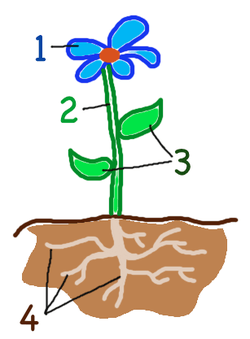
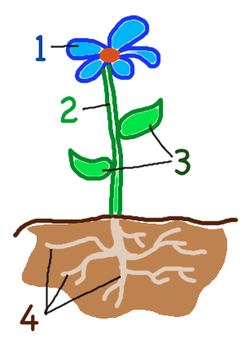
What part of the plant is #1?
a)
flower
b)
stem
c)
root
d)
leaf
21.
What part of the plant is #4?
a)
leaf
b)
flower
c)
stem
d)
root
22.
The part of the plant that holds the plant in place and absorbs water and minerals from the soil.
a)
stem
b)
roots
c)
leaves
23.
The function of a ___ is to absorb water, store food, and anchor plants. 
a)
flower
b)
leaf
c)
stem
d)
root
24.
What is the substance in plants that make them green?
a)
stigma
b)
carbon dioxide
c)
photosynthesis
d)
chlorophyll
25.

What substance is made through photosynthesis and is food for the plant?

a)

chlorophyll

b)

chloroplast

c)

glucose

d)

dextrose

26.

The vascular tissues of the plant are the ____________ which brings water up to from the roots of the plant and the _______________ which brings nutrients from the leaves to other parts of the plant

a)

xylem, phloem

b)

phloem, xylem

c)

stomata, guard cell

d)

guard cell, stomata

27.
Moves sugar from leaves to roots
a)
Xylem
b)
Phloem
28.
Xylem and Phloem are both __.
a)
Transpiration
b)
Absorption
c)
Photosynthesis
d)
Vascular tissue
29.
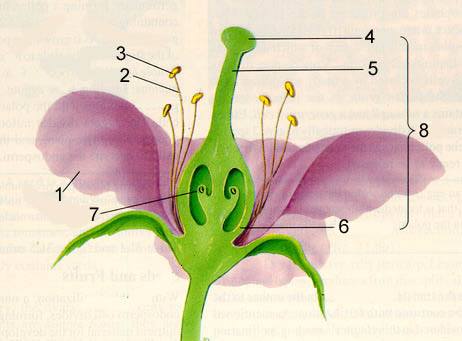
What is #3 pointing to?
a)
stigma
b)
filament
c)
ovary
d)
anther
30.
Why are flowers very colorful (and why do they produce odor?)
a)
So people buy them
b)
To make gardens look good
c)
To attract pollinators
d)
To attract sunlight
31.
In which part of the flower is pollen found?
a)
Filament
b)
Anther
c)
Ovary
d)
Xylem
32.
What is the sticky part of the flower that catches pollen?
a)
style
b)
stigma
c)
ovary
d)
petal
33.
What are the little holes underneath a leaf called?
a)
Ribosomes
b)
Roots
c)
Stomata
d)
Pores
34.

Cells require glucose and_____________to undergo respiration

a)

Water

b)

Soil

c)

Carbon dioxide

d)

Oxygen

35.

Cycads, ginkgo, and conifers are examples of __________.

a)

Angiosperm

b)

Gymnosperm

c)

Pteridophytes

d)

Bryophytes

36.
Glucose is ... 
a)
salt 
b)
sugar 
c)
air 
d)
water
37.
Plants are considered producers because 
a)
they produce carbon dioxide 
b)
they produce their own water 
c)
they produce sunlight 
d)
they produce their own food 
38.
Which of the following methods is used by plants to disperse their seeds widely?
a)
sticking on animal fur
b)
traveling through an animal's digestive system 
c)
wind
d)
all of the above 
39.
Which is an example of a conifer?
a)
Maple tree
b)
Pine tree
c)
rose bush
d)
Bermuda grass
40.

Angiosperms (flowering plants) produce both a seed and a ______________ to nourish the seed.

a)

nut

b)

spore

c)

fruit

d)

cone

41.

Conifers are called conifers because they produce _______________ ?

a)

flowers

b)

cones

c)

spores

d)

fruit

42.

What other job do the roots do for a plant?

a)

make food

b)

anchor the plant in the soil

c)

attract insects

d)

smell nice

43.

What is germination?

a)

when germs spread to different plants

b)

when a plant begins to grow

c)

when a bird takes a plant seed to another place

44.
Cones are the reproductive structures of ......
a)
angiosperms 
b)
gymnosperms
c)
mosses
45.
Plants whose seeds that are protected by fruits are called.... 
a)
conifer
b)
gymnosperm 
c)
angiosperm 
46.
A non-flowering plant that produces seeds that are NOT enclosed in a fruit is called... 
a)
petal 
b)
angiosperm 
c)
gymnosperm 
d)
stamen 
47.

What is a single cell that can be carried to a new location by wind or water to grow into a new plant?

a)

pollen

b)

xylem

c)

spore

d)

ploem

48.

How do nutrients move through nonvascular plants such as moss?

a)

cell to cell

b)

xylem & phloem

c)

stem & leaves

d)

pollenation

49.

What do pollen grains need to stick to for pollination to occur?

a)

an insect's body

b)

the stigma of the flower

c)

trees

d)

nectar

50.
What is #3 pointing to?
a)
stigma
b)
filament
c)
ovary
d)
anther
51.
What is #4 pointing to?
a)
anther
b)
style
c)
stigma
d)
ovary
52.
What is #6 pointing to?
a)
stigma
b)
style
c)
ovary
d)
petal
53.

What part of the flower develops into the fruit?

a)

stigma

b)

ovary

c)

anther

d)

petals