Wayground logo

Free Printable Worksheets

Font size

S
M
L
XL
Worksheets

Fossils/Geologic Time Review

Total questions: 51

Worksheet time: 47mins

Name
Class
Date
1.

a model scientists use to describe the timing of events and the relationships between those events in earth’s history.

a)

geologic time scale

b)

era

c)

period

d)

epoch

2.

geologic time intervals that eras are divided into.

a)

geologic time scale

b)

era

c)

period

d)

epoch

3.

when the mold becomes filled with minerals that are not a part of the original organism.

a)

Petrified

b)

Mold

c)

Cast

d)

Index

e)

Trace Fossil

4.

fossilized mark that is formed in soft sediment by the movement or actions of an animal.

a)

Petrified

b)

Mold

c)

Cast

d)

Index

e)

Trace Fossil

5.

According to paleontologists, how old is the Earth?

a)

3.5 Billion Years Old

b)

543 Million Years Old

c)

57 Million Years Old

d)

4.6 Billion Years Old

6.

looks at where the fossil is located to determine its age relative to other fossils.

a)

Relative Dating

b)

Absolute Dating

7.

Analyze the layers of undisturbed sedimentary rock. Which layer of sedimentary rock is oldest?

a)

Q

b)

R

c)

S

d)

T

e)

U

8.
What type of rock do fossils form in?
a)
Igneous
b)
Sedimentary
c)
Metamorphic
d)
Classic
9.
The Law of Superposition helps scientists to determine what?
a)
The absolute age of rock layers
b)
The age of fossils
c)
The relative age of rock layers
d)
the super powers of rocks
10.
The Geologic Time Scale is a record of what?
a)
old geologists
b)
sweet geology music
c)
the known history of rocks and fossils
d)
a list of every living thing ever
11.
Relative dating of rock layers tells us that the deeper we dig, _______.
a)
the younger the rocks get
b)
the smellier the rocks get
c)
the harder the rocks get
d)
the older the rocks get
12.
How do most fossils form?
a)
A living thing dies and is buried under sediment
b)
The sediment is compressed and compacted 
c)
They are formed in sedimentary rock
d)
All of these answers
13.
What is a rock mass formed by molten rock being forced into an earlier formation of rock layers?
a)
Extrusion
b)
Intrusion
c)
Fault
d)
Supposition
14.
According to the law of superposition, which layer is the youngest?
a)
A
b)
B
c)
C
15.
What is a cavity in rock made when an organism decayed
a)
mold
b)
cast
c)
fossil
16.
 The oldest rocks are on the bottom and the rocks become progressively younger toward the top
a)
uniformitarianism
b)
natural selection
c)
principle of superposition
d)
index fossils
17.
Humans appeared in the ____ Era.
a)
Cenozoic
b)
Paleozoic
c)
Mesozoic
d)
Devonian
18.
Preserved animal tracks are trace fossils.
a)
True
b)
False
19.
Which layer formed first?
a)
Rock Layer W
b)
Rock Layer X
c)
Rock Layer Y
d)
Rock Layer Z
20.
Finding fossils in an area can help us learn what about that location?
a)
Which places in the region receive the most sunlight
b)
The effect of the climate on the formation of the soil
c)
How modern plants and animals interact there
d)
The kinds of organisms that lived there long ago
21.
Principle that states in a sequence of undisturbed rocks, the oldest rocks are on the bottom and the rocks become progressively younger toward the top 
a)
superposition 
b)
uniformitarianism
c)
half-life
22.
Correctly sequence the layers of rocks oldest to youngest 
a)
A,D, C, B, E
b)
E, B,C D, A
c)
B,E,C, D, A
23.

Knowing the relative age of an index fossil in one location can help scientists infer the relative age of fossils and rock layers in other locations

a)

true

b)

false

24.
Which layer is the oldest?
a)
A
b)
B
c)
C
d)
D
25.
Which is younger: A or D?
a)
A
b)
D
c)
Both are the same
26.
Why is D younger than B?
a)
D had to be there for B to intrude
b)
D and B happened at the same time
c)
B was laid on top of D
d)
B had to be there for D to intrude
27.
What is the law that states why F is younger than G?
a)
law of uniformitarianism
b)
law of superposition
c)
law of cross-cutting
d)
law of Memorial Jags
28.

Which era is the most recent, the one that we are currently in?

a)

Mesozoic

b)

Paleozoic

c)

Cenozoic

d)

Precambrian

29.

Which of the following is an example of a trace fossil?

a)

Dinosaur bone

b)

Shark tooth

c)

Insect in amber

d)

Dinosaur footprint

30.

Which of these pictures is an example of a trace fossil?

a)
b)
c)
d)
31.
Which fossil is a replica of the original shape of the organism?
a)
cast
b)
mold
c)
trace
d)
preserved remains
32.
Which fossil is an impression left by the original organism?
a)
cast
b)
mold
c)
trace
d)
preserved remains
33.

A fault in a rock layer is younger than the layers it ______ through.

a)

sets

b)

cuts.

34.
Where can the oldest layer be found?
a)
The top layer
b)
The middle layer
c)
They are all the same age
d)
The bottom layer
35.
How are fossils created?
a)
Traces of organisms get turned into stone.
b)
Dead organisms are quickly buried for millions of years.
c)
Animals get trapped.
d)
All of the above
36.
How does the law of crosscutting explain the age of a fault?
a)
The fault is younger than the rocks above it.
b)
The fault is younger than the rocks it cuts through.
c)
The fault is older than the rocks above it.
d)
The fault is older than the rocks it cuts through.
37.
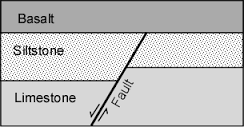
What are the relative ages of the features in order from oldest to youngest?
a)
Limestone, Basalt, Fault, Siltstone
b)
Siltstone, Fault, Basalt, Limestone
c)
Limestone, Fault, Basalt, Siltstone
d)
Limestone, Siltstone, Fault, Basalt
38.
The rock formation labeled "P" is a(n)...
a)
fault
b)
intrusion
c)
inclusion
d)
unconformity
39.
The Law of Crosscutting states that a fault or intrusion is __________ than the bodies of rock it cuts through.
a)
younger
b)
older
c)
funnier
d)
nastier
40.
How have the rocks been disturbed?
a)
tilting
b)
folding
c)
faulting
d)
igneous intrusion
41.
Which letter indicates an igneous intrusion?
a)
A
b)
C
c)
D
d)
E
42.
A is older than layer C
a)
TRUE
b)
FALSE
43.
The fault is older than layer B.
a)
TRUE
b)
FALSE
44.
How does the law of crosscutting explain the age of a fault?
a)
The fault is younger than the rocks above it.
b)
The fault is younger than the rocks it cuts through.
c)
The fault is older than the rocks above it.
d)
The fault is older than the rocks it cuts through.
45.
Analyze the seashell found in the white layer.  Which statement is true of the rock layer that contains this fossil?
a)
It could also contain a fossil from the bottom layer.
b)
It is older than the layers below it.
c)
It is younger than the layers above it.
d)
It is older than the layers above it.
46.
What states that a fault or a body of rocks must be younger than any feature or layer of rock that the fault or rock body cuts through?
a)
Unconformity
b)
Intrusion
c)
Law of superposition
d)
Law of crosscutting
47.
Used to determine whether an object is older or younger than other objects
a)
Superposition
b)
Relative Dating
c)
Fossil
d)
Unconformity
48.
provides evidence about the history of life and past environments on earth, and how life has changed over time
a)
relative dating
b)
fossil record
c)
unconformities
49.

a fossil found in a narrow time range but widely distributed around the earth; used to date rock layers.

a)

Petrified

b)

Mold

c)

Cast

d)

Index

e)

Trace Fossil

50.

Layer B on side #1 (left) is a match to which layer on side #2 (right)?

a)

z

b)

y

c)

w

d)

there is no match

51.

What is the correct order of the rock layers from oldest to youngest?

a)

F, E, C, B, A, D

b)

F, E, D, C, B, A

c)

A, B, C, D, E, F

d)

D, F, E, C, B, A