wayground logo

Free Printable Worksheets

NEW

Font size

S
M
L
XL
Worksheets

Unit 3 Test Study Guide

Total questions: 52

Worksheet time: 38mins

Name
Class
Date
1.
Which of the following is the smallest unit of life that can carry out all life functions?
a)
the mitochondria
b)
the vacuoles
c)
the nucleus
d)
the cell
2.
Which structures are found in every living cell?
a)
cell membrane and cytoplasm
b)
chloroplasts and mitochondria
c)
a cell wall and nucleus
d)
chloroplasts and cell wall
3.
Which cell structure is found in plant and animals cells and controls what can come into or leave a cell?
a)
cell membrane
b)
cytoplasm
c)
nucleus
d)
vacuole
4.
Cell organelles that are responsible for digesting food, worn out organelles and other cellular wastes are called ___________________.
a)
Mitochondria
b)
Vacuoles
c)
Lysosomes
d)
Chlororplasts
5.
What is one basic function of the vacuoles?
a)
circulating oxygen
b)
producing food
c)
controlling cell processes
d)
storing water
6.
Chloroplasts in plant cells allow the plant to perform a function that animal cells cannot do.  What is the main function of the chloroplasts found in plant cells?
a)
to absorb light energy and manufacture food
b)
to remove waste materials by active transport
c)
to manufacture chemical energy from food
d)
to control the shape of the cell
7.
All cells need energy to function.  Which cell organelle is responsible for producing energy in the cell?
a)
chloroplasts
b)
mitochondria
c)
nucleus
d)
vacuoles
8.
What is the function of a cell wall?
a)
to protect and support the cell
b)
to perform different functions in each cell
c)
to prevent water from passing through it
d)
to prevent oxygen from entering the cell
9.
In what part of the plant cell does the process of photosynthesis take place?
a)
nucleus
b)
mitochondria
c)
chloroplasts
d)
vacuoles
10.
 Starch and water molecules in potato cells are stored in what organelle?
a)
mitochondria
b)
nucleus
c)
cell wall
d)
vacuole
11.
Cells with a nucleus and membrane-bound organelles are called ____________________.
a)
prokaryotes
b)
eukaryotes
c)
bacteria
d)
protists
12.
Every living organism is made up of one or more cells
a)
True
b)
False
13.
The nucleus is like the ____________ of the cell.
a)
foot
b)
hand
c)
stomach
d)
brain
14.

The fluid that surrounds the organelles is... (hint... "Try to pull a fast one and..."

a)

chloroplast

b)

cytoplasm

c)

vacuole

d)

cell wall

15.

All of the following are Eukaryotic EXCEPT . . . .

a)

animal cells

b)

plant cells

c)

fungi

d)

bacteria

16.

Where is DNA found in a Eukaryotic cell?

a)

in the nucleus

b)

in the cell wall

c)

in the vacuole

d)

in the mitochondria

17.
Which of the following is a characteristic of both Eukaryotic and Prokaryotic cells?
a)
ribosomes
b)
nucleus
c)
membrane bound organelles
d)
simple
18.
Which of the following is not a characteristic of a Prokaryotic cell?
a)
unicellular
b)
floating DNA
c)
very small
d)
complex
19.
Eukaryotic cells are complex.
a)
true
b)
false
20.
Unicellular means
a)
single-celled
b)
unicycle
c)
multi-celled
d)
united cells
21.
What is multicellular? 
a)
one cell 
b)
no cells 
c)
many cells 
d)
no nucleus 
22.
Animal, fungi, plant, and protista cells are all examples of which type of cell?
a)
Eukaryotic
b)
Prokaryotic
c)
Both prokaryotic and eukaryotic
23.
A balance that an organism maintains by regulating what goes into and out of the cell.
a)
Hypertonic
b)
Homeostasis
c)
Plasmolysis
d)
Hypotonic
24.
The type of cellular transport that requires no energy.
a)
Active Transport
b)
Protein Pumps
c)
Passive Transport
d)
Endocytosis
25.
Which of the following modes of cellular transport does NOT require energy?
a)
Facilitated Diffusion
b)
Protein Pumps
c)
Endocytosis
d)
Exocytosis
26.
The amount of particles in a given space.
a)
diffusion
b)
concentration
c)
permeable
d)
active transport
27.
When the concentration of particles inside of a cell is the same as the concentration of particles outside of the cell. 
a)
active transport
b)
concentration
c)
diffusion
d)
equilibrium
28.
The process where only water is allowed to pass through the cell membrane from a high to low concentration.
a)
meiosis
b)
respiration
c)
diffusion
d)
osmosis
29.
The movement of molecules from an area of high concentration to an area of low concentration.
a)
Osmosis
b)
Respiration
c)
Diffusion
d)
Active Transport
30.
Cells use energy to move materials across a membrane (low to high concentration).
a)
Active transport
b)
Passive transport
c)
Diffusion
d)
Osmosis
31.
Which of the following is an example of osmosis?
a)
Oxygen exiting leaves after photosynthesis
b)
A raisin swelling in a cup of water
c)
Water changing from a liquid to a gas
d)
Oxygen moving into an animal cell
32.
A cell membrane has pores that allow certain materials to pass through. This is a type of cell membrane.
a)
Permeable
b)
In high concentration
c)
At equilibrium
d)
In low concentration
33.
Why is diffusion and osmosis important to cells?
a)
It allows them to take in materials without using energy.
b)
It allows them to reproduce.
c)
It allows them to absorb sunlight.
d)
It allows cells to use all energy.
34.
Which way will the water molecules move during osmosis?
a)
Out of the cell, so the cell shrinks.
b)
Out of the cell, so the cell swells.
c)
Into the cell, so the cell shrinks.
d)
Into the cell, so the cell swells.
35.
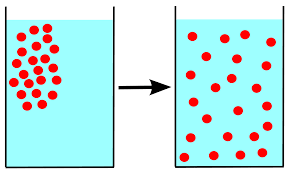
The picture below is an example of _________________.
a)
osmosis
b)
isotonic
c)
diffusion
d)
active transport
36.
Passive transport requires no
a)
concentration gradients
b)
osmosis
c)
motion
d)
energy
37.

When the smell of perfume spreads throughout a room, it is an example of ....

a)

passive transport

b)

diffusion

c)

active transport

d)

osmosis

38.

If a gummy bear is placed in salt water, the mass of the gummy bear will decrease because water will move out of the gummy bear. What process does this represent?

a)

osmosis

b)

fermentation

c)

respiration

d)

diffusion

39.
Which of the following is the correct order of organization in living things from most basic (simple) to most complex?
a)
a.  Organism, cell, tissue, organ, organ system
b)
a.  Organ system, organ, tissue, cell, organism
c)
a.  Cell, tissue, organ, organ system, organism
d)
a.  Cell, organ, tissue, organ, organism, organ system
40.
A group of similar cells that come together to perform a specific function is a/an
a)
organ
b)
organism
c)
organ system
d)
tissue
41.
When a group of organs work together to perform a particular function they create a/an
a)
organ system
b)
organism
c)
tissue
d)
organ
42.
What is the difference between a cell and a tissue?
a)
cell is basic unit of life; tissue is group of cells that work as one
b)
cell is group of tissues; tissue is basic unit of life
c)
cell is basic unit of life; tissue is groups of different cells
d)
cell is group of organs; tissue is group of different cells
43.
The heart contains different types of tissue. What level is the heart?
a)
cell
b)
organ system
c)
organ
d)
tissue
44.
When many organ systems work together it can form...
a)
organ
b)
cells
c)
organ system
d)
organism 
45.
Which system detects information from the environment and directs the way your body responds to this information?
a)
excretory
b)
circulatory
c)
respiratory
d)
nervous
46.
Which two body systems deliver oxygen to your cells and take away carbon dioxide?
a)
respiratory and nervous
b)
circulatory and nervous
c)
circulatory and excretory
d)
Respiratory and circulatory
47.

Which two body systems work together to break down food and get rid of wastes?

a)

digestive and excretory

b)

digestive and nervous

c)

excretory and respiratory

d)

nervous and digestive

48.
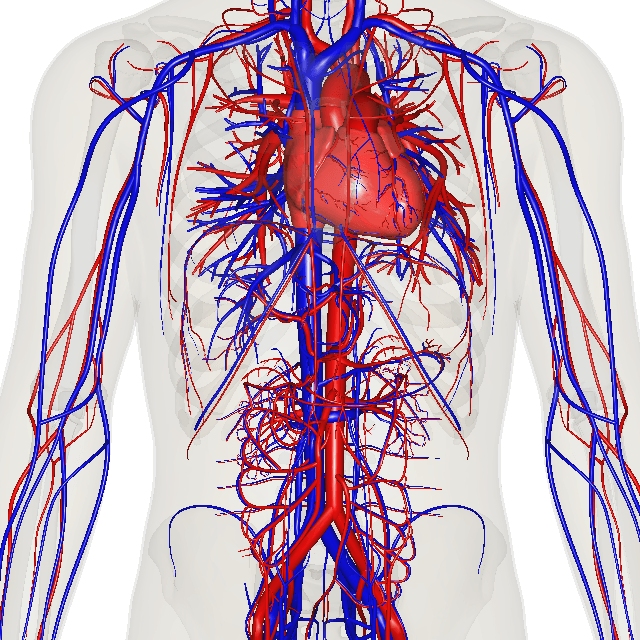
This is a example of ........
a)
cell
b)
organ system
c)
organ
d)
tissue
49.
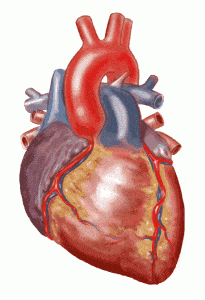
This is a example of ........
a)
organ
b)
organ system
c)
tissue
d)
cell
50.
 Which system is the stomach in?
a)
respiratory
b)
digestive
c)
nervous
d)
excretory
51.

This system gets rid of waste. What is it?

a)

Muscular System

b)

Excretory System

c)

Lymphatic System

d)

Endocrine System

52.
Which of the following is NOT part of the integumentary system?
a)
Skin
b)
Cartilage 
c)
Nails
d)
Hair