wayground logo

Free Printable Worksheets

NEW

Font size

S
M
L
XL
Worksheets

Evolution

Total questions: 47

Worksheet time: 1hrs 28mins

Name
Class
Date
1.
The law of superposition states
a)
the oldest rock layer is on the top, the younger rock layer is on the bottom
b)
rock layers are always in sequence from oldest to youngest
c)
the youngest rock layer is on the bottom and the oldest is on the top
d)
the oldest layer is on the bottom and the youngest is on the top when it is undisturbed
2.
Dolphins have the same arm structure as wolfs, what type of evidence for evolution does this represent?
a)
DNA
b)
vestigial structures
c)
homologous structures
d)
embryology
3.
Change over time is
a)
evolution
b)
generation
c)
growth
d)
biogenesis
4.
Natural selection is
a)
survival of the fittest
b)
humans change
c)
two species are the same
d)
more animals survive
5.
This makes an organism more suited to its enviornment
a)
species
b)
lifespan
c)
adaptation
d)
mutation
6.
Surviving and reproducing show that an organism
a)
is adapting
b)
is not adapting
c)
is forming fossils
d)
is not reproducing
7.
what did Charles Darwin observe in finch populations of the Galapagos Islands off the coast of South America?
a)
different species on different islands
b)
all species on one of the islands
c)
identical species on all the islands
d)
the same species as North America
8.
Some organisms that share a common ancestor have features that have different functions, but similar structures.  These are known as
a)
vestigial structures
b)
analogous structures
c)
homologous structures
d)
fossil structures
9.
Comparing human hemoglobin of chimpanzees, horses, kangaroos, and chickens, reveal that humans have the fewest amino acid differences with 
a)
Kangaroos
b)
Horses
c)
chickens
d)
chimpanzees
10.
A __________ is a branching diagram that shows evolutionary relationships.
a)
cladogram
b)
table
c)
derived character
d)
relationship tree
11.
Based upon the conditions of the early Earth, which forms of live most likely appeared first?
a)
Prokaryotic and aerobic
b)
Prokaryotic and anaerobic 
c)
Eukaryotic and aerobic
d)
Eukaryotic and anaerobic
12.
The two extant species that are closely related to each other are __.
a)
A and B
b)
B and C
c)
C and D
d)
D and E
13.
What is thought to be the correct sequence of these events, from earliest to most recent, in the evolution of life on Earth?
1. origin of mitochondria
2. origin of multicellular eukaryotes
3. origin of chloroplasts
4. origin of cyanobacteria
5. origin of fungi and animals
a)
4, 3, 2, 1, 5
b)
4, 1, 2, 3, 5
c)
4, 1, 3, 2, 5
14.
What was the product of the Miller-Urey Experiment?
a)
Simple amino acids
b)
Simple nucleotides
c)
Simple lipids
d)
Simple monosaccarides
15.
Which of the following was probably not present in the atmosphere of the primitive Earth? 
a)
Methane
b)
Oxygen
c)
Water
d)
Carbon dioxide
16.
According to the data, the unknown bacterial species is most closely related to...
a)
Species I
b)
Species II
c)
Species III
d)
Species IV
17.

What classification category is Porcellio in the name Porcellio scaber?

a)

Phylum

b)

Family

c)

Genus

d)

Species

18.

The 8 levels of classification, most broad to most specific.

a)

Genus, Family, Order, Domain, Class, Phylum, Kingdom, Species

b)

Species, Kingdom, Genus, Phylum, Family, Class, Order, Domain

c)

Domain, Kingdom, Phylum, Class, Order, Family, Genus, Species

d)

Order, Kingdom, Species, Phylum, Family, Class, Domain, Genus

19.

Which came first?

a)

the Cambrian explosion

b)

oxygen in the atmosphere

c)

prokaryotic cells

d)

mammal radiation

20.

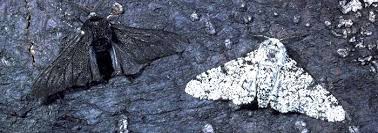
Predict which moth would increase in population

a)

light

b)

dark

21.

If a sick person takes an antibiotic but it doesn't kill all of the bacteria causing the sickness, what might explain this?

a)

Variations in the bacteria allowed some organisms to be less affected by the antibiotic?

b)

Bacteria cannot be killed by antibiotics

c)

You cannot cure a bacterial infection

d)

Bacteria do not cause sicknesses

22.
What type of selection is depicted in the picture? 
a)
stabilizing 
b)
directional 
c)
disruptive 
d)
the answer is not here
23.
If finches with large beaks and finches with small beaks increase in a population while finches with average sized beaks decreases, which pattern of natural selection has occurred?
a)
Directional selection
b)
Disruptive selection 
c)
Stabilizing selection
24.
What type of natural selection is this?
a)
Disruptive Selection
b)
Directional Selection
c)
Stabilizing Selection
d)
Sexy Selection
25.
The term for the role an organism has in the community.
a)
niche
b)
habitat
c)
tolerances
d)
competition
26.
A flash flood carried a raft of Amazon ants away from their original population. There is enough distance between the two groups, that they will never meet in nature again. What type of reproductive barrier is this?
a)
behavioral isolation
b)
temporal isolation 
c)
gametic isolation
d)
geographic isolation 
27.
The term for the formation of new and distinct species over the course of evolution is...
a)
speciation
b)
biological species concept
c)
reproductive barrier
d)
natural selection
28.
In recent years "SuperBugs" (bacteria that aren't effected by antibiotics) are becoming more and more common. How could natural selection explain this?
a)
Superbugs survive antibiotics and reproduce
b)
Antibiotics cause bacteria to become superbugs
c)
We have always had the same amount of superbugs; modern media just discusses them more.
d)
There is no reliable data on the origin of super bugs.
29.
Why do peppered moths tend to be the same color as the trees on which they live?
a)
The coloring goes along with tasting like the tree. 
b)
It keeps the moth the same temperature as the tree. 
c)
It makes the moths faster than the birds
d)
It makes the moths harder to see.
30.
The long and sharp beak of a woodpecker is an example of:
a)
Natural Selection
b)
Selective Breeding
31.
You look at two species and see very similar DNA. What does this likely tell you?
a)
These are the same animal.
b)
These animals have a common ancestor.
c)
These animals are not likely related.
d)
These animals are likely becoming one species.
32.
Which of the following levels of classification would have organisms that had the most in common?
a)
Phylum
b)
Family
c)
Order 
d)
Kingdom
33.
Term given to describe the 2 name naming system is:
a)
dichotmous key
b)
binomial nomenclature
c)
2 scientific names
d)
binomial key
34.
What is the most primitive organism shown on the cladogram?
a)
chimp
b)
perch
c)
hagfish
d)
salamander
35.
A student discovers an arachnid with a segmented abdomen, long legs, and a tail with no stinger. The student uses the dichotomous key below to identify it. Which arachnid has the student found?
a)
Whip Scorpion
b)
Wind Scorpion
c)
Daddy long legs
d)
Scorpion
36.
The scientific name of the mountain lion is Felis concolor and a house cat is Felis domesticus . Based on the names, you can determine that these two animals belong to the same:
a)
Species but different genus
b)
Species but different family
c)
Genus but different species
37.
A common ancestor for both C and E could be at position __.
a)
1
b)
2
c)
3
d)
4
38.

According to this cladogram, the species Lutra lutra's closest species relative is

a)

Panthera pardus

b)

Canis latrans

c)

Taxidea taxus

d)

Canis lupus

39.
Based on the phylogenic tree, which of these shows a correct ancestral lineage?
a)
E is an ancestor to F and G
b)
C is an ancestor to D and E
c)
B is an ancestor to A
d)
E is an ancestor to H and I
40.

What number is the common ancestor of C and D

a)

1

b)

2

c)

3

d)

4

41.

What is the common ancestor of Letters A, B, C, D, E?

a)

1

b)

2

c)

3

d)

4

42.
The human appendix is a __________ structure that suggests that humans evolved from plant-eating ancestors.
a)
homologous
b)
embryonic
c)
essential
d)
vestigial
43.
The human appendix is a __________ structure that suggests that humans evolved from plant-eating ancestors.
a)
homologous
b)
embryonic
c)
essential
d)
vestigial
44.
The science of classifying living things according to their similarities is called:
a)
Biology
b)
Zoology
c)
Taxonomy
d)
Taxidermy
45.
What is the specimen number for the following insect?
a)
123
b)
145
c)
232
d)
256
46.
Which of the following statements best explains why some mosquitoes survived after the first spraying?
a)
Some mosquitoes had a genetic mutation that made them resistant to the insecticide
b)
A.  All mosquitoes had a genetic mutation that made them resistant to the insecticide
c)
A.  None of the mosquitoes had a genetic mutation that made them resistant to the pesticide
47.
A graph regarding the effect of agricultural bioengineering on insect pests is shown below How has natural selection affected species of insect pests?
a)
A.  Natural selection has not affected the number of species that are resistant to pesticides
b)
A.  Natural selection has rapidly increased the number of species that are resistant to pesticides
c)
A.  Natural selection has only affected the number of species that are resistant to pesticides