

Wayground logo

Free Printable Worksheets

Font size

S
M
L
XL
Worksheets

Periodic table

Total questions: 40

Worksheet time: 28mins
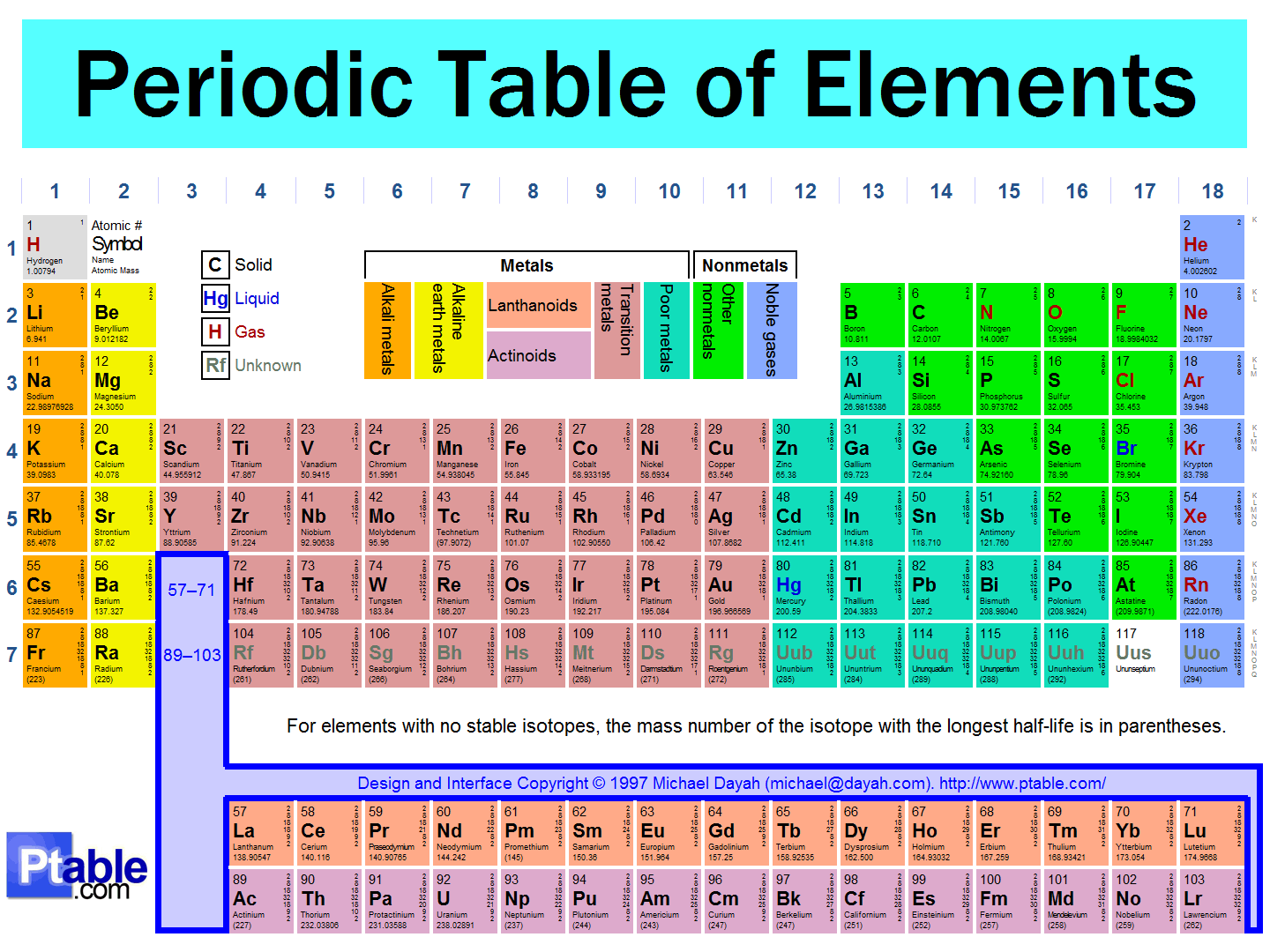
Name
Class
Date
1.

The vertical (up and down) columns in the Periodic Table are called

a)

groups

b)

towers

c)

periods

d)

atomic numbers

2.
The Modern Periodic Table of Elements is arranged by
a)
atomic mass
b)
atomic number
c)
valence electrons
d)
number of isotopes
3.
The atomic number tells you what?  READ THE ANSWERS CAREFULLY
a)
only the number of electrons
b)
 only the number of protons
c)
only the number of neutrons
d)
the number of both electrons and protons in an atom.
4.
The atomic number tells you what?
a)
number of electrons
b)
number of protons
c)
number of neutrons
d)
both electrons and protons in an atom.
5.
Which group of the periodic table is composed of inert (not reactive)  gases?
a)
alkali metals
b)
alkaline earth metals
c)
halogens
d)
noble gases
6.
Elements which are shiny, conduct electricity and heat are called
a)
metal
b)
nonmetal
c)
metalloid
d)
nonexistent
7.
Which element is not a metal?
a)
H
b)
Re
c)
Al
d)
B
8.
The atoms along the staircase are called 
a)
metals
b)
nonmetals
c)
metalloids
d)
noble gases
9.
Which is a halogen?
a)
Helium
b)
Chlorine
c)
Oxygen
d)
Neptune
10.
Which is an alkali metal?
a)
Magnesium
b)
Iron
c)
Sodium
d)
Europium
11.
A horizontal row of elements in the periodic table.
a)
column
b)
group
c)
period
12.
A vertical column in the periodic table.  Elements share similar properties.
a)
row
b)
group
c)
period
13.
Elements in a ..................have similar chemical properties.  
a)
period
b)
group
c)
row
14.

The order of elements in the periodic table is based on

a)

the number of protons in the nucleus.

b)

the electric charge of the nucleus.

c)

the number of neutrons in the nucleus.

d)

atomic mass.

15.

Atoms of elements that are in the same group have the same number of

a)

protons.

b)

neutrons.

c)

valence electrons.

d)

protons and neutrons.

16.

Which of the following elements is an alkali metal?

a)

calcium

b)

magnesium

c)

mercury

d)

sodium

17.

In Mendeleev's periodic table, elements in each column had similar

a)

atomic masses.

b)

properties.

c)

atomic numbers.

d)

symbols.

18.

The three main groups of elements are metals, nonmetals, and

a)

inert gases.

b)

alkali metals.

c)

radioactive isotopes.

d)

semiconductors/metalloids.

19.

Metals tend to be

a)

gases.

b)

dull.

c)

brittle.

d)

good conductors.

20.

Which group is very stable due to the fact that they have a full outermost energy level?

a)

alkali metals

b)

halogens

c)

alkaline-earth metals

d)

noble gases

21.

Based on its location on the periodic table, which of these elements most likely has physical and chemical properties most similar to boron (B)?

a)

magnesium (Mg)

b)

aluminum (Al)

c)

neon (Ne)

d)

chlorine (Cl)

22.

Which of the following groups on the Periodic Table is likely to form positively charged ions (or cations)?

a)

group 1

b)

group 13

c)

group 17

d)

group 18

23.

Which of the following elements would most likely be a shiny, gray-colored solid at room temperature, conduct electricity, and dent when hit with a hammer?

a)

argon (Ar)

b)

chlorine (Cl)

c)

sulfur (S)

d)

aluminum (Al)

24.

Alkali metals are extremely reactive because they

a)

have every small atomic masses.

b)

are not solid at room temperature.

c)

have one valence electron that is easily removed to form a positive ion.

d)

have two valence electrons that form compounds with calcium and magnesium.

25.
Sodium (Na) and potassium (K) are in the same group on the periodic table. Based on their locations, which statement about sodium and potassium is true?
a)
Sodium is less electronegative than potassium. 
b)
Sodium has fewer energy levels than potassium. 
c)
Sodium has a larger ionic radius than potassium. 
d)
Sodium has lower ionization energy than potassium. 
26.
Which of these elements has the greatest atomic radius? 
a)
H
b)
N
c)
Cl
d)
Cs
27.
The Periodic Table of the Elements is useful for revealing patterns and trends in the elements. Which statement accurately describes a pattern in the size of atomic radii in the Periodic Table of the Elements?
a)
Atomic radii decrease from left to right across a period and decrease from top to bottom in a group.
b)
Atomic radii increase from left to right across a period and increase from top to bottom in a group.
c)
Atomic radii decrease from left to right across a period and increase from top to bottom in a group.
d)
Atomic radii increase from left to right across a period and decrease from top to bottom in a group.
28.
The symbols W, X, Y, and Z represent four elements shown on the outline of a periodic table.
Which element has the highest electronegativity?

a)
W
b)
X
c)
Y
d)
Z
29.
The ionization potential of an element is the amount of energy required to remove an electron from an isolated atom or molecule. According to the periodic table, which of the following indicates the correct decreasing order of ionization energy?
a)
Li > Na > K > Cs
b)
Na > K > Li > Cs
c)
Li > K > Na > Cs 
d)
Cs > K > Na > Li 
30.
All elements found on the left side of the Periodic Table of the Elements have what properties in common?
a)
They conduct heat and electricity 
b)
They are all gases 
c)
They are brittle and dull
d)
They are radioactive
31.
Based on their locations in the periodic table, which element has chemical properties most similar to those of calcium, Ca?
a)
beryllium, Be
b)
potassium, K
c)
titanium, Ti
d)
yttrium, Y
32.
What is the family name of this group of elements? 
a)
Alkali metals 
b)
Halogens 
c)
Noble Gases 
d)
Alkali Earth Metals 
33.
According to the Periodic Table of the Elements, which set of elements has similar properties?
a)
H, C, I
b)
He, H, Al
c)
He, Ne, Ar
d)
Na, Ca, Al
34.
Which element has 2 valence electrons? 
a)
cesium (Cs) 
b)
magnesium (Mg)
c)
boron (B)
d)
argon (Ar) 
35.
How many Valance electrons does Iodine Have?
a)
6
b)
16
c)
7
d)
17
36.
Which atom has the largest atomic radius?
a)
potassium
b)
rubidium 
c)
francium
d)
cesium
37.
Which of the following will have a lower ionization energy than Scandium (Sc)?
a)
Helium (He)
b)
Titanium (Ti)
c)
Calcium (Ca)
d)
Magnesium (Mg)
38.
Electronegativity is...
a)
how good an atom is at attracting electrons
b)
the ability of an atom to lose electrons
c)
the energy required to remove an electron from a specific atom
d)
how easy it is to make friends. 
39.
Which of the following will have a larger radius than Zinc?
a)
Gallium
b)
Aluminum
c)
Magnesium
d)
Strontium
40.
As you move down the periodic table atoms get bigger.  This is because ____________.
a)
The atoms have more mass.
b)
The atoms have more protons.
c)
The atoms have more energy levels
d)
The atoms have more neutrons
