wayground logo

Free Printable Worksheets

Font size

S
M
L
XL
Worksheets

Earth Systems Midterm

Total questions: 94

Worksheet time: 1hrs 12mins

Name
Class
Date
1.

The outermost layer is the ________.

a)

mantle

b)

crust

c)

inner core

d)

outer core

2.

80% of the Earth's volume is made up of the _____.

a)

continental crust

b)

core

c)

mantle

d)

oceanic crust

3.

The inner core is ____________.

a)

solid

b)

molten

c)

unknown

d)

liquid

4.

The rock type that makes up continental crust is ____________________.

a)

copper

b)

silver

c)

basalt

d)

granite

5.

The rock type that makes up Oceanic Crust is __________.

a)

granite

b)

conglomerate

c)

basalt

d)

gold

6.

This layer has rocks that move in circular motion.

a)

crust

b)

continental crust

c)

mantle

d)

oceanic crust

7.

This layer has the hottest temperatures of all the layers.

a)

continental crust

b)

mantle

c)

outer core

d)

inner core

8.

This layer has the highest pressure of all the layers.

a)

inner core

b)

outer core

c)

crust

d)

mantle

9.
Middle part of the mantle that is partially molten rock, or putty like, or semisolid.
a)
Asthenosphere
b)
Mesosphere
c)
Lithosphere
d)
Crust
10.
Includes the crust and upper mantle that is divided into several constant moving plates of solid rock that floats on the layer below it. 
a)
Asthenosphere 
b)
Mesosphere
c)
Lithosphere 
d)
Crust
11.

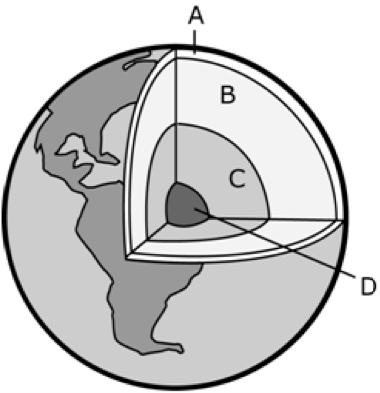
Which letter in the diagram identifies the layer of Earth made up of solid nickel and iron?

a)

layer A

b)

layer B

c)

layer C

d)

layer D

12.

Which of the following correctly lists the layers from innermost to outermost?

a)

inner core, outer core, lower mantle, upper mantle, crust

b)

lower mantle, upper mantle, crust, inner core, outer core

c)

lower mantle, inner core, upper mantle, outer core, crust

d)

crust, inner core, lower mantle, upper mantle, outer core

13.
What happens to temperature as we move from the crust to the inner core?
a)
Decreases
b)
Increases
c)
Nothing
14.
Less dense materials rise to the top.
a)
True
b)
False
15.
Which layer of Earth has the GREATEST density?
a)
crust
b)
mantle
c)
outer core
d)
inner core
16.
What is the elevation of point B?
a)
800 ft
b)
850 ft
c)
900 ft
d)
1000 ft
17.

In which direction is Mill River flowing?

a)

Southeast

b)

Southwest

c)

Northeast

d)

Northwest

18.
What is the elevation of Y?
a)
Between 120-140 meters
b)
Between 100-120 meters
c)
Between 140-160 meters
d)
Between 80-100 meters
19.
What feature is formed at B?
a)
river
b)
rift valley
c)
sink hole
d)
mountain
20.
If we were in a plane, Path B --> C is about the same distance as path E --> N. But, which path is the easier walk? 
a)
B --> C is the easier walk
b)
E --> N is the easier walk
c)
B --> C and E --> N are the same walking distance
21.
Determine the contour interval:
a)
5 m
b)
10 m
c)
15 m
d)
20 m
22.
What do contour lines that are farther apart represent?
a)
waterfall
b)
steep area
c)
gentle slope
d)
river
23.
How many mountain tops does this map have?
a)
one
b)
two
c)
three
d)
four
24.
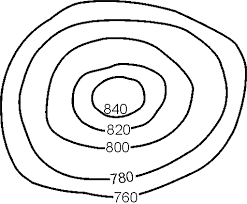
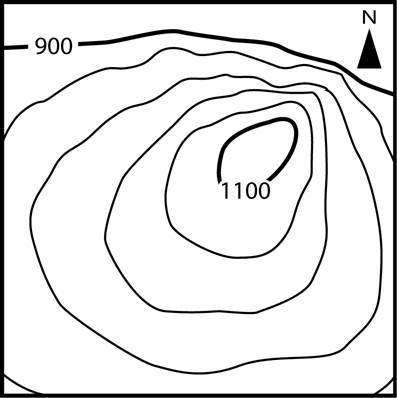
Provided is a topographic map of a hill with contour lines drawn showing elevation in meters.
The steepest slope on this hill can be found on the side that is facing which direction?
a)
Southwest
b)
Northeast
c)
Northwest
d)
Southeast
25.
If contour lines are close together, then the slope is
a)
gentle
b)
steep
c)
flat
d)
going up and down
26.

What does this symbol on a topographic map mean?

a)

depression (going down)

b)

hilltop

c)

train tracks

d)

valley

27.

What feature do these V-shaped contour lines represent?

a)

cliff

b)

peak

c)

hill

d)

river

28.
Lines of Longitude measure how far from the _______ a place is located.
a)
Equator
b)
International Date Line
c)
Prime Meridian
d)
Tropic of Cancer
29.
Lines of Longitude run from the _____ to the ______.
a)
East, West
b)
North, South
c)
South, East
d)
North, West
30.
The invisible line at 0 degrees longitude is called the _________.
a)
International Date Line
b)
Prime Meridian
c)
Equator
d)
Antarctic Circle
31.

Location D is located at which coordinates?

a)

30oN, 90oW

b)

90oN, 30oW

c)

10oN, 40oW

d)

30oN, 90oE

32.

Which point is located at 30oN, 90oW?

a)

K

b)

D

c)

E

d)

G

33.
What is the absolute location for G?
a)
45oS, 54oE
b)
30oS, 150oW
c)
150oS, 30oE
d)
30oS, 150oE
34.
What is the difference between the inner planets and the outer planets?
a)
The outer planets are smaller than the inner planets 
b)
The inner planets are smaller than the outer planets
c)
The outer planets have more rocks than the inner planets
d)
the inner planets are heavier than  the outer planets
35.
The inner planets are called terrestrial planets because they are composed of
a)
water
b)
gas
c)
frozen surfaces
d)
rocks
36.
Which planet has a giant red spot?
a)
Jupiter
b)
Saturn
c)
Uranus
d)
Neptune
37.
Who stated the earth was the center of the solar system?
a)
Ptolemy
b)
Copernicus
c)
Kepler
d)
Galileo
38.
Who used the telescope to observe the heavens?
a)
Ptolemy
b)
Copernicus
c)
Kepler
d)
Galileo
39.
What model of the solar system states the sun is the center
a)
Geocentric Model
b)
Heliocentric model
c)
Biocentric modal
d)
Hydrocentric  model
40.
What model of the solar system states the earth is the center
a)
Geocentric Model
b)
Heliocentric model
c)
Biocentric modal
d)
Hydrocentric  model
41.
What theory tries to explain the origin of the universe?
a)
Big Bang Theory
b)
Copernican Theory
c)
Ptolemain Theory
d)
Galilean Theory
42.

The HOTTEST stars are usually what color

a)

yellow

b)

orange

c)

blue

d)

pink

43.

What causes our seasons here on Earth?

a)

Stars in our universe

b)

Our revolution around the moon

c)

Earth's tilted axis and our rotation

d)

The revolution of Earth around the sun and Earth's tilted axis

44.

Where is the Asteroid Belt located in the Solar System?

a)

near Neptune

b)

between Mercury and Venus

c)

between Mars and Jupiter

d)

around the Sun

45.
If its ____ in the Northern hemisphere, then its summer in the Southern hemisphere. 
a)
spring
b)
summer
c)
fall
d)
winter
46.

The lifetime of a star depends on its:

a)

temperature

b)

absolute brightness

c)

apparent brightness

d)

mass

47.

What color are the coolest stars?

a)

red

b)

blue-white

c)

orange

d)

yellow

48.

The force that tends to pull together the matter in stars is:

a)

dark energy

b)

gravity

c)

nuclear fusion

d)

dark matter

49.

All stars begin as part of a large cloud of gas and dust called a(n):

a)

protostar

b)

nebula

c)

white dwarf

d)

super giant

50.

The surface of the sun is called ______________________.

a)

photosphere

b)

chromosphere

c)

sunspots

d)

flares

51.
Where does nuclear fusion occur?
a)
Space
b)
Radiation Zone
c)
Photosphere
d)
The Core
52.

The type of plate boundary where two plates come together is a .....

a)

Convergent Boundary

b)

Divergent Boundary

c)

Transform Boundary

d)

Plate Boundary

53.

Which of the following causes Earth's tectonic plates to move?

a)

Energy from the Sun

b)

Magnetic Pole Reversal

c)

Convection currents in the mantle

d)

Faults in Mountain Ranges

54.

A divergent boundary occurs when plates ....

a)

Pull apart

b)

Come together

c)

Slide past each other

d)

subducting

55.

Mountains are created when....

a)

Two continental plates collide

b)

Two oceanic plates pull apart

c)

An Oceanic plate subducts under a Continental Plate

d)

Two continental plates pull apart

56.

The Great Rift Valley in Africa and the Mid-Ocean Ridge were all created by this boundary

a)

Divergent

b)

Convergent

c)

Reform

d)

Transform

57.

Which of these events can ONLY happen on a DIVERGENT BOUNDARY?

a)

Rift Valley

b)

Mountain

c)

A peninsula

d)

An Insanely complex, long answer that you will click out of instinct.

58.

What occurs when two plates come together and the denser one is forced under back into the mantle?

a)

reduction

b)

conduction

c)

subduction

d)

convection

59.

What do volcanic island arcs indicate about the plate tectonics in the region?

a)

a converging plate boundary

b)

a diverging plate boundary

c)

a transform plate boundary

d)

new seafloor being created

60.

What geologic process formed the Himalayas?

a)

two continental plates converging

b)

an earthquake in a subduction zone

c)

a tectonic plate moving over a hot spot

d)

movement at a transform fault boundary

61.
The San Andreas Fault is a crack in the Earth's crust that runs the length of California. What plate boundary feature caused this?
a)
an inactive convergent boundary
b)
an active convergent boundary
c)
an active transform boundary
d)
a volcanic eruption
62.
The process by which molten material adds new oceanic crust to the ocean floor is called ___________.
a)
Divergent boundary
b)
Sea-floor spreading
c)
Convergent boundary
d)
Renovating 
63.
What layer is a semisolid and acts like a plastic?
a)
Lithosphere
b)
Mantle
c)
Asthenosphere
64.
The oceanic floor is made of?
a)
Granite
b)
Basalt
c)
Cookies
d)
Water
65.
The continental floor is made up of?
a)
Flowers and grass
b)
Basalt
c)
Granite
d)
Crust
66.
What happens to pressure as we move from the crust to the inner core?
a)
Pressure Decreases
b)
Pressure Increases
c)
Nothing
67.
What happens to temperature as we move from the crust to the inner core?
a)
Decreases
b)
Increases
68.
This layer of Earth is solid Iron and Nickel
a)
Outer Core
b)
Mantle
c)
Inner Core
d)
Crust
69.
Less dense materials rise to the top.
a)
True
b)
False
70.
Earth's magnetic field results from movements in the
a)
mantle
b)
outer core
c)
inner core
d)
crust
71.
Which layer of Earth is LIQUID?
a)
upper mantle
b)
lower mantle
c)
outer core
d)
inner core
72.
What is molten rock that has formed deep within the Earth?
a)
Hot Spot
b)
Magma
c)
Lava
d)
Volcano
73.
What is molten rock that has reached the Earth's surface?
a)
Aa
b)
Lava
c)
Magma
d)
Pahoehoe
74.
Where are most volcanoes found?
a)
Southern Hemisphere
b)
Ring of Fire
c)
Mid-Atlantic Ridge
d)
Hot Spots
75.
A volcano that has gentle sloping sides and is formed from runny lava
a)
Shield volcano
b)
Cinder cone
c)
Composite
d)
None of these
76.
When an explosive eruption  forms a mixture of hot rock, ash, and gas, this material is called a...?
a)
Land slide
b)
Lava
c)
Eruption trail
d)
Pyroclastic flow
77.
A volcano that has steep sides and is formed from lava chunks is called
a)
a shield volcano
b)
a cinder cone volcano
c)
a composite volcano
78.
A volcano that is made from layers of both runny lava and lava chunks is called 
a)
a shield volcano
b)
a cinder cone volcano
c)
a composite volcano
79.
Dormant volcanoes might erupt in the future.
a)
True
b)
False
80.
The volcanoes on the Hawaiian Islands form due to which of the following?
a)
Divergent Boundary
b)
Hot Spot
c)
Subduction Boundary
d)
Transform Boundary
81.
Where do volcanoes come from?
a)
Places where plates move apart
b)
Places where plates are moving together
c)
Hot Spots
d)
All of these options
82.
Tall, cone-shaped mountains in which layers of lava alternate with layers of ash
a)
Cinder Cone volcano
b)
Shield volcano
c)
Composite volcano
d)
Caldera
83.
Wide gentle sloping mountain from lava pouring out of the vent and hardens on top of previous layers
a)
Earthquake
b)
Cinder cone volcano
c)
Composite volcano
d)
Shield volcano
84.
What is a huge hole left behind When a volcano has an enormous eruption and empties the magma chamber and the main vent.  The volcano becomes hollow and collapses leaving this hole behind
a)
Central vent
b)
Caldera
c)
Side vent
d)
Magma
85.
What are solid rock fragments that are ejected during a volcanic eruption?
a)

Lahar

b)
Magma
c)
Pyroclastic Material
d)
Silica
86.
Which travels fastest, always being the first detected by seismic stations?
a)
P waves
b)
S waves
87.
The epicenter of an earthquake is
a)
The point below the surface where rock begins to break and the first motion occurs
b)
The seismic station closest to the earthquake
c)
The place where the greatest damage occurs
d)
The point on the surface directly above the focus
88.
Which wave can travel through solids, liquids, and gases?
a)
P
b)
S
c)
Surface
d)
Seismic
89.
How do scientists find the epicenter of an earthquake?
a)
by comparing arrival times of P waves and S waves at several seismograph stations
b)
by digging at several locations and comparing data
c)
by comparing departure times of P waves and S waves at several seismograph stations
d)
by reviewing satellite photos of tsunamis
90.
Which of these seismic waves creates the most damage during an earthquake?
a)
primary
b)
secondary
c)
surface
91.
At what location does the first motion of an earthquake occur
a)
the focus
b)
the seismic gap
c)
the mantle
d)
the epicenter
92.
What is the minimum number of seismograph stations needed to locate an earthquake epicenter?
a)
1
b)
2
c)
3
d)
1 billion
93.
Which city is closest to the epicenter?  
a)
A
b)
B
c)
C
94.
S Waves can move through which of the following?
a)
Gas
b)
Liquid
c)
Solid
d)
All of these