
 Worksheets
Review US History Semester EXAM
Total questions: 100
Worksheet time: 3hrs 44mins


"We conclude that this overpowering, irresistible tendency toward aggregation of capital and increase of size... cannot be arrested or even greatly impeded, and... instead of attempting to restrict either, we should hail every increase as something gained..." --Andrew Carnegie, The century
The business practice described above eventually led to the enactment of legislation that --
Guaranteed public access to corporate records
Protected consumers by prohibiting monopolies
Protected domestic industries from foreign competetition
Required reciprocity agreements between state governments
How did Andrew Carnegie contribute to civic and social life in the United States?
By promoting spiritual and moral values in public schools
By supporting conservative ideals in federal legislation and foreign policy
By establishing philanthrophic organizations dedicated to education and the arts
By creating a charitable foundation to end hunger
U.S. Cattle Industry in the Nineteenth Century
• Wild cattle multiplied for centuries in the Southwest.
• Growing cities created more demand for beef.
• Cowboys rounded up cattle and drove them to shipping centers on railroad lines.
• The introduction of barbed wire and windmills led to large fenced ranches.
• ________?_________
Which statement best completes this list?
Congress passed legislation imposing tariffs on imported beef.
Most of the cowboys on cattle drives were European immigrants.
The cattle industry was nationalized under the Department of Agriculture.
The need to process large amounts of cattle made meatpacking a major industry

Which of the following occurred between 1865 and 1900 as a result of the rapid industrialization of the United States?
Social and economic class divisions began to disappear
Concerns about air pollution led to stricter environmental regulations
Union membership increased as workers sought better pay and conditions
Factory owners introduced wage-equality policies for women in the workplace
• Escape from religious persecution
• Hope for freedom and equality
• Hope for better economic conditions
• Escape from political turmoil and war
A high school teacher wrote these bullet points on the whiteboard. What was the most likely topic of discussion?
Goals of U.S. assimilation policies
Objectives of the Grange movement
Reasons for immigration to the United States
Principles of Social Darwinism increased
The Chinese Exclusion Act of 1882 was primarily a response to —
increased U.S. presence in China
competition for jobs on the West Coast
rapid population growth in the Northeast
China’s actions during the Boxer Rebellion

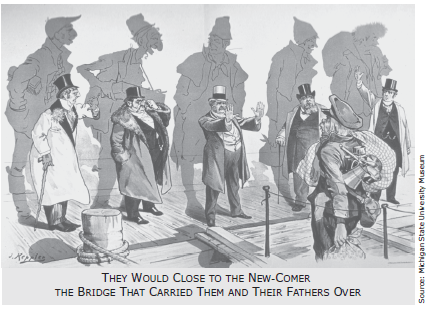
Which situation does this cartoon from an early 1900s pamphlet illustrate?
The deportation of many Chinese immigrants in the Northwest
The recruitment of Chinese immigrants by large labor unions
The fear in the West of losing jobs to Chinese immigrants
The lack of available resources in the East to support a large influx of Chinese immigrants


This table supports the conclusion that in 1900 —
People moved to areas with religious protections similar to those in their native country.
Geographic proximity to native countries influenced immigration patterns.
Economic incentives offered by native countries encouraged emigration.
People moved to areas with government regulations similar to those in their native country.


Which demographic change in the United States is most associated with this transformation?
Increased property values in rural areas
Increased life expectancies in urban areas
Increased birth rates in rural areas
Increased migration to urban areas
During the Gilded Age there was a notable increase in federal support for --
the growth of big business
involvement in foreign affairs
the acquisition of foreign territories
increased temperance regulations
The primary objective of the Dawes Act was to -
Promote American Indian investment in private industry
End warfare between American Indians and the U.S. military
Promote cultural assimilation of American Indians
Turn American Indian reservations into corporate farmland

Which word best explains the changes shown in these photographs?
Immigration
Assimilation
Nullification
Nativism
Which of the following contributed most to increased settlement of the Great Plains?
The availability of buffalo
The discovery of precious metals
A series of federal land grants
A decrease in agricultural production

The process described above led to
peaceful resolution of territorial disputes with American Indians.
the establishment of agricultural communities on the American frontier.
federal regulation of agriculture.
a decline in immigration to urban areas.


The creation of initiative, referendum, and recall procedures during the Progressive Era resulted in —
A system of separate schools for new immigrants
the expansion of citizens' direct participation in the democratic process
a redistribution of the tax burden among citizens
more sources of revenue for state governments

In response to public concern over issues raised by Upton Sinclair's the Jungle, the federal government expanded its role in -
working with labor unions to increase worker salaries
taking responsibility for the safety of consumers
setting limits on the growth of private industry
implementing social welfare programs
Which of these was a major goal of Jane Addams’s Settlement House movement in Chicago?
The founding of women’s colleges
The introduction of prison reform
The assimilation of immigrants
The establishment of public libraries

These lyrics are representative of a movement that culminated in a constitutional amendment during the —
Harlem Renaissance
New Deal
Reconstruction Era
Progressive Era


These achievements illustrate Ida B. Wells’s contributions as —
a religious leader
an artist of the Harlem Renaissance
a supporter of Prohibition
an advocate of equality
The Progressive goal to implement women’s suffrage was accomplished by —
A a national referendum
an executive order
a Supreme Court decision
a constitutional amendment

The goal of this resolution was eventually achieved with the —
Signing of the Civil Rights Act.
Passage of Prohibition laws.
Ratification of the Nineteenth Amendment.
Creation of the Women’s Army Auxiliary Corps.


Which groups were most influential in passing the Pure Food and Drug Act?
Southern farmers and clergy members
Factory owners and bankers
Muckrakers and women’s organizations
College students and immigrants


What was the primary result of this legislation?
States instituted their own environmental regulations.
Settlement on lands with fragile ecosystems was prohibited.
Monopolies seized control of natural resources.
National parks were create as a way to manage land resources.

Which agency name belongs on the blank line?
U.S. Geological Survey.
National Park Service.
Bureau of Reclamation.
U.S. Border Patrol.
How did the publication of Upton Sinclair’s The Jungle contribute to a change in the relationship between government and business?
Federal troops were mobilized to break strikes by labor unions.
Government regulations requiring the inspection of food products were implemented.
Congress created a regulatory agency to audit railroads.
Laws were enacted that banned private companies from discriminating when hiring.


Mahan’s books influenced U.S. efforts to become a world power primarily by —
advocating overseas expansion
emphasizing the need for protectionist tariffs
demonstrating the political risks of foreign trade
arguing against forming overseas alliances

How did these events affect of the United States?
The increased public support for cuts in US defense spending
They prompted the end of Dollar Diplomacy in Latin America
They set a precedent of including territorial acquisitions in settlements
They helped establish the United States as an imperial power similar to European nations

Which sentence provides information needed to complete both the cause and effect portions of this diagram?
The 1898 Spanish-American War led to world power status for the United States.
The 1914 opening of the Panama Canal encouraged international trade.
The 1919 Treaty of Versailles contributed to the start of World War II in Europe.
The 1929 stock-market crash set off the Great Depression in the United States.

Which numbered territory did the United States gain by winning the Spanish American War?
1
2
3
4


This cartoon comments on tactics used to
secure the southern border of California
protect shipping lanes in the Great Lakes
create a defensive alliance with France
obtain control of the Panama Canal Zone

President Roosevelt issued this statement in response to --
the construction of the canal in Panama
the threat of European intervention in Latin America
Spanish efforts to suppress a rebellion in Cuba
public outcry regarding war between Russia and japan

What was the main effect of the changes shown in this graph on the western U.S.?
Immigration from Europe to western U.S. cities increased rapidly
Western U.S. businesses traded more efficiently with the East Coast and Europe
Asian businesses bypassed the West Coast to trade directly with the East Coast
Western states recruited guest workers from the Caribbean and South America


What was one result of the events reported in the excerpt above?
Germany financed the Mexican army’s attempted invasion of the United States.
The U.S. government abandoned its official policy of neutrality.
Germany’s navy blockaded several Mexican seaports.
The U.S. government boycotted goods imported from Europe.
How did the Zimmermann telegram influence U.S. entry into World War I?
It announced the czar’s overthrow in Russia.
It revealed a proposed military alliance between Mexico and Germany.
It contained orders for German U-boats to destroy British passenger ships.
It described Romania’s plan to abandon neutrality.

This photograph shows a military tactic that --
made troops more vulnerable to long-range missiles, resulting in heavy casualties
required highly skilled soldiers, resulting in lengthy training periods
made frontal assaults difficult, resulting in long periods of stalemate
required the ability to attack quickly, resulting in a reliance on cavalry forces
During World War I, tanks were used on the western front primarily to -
lead infantry advances across no-man’s-land and into enemy territory
destroyed railroads and bridges used by enemy troops
release chemical weapons in advance attacks on enemy positions
launch long-range rockets at enemy aircraft


Which action completes the diagram?
Submarines attacked unarmed ships.
Armored tanks crossed fortified lines.
The use of machine guns resulted in massive causalities.
Airplanes conducted reconnaissance missions
Which pull factor contributed to the Great Migration?
The availability of land grants for homesteaders
Economic opportunities in industrialized cities
Better soil conditions in previously uncultivated areas
The lower cost of living in urban areas


Whoever, when the United States is at war, shall willfully . . . utter, print, write, or publish any disloyal, profane, scurrilous, or abusive language about the form of government of the United States . . . shall be punished by a fine of not more than $10,000 or imprisonment for not more than twenty years, or both. . . .
—Espionage Act, May 1918
This law demonstrates that at one time the federal government was willing to —
suspend habeas corpus
confiscate privately owned weapons
force people into internment camps
suspend freedom of speech

Senator Lodge made this statement in opposition to
U.S. membership in the League of Nations
the funding of a massive buildup of the U.S. Navy
a relaxation of U.S. citizenship requirements
U.S. entry into the Spanish-American War

One reason this provision was included in the Treaty of Versailles was to -
create a democratic government in Germany
divide Germany into smaller states to be governed by Allied countries
grant independence to all German colonies
weaken the power of Germany in the international community
The Fourteen Points reflected President Woodrow Wilson’s belief that —
intervention in the affairs of other nations was never justifiable
travel among nations should be regulated by an international organization
no country should be allowed to spend more on defense than any other country
cooperation among international leaders was essential to maintaining world peace
President Woodrow Wilson’s Fourteen Points supported Poland by calling for its —
establishment as a Soviet satellite nation
annexation by Great Britain
establishment as an independent nation
inclusion in one of the larger empires

Which action did the federal government take to recognize these soldiers?
Passing the GI Bill to give them educational benefits.
Awarding them the Congressional Medal of Honor for actions above the call of duty.
Providing them with monetary bonuses for demonstrating courage under fire.
Awarding them battlefield promotions from enlisted to officer.


How did the introduction of these new practices most benefit U.S. business?
By increasing production efficiency.
By preventing shortages of goods.
By increasing protective tariffs.
By decreasing exports.
Why did the "Return to Normalcy" agenda of the U.S. presidential candidate Warren G Harding appeal to many voters in the 1920 election?
The public wanted to help rebuild war-torn countries
There were significant shortages of military supplies
There was a decrease in demand for consumer goods
The public wanted to concentrate on domestic economic issues.


Which headline describes a consequence of the Teapot Dome scandal?
A
B
C
D
The establishment of speakeasies in the 1920's was an unintended consequence of which federal government action?
The taxation of imported luxury goods
The deportation of suspected communist sympathizers
The prohibition of the sale of alcoholic beverages
The implementation of immigration restrictions

What was the primary reason for the raids described in this excerpt?
To prevent workers from joining labor organizations.
To block civil rights advocates from staging public protests.
To suppress the teaching of evolution in colleges.
To halt the spread of communist ideas by radicals.

Cartoons such as this one took the position that deportation was necessary because --
assimilation programs in the United States had been unsuccessful
economic decline had increased the competition for jobs
communist were infiltrating the US
political machines had too much power in urban areas

During the 1920s, Clarence Darrow and William Jennings Bryan were most closely identified with the...
Increased use of credit by U.S. consumers.
Development of new forms of popular entertainment.
Decline of public support for Progressive reforms.
Conflict between modernism and traditionalism.

Which inference about the 1920s is supported by this illustration?
Women confronted discrimination in employment and education.
Women challenged traditional attitudes and social norms.
Reform organizations targeted women's issues.
Mass media reflected trends popular in rural communities.
Which of the following identifies two effects of the Harlem Renaissance?


Which of these cause-and-effect relationships is accurate?
The ideas of social Darwinism led to the passage of Prohibition laws.
The signing of the Treaty of Versailles contributed to the implementation of the New Deal.
The ideas of the Harlem Renaissance influenced the growth of the Civil Rights movement
The rise of fascism in Italy influenced the onset of the Red Scare
Which of the following identifies two effects of the Harlem Renaissance?
Increased geographic concentration of African American
Increased popularity of venues featuring African American Artists
Founding of colleges for African Americans
Founding of the Socialist Party
Founding of Tuskegee University
Migration of African Americans to western states
Ratification of Constitutional amendments ensuring rights for African Americans
Increased support for prohibition of alcoholic bevegrages
As early as 1925, then-Secretary of Commerce Hoover had warned President Coolidge that stock market speculation was getting out of hand. Yet in his final State of the Union Address, Coolidge saw no reason for alarm. Hoover, however, remained fearful. Even before his inauguration, he urged the Federal Reserve to halt “crazy and dangerous” gambling on Wall Street by increasing the discount rate the Federal Reserve charged banks for speculative loans. He asked magazines and newspapers to run stories warning of the dangers of rampant speculation.
But Presidents in 1929 were not supposed to regulate Wall Street, or even talk about the gyrating market for fear of inadvertently setting off a panic, and Hoover backed off.
—Richard Norton Smith and Timothy Walch, “The Ordeal of Herbert Hoover,” 2004
The economic conditions described in this excerpt contributed to
a global economic depression
an increase in foreign investments in the U.S. market
the adoption of the gold standard
an increase in free market activity
Which of the following directly contributed to the economic instability of the United States in 1929?
The implementation of a personal income tax
Overspeculation in the Stock Market
New Regulations on banking
The elimination of of import tariffs


Which of the following best completes this diagram?
Led to a decrease in U.S. international trade.
Helped stabilize the U.S. economy.
Strengthened U.S. relationships overseas.
Led to a decline in U.S. unemployment.

Which of the following best completes this graphic organizer
Increase in consumer spending
overspeculation in the stock market
decrease in military spending
government subsidization of crops

