wayground logo

Free Printable Worksheets

Font size

S
M
L
XL
Worksheets

Midterm Review

Total questions: 141

Worksheet time: 7hrs 7mins

Name
Class
Date
1.

Use the distributive property to simplify the expression.

5(a + 6)

a)

5a + 6

b)

a + 30

c)

5a + 30

d)

5a - 30

2.

Use the distributive property to simplify the expression.

3(2c - 5)

a)

6c - 15

b)

6c + 15

c)

6c + 15

d)

-6c - 15

3.

Use the distributive property to simplify the expression.

2(c - 8)

a)

2c - 16

b)

2c + 16

c)

2c - 8

d)

c - 16

4.

Use the distributive property to simplify the expression.

3(6x-5)

a)

18x-15

b)

18x+-15

c)

9+15x

d)

9x-15

5.

Simplify the expression by combining like terms.

8a+4b+2c-3b+a

a)

9a+b+2c

b)

10a+7b+c

c)

13abc

d)

18abc

6.

Simplify the expression by combining like terms.

9x2+14x-x2+6x

a)

8x2+20x

b)

9x2+20x

c)

10x2+20x

d)

8x2+8x

7.

Simplify the expression

8(2x+3)-13

a)

16x+11

b)

16x

c)

24x+41

d)

4-24x

8.
The difference of 3 times a number and 7
a)
3 + 7n
b)
3n - 7
c)
3n + 7 
d)
3 / 7n
9.
a number increased by eighteen
a)
18n
b)
n+18
c)
18-n
d)
18/n
10.
fourteen times a number
a)
n-14
b)
14n
c)
14+n
d)
14-n
11.
the sum of fifty-two and a number
a)
n-52
b)
52 + n
c)
52/n
d)
52n
12.
w increased by 5
a)
w - 5
b)
5w
c)
w + 5
d)
w / 5
13.
g divided by nine
a)
9g
b)
g-9
c)
g ÷ 9
d)
9 ÷ g
14.
6 (x + 5)
a)
Six times X increased by five
b)
Six times the sum of a number and five
c)
The quotient of six and a number increased by five
d)
Five more a number times six
15.
a)
46
b)
126
c)
70
d)
-26
16.
Solve:
-4x = 24
a)
20
b)
-20
c)
6
d)
-6
17.
Solve:
3x + 7 = -8
a)
5
b)
-5
c)
-12
d)
-18
18.
Solve:
7x - 3x - 8 = 24
a)
8
b)
-8
c)
3.2
d)
4
19.
Solve:
3(x - 2) = 18
a)
6.7
b)
4
c)
8
d)
-4
20.
Solve:
-8 + 5x - 2 = 20
a)
6
b)
-6
c)
2
d)
-2
21.
Solve:
2(2x + 3) = -6(x + 9)
a)
1.2
b)
6
c)
-6
d)
7.5
22.
Solve:
32 - 7x = -6(x + 3)
a)
50
b)
3
c)
-3
d)
-50
23.
Solve:
2(a + 4) = 2a - 8 + 4a
a)
3
b)
-3
c)
-4
d)
4
24.
Solve for y: 
2y + 7 = 11
a)
y = 2
b)
y = 1
c)
y = 9
d)
y = 4
25.
x + 5 > 7
a)
x > -2
b)
x > 2
c)
x > 12
d)
x > -12
26.
-4 + y < -8
a)
y < 4
b)
y < -12
c)
y < -4
d)
y < 12
27.
-8x < 48
a)
x < -6
b)
x > -6
c)
x < 6
d)
x > 6
28.
4x + 1 > 13
a)
x > 48
b)
x < 3
c)
x > 3.5
d)
x > 3
29.
-9x + 7 ≥ 25
a)
x ≥ -3.6
b)
x ≤ 2
c)
x ≥ -2
d)
x ≤ -2
30.

Solve the following inequality. Show your algebraic work!

a)

b > 6

b)

b < -4

c)

b > 1

d)

b < -12

31.
-1(2x + 4) ≥ 6
a)
x ≤ -5
b)
x ≥ -5
c)
x ≤ -1
d)
x ≥ -1
32.

Solve the following inequality. Show your algebraic work!

a)

x > -2

b)

x > 1

c)

x > 3

d)

x < 4

33.
What inequality does the number line graph represent?
a)
x > 5
b)
x < −5
c)
x ≥ 5
d)
x ≥ −5
34.
Match the graph with its inequality.
a)
a > 11
b)
a < 11
c)
a ≥ 11
d)
a ≤ 11
35.
Match the graph with its inequality.
a)
b > –2
b)
b < –2
c)
b ≥ –2
d)
b ≤ –2
36.

Which number line best represents the solution to the inequality 5w ≥ 30

a)

A

b)

B

c)

C

d)

D

37.
Which graph matches the inequality
r ≥ -6?
a)
A
b)
B
c)
C
d)
D
38.
What is the correct equation in 
Slope-Intercept Form?
(y = mx +b)
a)
y = x + 2
b)
y = 2x - 1
c)
y = -x + 2
d)
y = -2x - 1
39.
What is the correct equation in 
Slope-Intercept Form?
(y = mx +b)
a)
y = 1/3x - 1
b)
y = 1/4x -1
c)
y = -1/3x +1
d)
y = -1/4x + 1 
40.
What is the correct equation in 
Slope-Intercept Form?
(y = mx +b)
a)
y = x
b)
y = x + 1
c)
y = -x 
d)
y = -x + 1
41.
What is the correct equation in 
Slope-Intercept Form?
(y = mx +b)
a)
y = 4/3x - 4
b)
y = -4/3x + 3
c)
y = 4/3x + 4
d)
y = -4/3x +3
42.
What is the correct equation in 
Slope-Intercept Form?
(y = mx +b)
a)
y = 3x - 3
b)
y = 3x - 1
c)
y = -3x - 3
d)
y = -3x - 1 
43.
What is the correct equation in 
Slope-Intercept Form?
(y = mx +b)
a)
x = 4
b)
y = 4 
44.
What is the correct equation in 
Slope-Intercept Form?
(y = mx +b)
a)
y = -3x - 2
b)
y = -2x - 2
c)
y = 2x - 2
d)
y = 3x - 2
45.
What is the correct equation?
a)
x = 5
b)
y = 5
c)
x = - 5
d)
y = -5 
46.
What is the correct equation in 
Slope-Intercept Form?
(y = mx +b)
a)
y = 3/5x + 1
b)
y = 5/3x + 1
c)
y = 3/5x
d)
y = 5/3x
47.
What is the correct equation in
Slope-Intercept Form?
(y = mx +b)
a)
y = -1/3x + 3
b)
y = 1/3x - 3
c)
y = -1/3x - 3
d)
y = 1/3x + 3 
48.
Solve for x:
a)
x = yb - v
b)
x = by - v
c)
x = by + v
49.
S = 3F - 24  Solve for F
a)
F = (S + 24)/3
b)
F = S/3 + 24
c)
F = 3S + 24
d)
F = 3(S + 24)
50.
8x + 4y= 16 for y
a)
y = -8x + 16
b)
y = 2x -4
c)
y = -2x + 4
d)
y = -8x + 12
51.
Solve for s:
2s = 6t + 8w
a)
s = 12t + 16w
b)
s = 6t + 4w
c)
s = 3t - 4w
d)
s = 3t + 4w
52.
M= i + r ; solve for r
a)
M-i
b)
M+i
c)
-M-r
d)
-M+i
53.
Solve the formula for b.  What is the 1st step? 
a)
Subtract h from each side. 
b)
Add h to each side. 
c)
Divide each side by h. 
d)
Multiply each side by 2. 
54.
Solve the formula for r.   What is the 1st step?
a)
Divide each side by t. 
b)
Subtract t from each side. 
c)
Add t to each side. 
d)
Multiply each side by t. 
55.

Solve for 'x': x + 2w = m

a)

x = m - 2w

b)

x = 0.5m - w

c)

x = 2mw

d)

x = m/(2w)

56.
Solve the literal equation for the given variable.
a)
2A/h
b)
2/(h)
c)
2Ah
d)
Ah/2
57.
Solve for w:
A = LW
a)
A = L/W
b)
w = L/A
c)
w = A
d)
w = A/L
58.
Solve:
C = 2πr, for r
a)
C/(2π) = r
b)
C + 2π = r
c)
C - 2π = r
d)
2πC = r
59.

what is the first step to solve for slope intercept form on

-x + 4y = 11

a)

subtract 11 from both sides

b)

add x to both sides

c)

subtract x from both sides

d)

put in th y=

60.

which of the following is the best first step to solve for y = mx +b? equation is -2x - 4y = -12

a)

add 4y to both sides

b)

subtract 2x from both sides

c)

add 2x to both sides

d)

divide by -4

61.

what is the slope of the following 12x - 6y = 30

a)

2

b)

-2

c)

12

d)

-12

62.

what is the slope for the following equation 9x + 2y = 9

a)

-2/9

b)

-9/2

c)

-9

d)

9

63.

what is the slope of y = 4 - 6x

a)

4

b)

6

c)

-6

d)

-4

64.

what is the slope intercept form of 9x - y = 9

a)

y = 9x

b)

f(x) = 9x - 9

c)

f(x) = -9x + 9

d)

y = 9

65.

what is the slope given the following two points (2,-4) and (1, 5)?

a)

9

b)

-5

c)

5

d)

-9

66.

what is the standard form for the equation y = -5x + 8?

a)

5x + 2y = 8

b)

5x + 8y = 8

c)

5x + y = 8

d)

8x + y = 5

67.

what is the slope intercept form for the equation -2x + 8y = 2

a)

y = -2x + 8

b)

y = 1/4x + 1/4

c)

y = -1/4x - 1/4x

d)

y = 2/8x + 4

68.
What are the x- and y -intercepts on this graph?
a)
(0,5), (0,5)
b)
(5,0), (5,0)
c)
(5,0), (0,5)
d)
(0,0), (5,0)
69.
What is the y-intercept in the equation x + 2y = 4
a)
0
b)
2
c)
4
d)
KC Royals
70.
Given the list of ordered pairs, what is the x-intercept?
(8,10),  (3, -4),  (0, 8), (4, -3), (9, 0)
a)
(8,10)
b)
8, 3, 0, 4, 9
c)
(0,8)
d)
(9,0)
71.
What is the x and y intercept for the following equation ?
4x - 10y = 20
a)
x - int = 4    
y-int = -10
b)
x-int = 5
y-int = 2
c)
x - int = 5
y int = -2
d)
x -int = 4
y -int = -10
72.
What is the y intercept?
y = 2x - 3
a)
3
b)
-3
c)
1
d)
2
73.
What is the y-intercept for the given graph?
a)
-5
b)
5
c)
1
d)
-1
74.
Determine the y-intercept for the following equation
4x + 2y = -12
a)
4
b)
-6
c)
-12
d)
2
75.
What is the y-intercept of the line?
a)
y = 1/2
b)
y = 1
c)
y = -1/2
d)
y = -1
76.
What is the x- intercept of the line?
a)
x = 1
b)
x = 2
c)
x = -1
d)
x = -2
77.
Give the y-interecept
3x + y = 5
a)
-3
b)
(0,5)
c)
-5
d)
(0, -3)
78.
Give the x-intercept
3x + 8y = 24
a)
(8, 0)
b)
(0, 8)
c)
(3, 0)
d)
(0, 3)
79.
What is the y-intercept?
a)
7
b)
0
c)
1
d)
2
80.
What is the x-intercept?
a)
12
b)
-3
c)
8
d)
0
81.
Give the slope and y-intercept
6x - 3y = -9
a)
slope is 6 
y-intercept is 9
b)
m=2
b=3
c)
slope is 2
y-intercept is -3
d)
m = 3
b = 2
82.
What is the slope?
a)
1/4
b)
4
c)
-3
d)
-2
83.
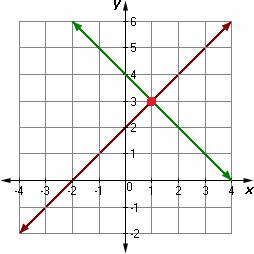
What is the solution to the system?
a)
(0, 3)
b)
(1, -1)
c)
(-3, 1)
d)
(1, 3)
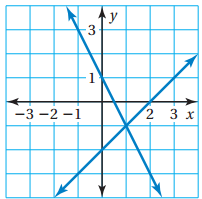
84.
What is the solution? 
a)
1
b)
-2
c)
(1, 2)
d)
(1, -1)
85.
What is the solution?
a)
(6, 3)
b)
(3, 6)
c)
(-6, 3)
d)
No solution
86.
Parallel Lines never intersect because...
a)
they have the same slopes. 
b)
they have the same y-intercept.
c)
they have different slopes.
d)
they have different y-intercepts. 
87.
Does the system have one, none or infinite solutions?
8x + 4y = 12
y = -2x + 3
a)
(0,3)
b)
(3,0)
c)
No solution(parallel lines)
d)
Infinitely many solutions
88.

2x - y = 0

4x - y = 0

a)

(1,2)

b)

(0,0)

c)

No Solutions

d)

Infinite Solutions

89.


How many solutions?
a)
One Solution
b)
No solution
c)
Infinitely Many Solutions
90.
If a system of equations has no solution, what does the graph look like? 
a)
intersecting lines
b)
parallel lines
c)
skew lines
d)
intersecting lines
91.
What is the solution?
a)
One Solution
b)
No solution
c)
Infinitely Many Solutions
92.
What is the solution?
a)
(1, -1)
b)
(-1, 1)
c)
(0, -2)
d)
(2, 0)
93.
Solve:
3x + 2y = 16
7x + y = 19
a)
(-2,5)
b)
(-2,-5)
c)
(2,-5)
d)
(2,5)
94.
Which point below is NOT part of the solution set?
a)
(0, 0)
b)
(5, 1)
c)
(-1, -3)
d)
(20, -5)
95.
Select the correct graph for each inequality.
a)
A
b)
B
c)
C
d)
D
96.
Select the correct graph for each inequality.
a)
A
b)
B
c)
C
d)
D
97.
Is (-2,4) a solution to the system?
a)
Solution
b)
Not a solution
98.
Which point is a solution?
a)
(0, 6)
b)
(-3, 4)
c)
(1, 0)
d)
(-4, 3)
99.
Which of the following is not a solution to this system of inequalities?
a)
(0,-1)
b)
(0,3)
c)
(4,0)
d)
(6,-2)
100.
Which of the following inequalities matches the given graph?
a)
x ≥ -1
b)
x ≤ -1
c)
x > -1
d)
x < -1
101.
Are the points on the boundary line part of the solution set or not?
a)
Yes, they are part of the solution set
b)
No, they are NOT part of the solution set
102.
Which point below is NOT part of the solution set?
a)
(0, 0)
b)
(5, 1)
c)
(-1, -3)
d)
(20, -5)
103.
Which system of inequalities matches the graph?
a)
y > 2x - 4
y < 2
b)
y < 2x - 4
y < 2
c)
y > 2x - 4
<  2 
d)
y < 2x - 4
<   -2
104.

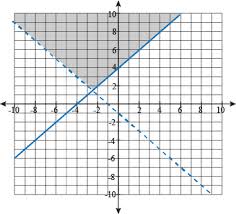
Which of the following is a solution to the systems of inequalities?

a)

(1, -5)

b)

(2, 3)

c)

(-2, 3)

d)

(-1, 1)

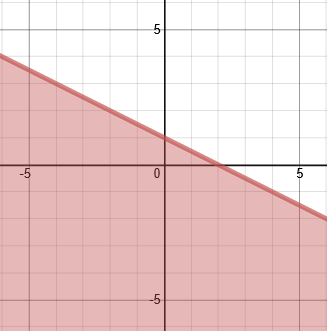
105.

Which of the following is a solution to the systems of inequalities?

a)

(0, 0)

b)

(1, 1)

c)

(-4, -2)

d)

(4, -2)

106.
What is the definition of function?
a)
Has inputs and outputs
b)
Every input has only ONE output
c)
Inputs have different outputs every time
d)
x-values and y-values
107.
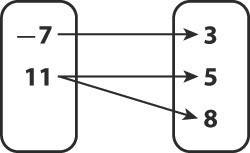
Is the relation a function? Why.
a)
Yes, because the x-value 11 has two y-values pair with it.
b)
Yes, because each x-value has only one y-value paired with it.
c)
No, because the x-value 11 has two y-values pair with it.
d)
No, because each x-value has only one y-value paired with it.
108.
a)
Function
b)
Not a Function
109.
Is this mapping a function or not a function? 
a)
Function
b)
Not a Function
110.
Is this table a function or not a function? 
a)
Function
b)
Not a Function
111.
Is this table a function or not a function? 
a)
Function
b)
Not a Function
112.
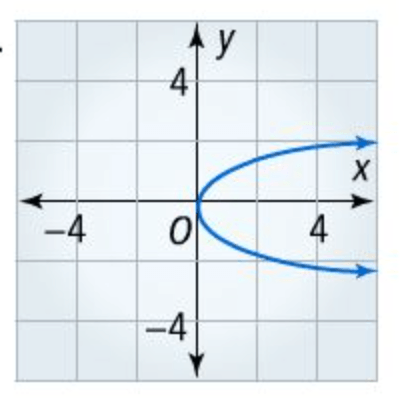
Is this graph a function or not a function? 
a)
Function
b)
Not a Function
113.
Which set of values is a function?
a)
(9,5) (10,5) (9,-5) (10,-5)
b)
(3,4) (4,-3) (7,4) (3, 8)
c)
(6,-5) (7, -3) (8, -1) (9, 1)
d)
(2, -2) (5, 9) (5, -7) (1, 4)
114.
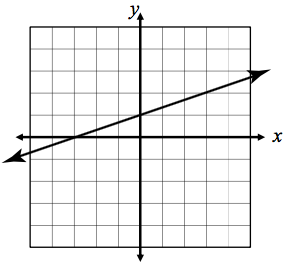
Is this graph a function or not a function? 
a)
Function
b)
Not a Function
115.
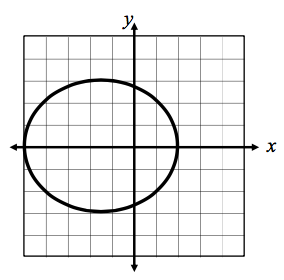
Is this graph a function or not a function? 
a)
Function 
b)
Not a Function 
116.
Is this graph a function or not a function? 
a)
Function
b)
Not a Function 
117.
f(x)=2x+1
If f(x)=4, what is the value of x?
a)
3/2
b)
2
c)
1/2
d)
4
118.
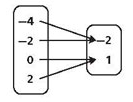
Give the domain and range. Tell if it is a function.
a)
D: {-4, -2, 0, 2}
R: {-2, -2, 1, 1}
Function
b)
D: {-4, -2, 0, 2}
R: {-2, 1}
Function
c)
D: {-4, -2, 0, 2}
R: {-2, -2, 1, 1}
Not a Function
d)
D: {-4, -2, 0, 2}
R: {-2, 1}
Not a Function
119.
All of the y values or outputs are called what?
a)
Domain
b)
Range
c)
Relation
d)
Function
120.
Which of these is NOT the same
a)
Range
b)
Input
c)
Dependent Value
d)
Y-Value
121.
For the function {(0,1), (1,-3), (2,-4), (-4,1)}, write the domain and range.
a)
D: {1, -3, -4,}
R: {0, 1, 2, -4}
b)
D:{0, 1, 2, -4}
R:{1, -3, -4}
c)
D:{0, 1, 2, 3, 4}
R:{1, -3, -4}
122.
What is the range of the following relation:
(9, -2) (4, 3)  ( 8, 10) ( -4, 8)
a)
-4, 4, 8, 9
b)
-2, 3, 8, 10
c)
(9, -2) ( 4, 3)
d)
(8, 10) (-4, 8)
123.
Given 
f(x)= 2x2 + 5x - 17, find f(-1). 
a)
f(-1) = -20
b)
f(-1) = -24
124.
Evaluate the function for the given value:
a)
8
b)
-7
c)
6
d)
2
125.
Evaluate the function for the given value:
a)
-5
b)
63
c)
450
d)
5
126.
Does the table represent a function?
a)
Yes, there  is a repeated x-value. 
b)
No, there aren't any repeated y-values. 
c)
Yes, there are repeated y-values. 
d)
No, there is a repeated x-value. 
127.
For the function f(x) = -3(x-1) find f(0).
a)
0
b)
-3
c)
3
d)
-1
128.
Find the common difference: -34, -29, -24, -19, ...
a)
d = -5
b)
d = 5
c)
d = -6
d)
d = 6
129.
Find the common difference: 29, 21, 13, 5, ...
a)
d = -10
b)
d = -9
c)
d = -8
d)
d = -7
130.
Find the common difference: -18, -23, -28, -33, ...
a)
d = -5
b)
d = 5
c)
d = -3
d)
d = 3
131.
Find the common difference: 1, 201, 401, 601, ...
a)
d = 100
b)
d = 101
c)
d = 200
d)
d = 201
132.
Find the next three terms in the arithmetic sequence: -33, -24, -15, -6, ...
a)
-1, 7, 15
b)
-5, 2, 9
c)
3, 12, 21
d)
-65, -73, -81
133.
Find the next three terms in the arithmetic sequence: -3, -8, -13, -18, ...
a)
-20, -24, -28
b)
-21, -25, -29
c)
-23, -28, -33
d)
-24, -29, -32
134.
Find the next three terms in the arithmetic sequence: 25, 34, 43, 52, ...
a)
63, 72, 81
b)
79, 88, 97
c)
70, 79, 88
d)
61, 70, 79
135.
Find the 35th term in the arithmetic sequence: -10, -14, -18, -22, ...
a)
-216
b)
-148
c)
-146
d)
-150
136.
Find 26th term in the arithmetic sequence: -15, -35, -55, -75, ...
a)
-515
b)
-490
c)
-535
d)
460
137.
Find the 26th term in the arithmetic sequence: 20, 26, 32, 38, ...
a)
182
b)
176
c)
170
d)
-118
138.
Is the sequence arithmetic: 37, 31, 25, 19, ...
a)
Yes
b)
No
139.
Select the explicit rule that represents the sequence.
a)
6 + 5(n - 1)
b)
4 + 6(n - 1)
c)
6 - 4(n - 1)
140.
Given the sequence:
 25, 21, 17, 13,...
Write the explicit equation that models the sequence.  (Hint:  Simplify your equation.)

a)
an = 4n + 29
b)
an = -4n + 25
c)
an = -4n + 29
d)
an = 4n + 25
141.
Write a recursive rule for the sequence 17, 1, -15, -31 . . .
a)
an = an-1 + 16
b)
an = an-1 - 17
c)
an = an-1 - 15
d)
an = an-1 - 16