
 Worksheets
Quarter 3 Exam Review
Total questions: 138
Worksheet time: 6hrs 37mins

Find the missing value.
Round to the nearest tenths.
52.1o
37.9o
52.1 cm
50.6 cm

Find the missing value.
Round to the nearest tenths.
33.9 mm
3.4 mm
10.5 mm
36.2 mm

Find the missing value.
Round to the nearest tenths.
34.2o
55.8o
39.6o
29.7o

Find the missing value.
Round to the nearest tenths.
36.6 in
43.7 in
47.8 in
37.4 in

Find the missing value.
Round to the nearest tenths.
50.6o
29.4o
34.8o
50.1o

Find the missing value.
Round to the nearest tenths.
23.6 miles
4.6 miles
.9 miles
20.7 miles

Find the missing value.
Round to the nearest tenths.
50.1o
39.9o
32.7o
51.6o

Find the missing value.
Round to the nearest tenths.
5.9 lightyears
5.0 lightyears
7.1 lightyears
7.5 lightyears
You are on a ship at sea. You see a lighthouse in the distance. You know the lighthouse is 175 feet tall. You measure the angle of elevation to the top of the lighthouse at 5o. How far are you from the bottom of the lighthouse?
2000.3 feet
2007.3 feet
1997.9 feet
2134.8 feet
You are attacking an enemy castle. Your strategy is to go over the castle wall. You are 1500 meters away from the bottom of the wall. You measure the angle of elevation to the top of the wall at 3o. How tall is the enemy castle wall?
78.6 meters
1498.0 meters
78.5 meters
75.3 meters
What are the only types of triangles we can use trigonometry with?
Obtuse
Acute
Right
Any type of triangle
Which is the trig function that relates the adjacent side and the hypotenuse?
cosine
sine
tangent
all of the above
Which is the trig function that relates the opposite side and the hypotenuse?
tangent
sine
cosine
all of the above
Which is the trig function relates the opposite side and the adjacent side?
sine
cosine
tangent
all of the above
What is the side of the right triangle that is opposite to the right angle called?
Short side
Adjacent side
Opposite side
Hypotenuse

Which ratio represents sin(A)?
32/40
32/24
24/40
24/32

Which ratio represents cos(C)?
16/34
16/30
30/34
34/16
What do the angles in a triangle sum to?
Every triangle is different
360 degrees
90 degrees
180 degrees


At point on the ground 50 feet from the front of a tree, the angle of elevation to the top of the tree is 48𝑜 . Find the height of the tree.
Which of the following is the correct diagram for the problem?


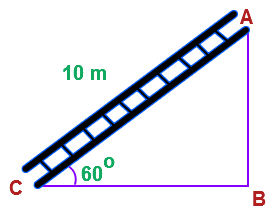
A ladder is leaning against a wall. The foot of the ladder is 6.5 feet from the wall. The ladder makes an angle of 74𝑜 with the level ground. How high on the wall does the ladder reach?
Which of the following is the correct diagram for the problem?


Translations, rotations, and reflections are three different types of what?
Transformations
Geometry
Vectors
Shapes
Translations, rotations, and reflections are three different types of what?
Transformations
Geometry
Vectors
Shapes
A turn is also called a ___________.
Translation
Reflection
Rotation
Transformation
A slide is also called a _________.
Translation
Reflection
Rotation
Transformation
A flip is also called a _________.
Translation
Reflection
Rotation
Transformation
Congruent means...
The same angles.
The same size and same shape.
Equal to.
The same transformation.

Describe the Transformation
Translation
Reflection
Rotation

Describe the transformation in the image.
Translation
Reflection
Rotation
The original figure prior to a transformation.
Pre-image
Image
The result of a transformation.
Pre-image
Image

What is this picture an example of?
Reflection
Translation
Rotation
Dilation

Name the transformation.
Translation
Reflection
Rotation
The mathematical term for the line that you reflect a shape over is the...
Mirror
Reflective tape
Line that you reflect over
Line of reflection
After a figure has been transformed, we call the new figure the...
Image
Different shape
Figure that moved
Prime
Describe the transformation:
(x, y) -> (x-2, y+7)
Translation 2 units to the left & 7 units up
Translation 2 units to the left & 7 units down
Translation 2 units to the right & 7 units up
Translation 2 units to the right & 7 units down

What type of transformation is this?
rotation
translation
reflection
dilation

What type of transformation is this?
rotation
translation
reflection
dilation
What rule represents a reflection over the x-axis?
Change sign on x-value, keep sign on y-value.
Change sign on both x-value and y-value
Flip & keep both signs the same
Keep sign on x-value, change sign on y-value.
What rule represents a reflection over the y-axis?
Change sign on x-value, keep sign on y-value.
Keep sign on x-value, change sign on y-value.
Flip & change both signs.
Change sign on both x-value and y-value.
What rule represents a rotation 180 degree about the origin?
Flip & change sign on x-value.
Change sign on x-value and y-value.
Flip & change sign on y-value.
Flip x-value and y-value.
What rule represents a rotation of 90 degrees clockwise about the origin?
Flip & change sign on x-value.
Change sign on y-value.
Flip & change sign on y-value.
Change sign on both x-value and y-value.
What rule represents a rotation of 90 degrees counterclockwise about the origin?
Flip & change sign on x-value.
Change sign on x-value.
Flip & change sign on y-value.
Change sign on both x-value and y-value.
During a translation, if the figure is moving right what do you need to do to the coordinates?
add to the x-value
add to the y-value
subtract from the x-value
subtract from the y-value
During a translation, if the figure is moving left what do you need to do to the coordinates?
add to the x-value
add to the y-value
subtract from the x-value
subtract from the y-value
During a translation, if the figure is moving up what do you need to do to the coordinates?
add to the x-value
add to the y-value
subtract from the x-value
subtract from the y-value

Which is a rule for a reflection over the x-axis?
f(x,y)=(x,−y)
f(x,y)=(−x,y)
f(x, y)= (−y, x)
f(x, y)= (y,− x)

What does the rule f(x,y)=(x−6,y+4) tell you to do?
Translate right 6 & up 4
Translate left 6 & up 4
Translate right 6 & down 4
Translate left 6 & down 4
What does the rule f(x,y)=(x−6,y+4) tell you to do?
Translate right 6 & up 4
Translate left 6 & up 4
Translate right 6 & down 4
Translate left 6 & down 4

Which rule shows a dilation with a scale factor of 2?
f(x,y)=(x+2, y+2)
f(x,y)=(21x,21y)
f(x,y)=(2x,2y)
You can't dilate a figure with a scale factor of two.

Check all transformations that are an isometry
Dilation
Translation
Rotation
Reflection

Which transformation is not an isometry?
Translation
Reflection
Rotation
Dilation

Elijah is drawing the line y=7 This line is drawn in which direction?
Horizontally, @ the point @ the point y=7
Vertically, @ the point y=7

Which written description matches the rule f(x,y)=(−x,y)
Rotation 90 degrees ccw
Rotation 270 degrees ccw
Reflection over the x-axis
Reflection over the y-axis

f(x,y)=(21x, 21y) is a rule for which transformation?
Dilation with scale factor of 2
Dilation with scale factor of 1/2
Translation right 2 up 2
Translation right 1/2 up 1/ 2

What is the area?
12cm2
14
14cm2
145

Find the area of this triangle.
15 in²
30 in²
15 in
30 in
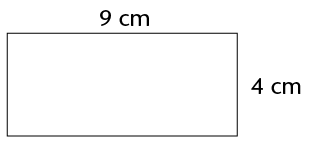
Find the area of this shape
13 cm
36cm²
13cm²
36cm

Find the area of this shape
49π inches squared
42π inches squared
153 inches squared
14π inches squared

Find the area of this shape
84 cm²
70 cm²
42 cm²
56 cm²

What is the area of the shaded region?
20 sq cm
4 sq cm
30 sq cm
24 sq cm
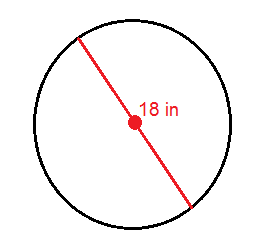
Find the area of the circle
18π squared units
81π squared units
36π squared units
324π squared units
What is the area of a circle with the diameter of 10cm ?
20π cm2
25π cm2
10π cm2
100π cm2
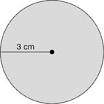
Find the area of the circle below.
6π cm2
3π cm2
9π cm2
36π cm2

What is the area of this circle?
8π m2
16π m2
64π m2
2π m2
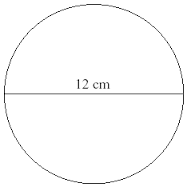
What is the radius of this circle?
12 cm
6 cm
24 cm
3 cm

Find the circumference of the circle.
28π in
196π in
14π in
7π in
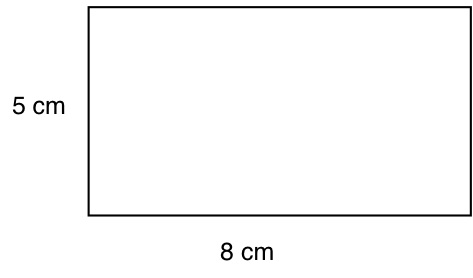
What is the area of the rectangle?
42 square cm
40 square cm
40 cm
42 cm
The area of a rectangle is 72 sq units. One side length is 9 units. What is the other side length?
9 units
7 units
10 units
8 units


Find the area of the kite.
315 in2
630 in2
180 in2
360 in2
Find the area of the kite.
315 in2
630 in2
180 in2
360 in2

Madalyn's dining room table is round and has a radius of 4.5 feet. What is the tabletop's area?
63.585 ft2
68.345 ft2
64.585 ft2
61.345 ft2

Find the area of the sector outlined in bold.
52.4 in2
18,864 in2
60 in2
10.47 in

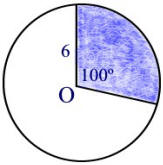
What is the formula for finding the area of a sector.
(360n)πr2
2πr
πr2

What is the name of the blue region?
A sector
A segment
A hooly bob
A central angle

What is the area of the shaded segment?
185.0619
88.9359
39.3078
5.7975
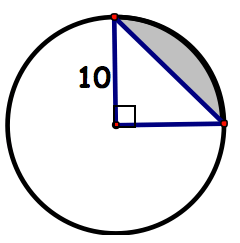
What is the area of the shaded segment? Leave your answer as an exact value.
25π - 50
25π - 100
5π - 50
5π - 100
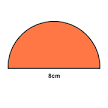
what is the area of this semicircle ?
100.48cm2
80cm2
200.96cm2
25.12cm2


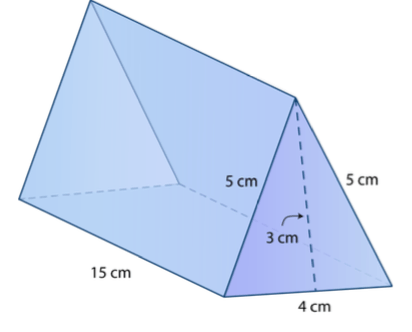
Calculate the volume. To find the volume find the area of the triangle base and multiply by the height of the figure. V=Bh, where B is area of triangle, h is length of rectangle.
90 cm³
150 cm³
180 cm³

S.A.=21(4πr2)
Find the surface area of the hemisphere (half a sphere)
339.3 in2
226.1in2
113.0 in2
452.2 in2
S.A.=4πr2 The surface area of a sphere of radius 14 cm is:
1386 sq.cm
1400 sq.cm
2464 sq.cm
2000 sq.cm
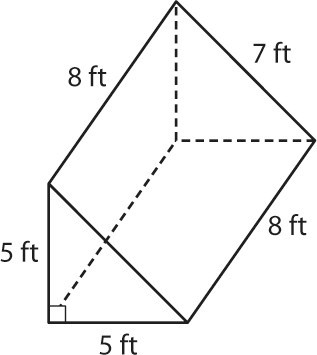
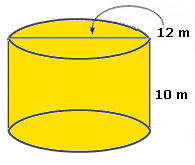

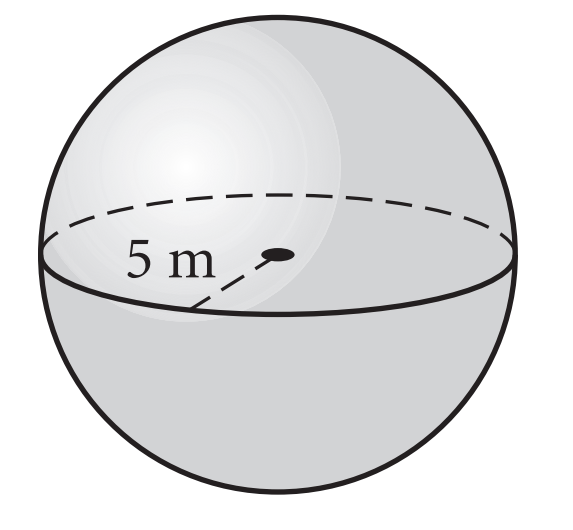
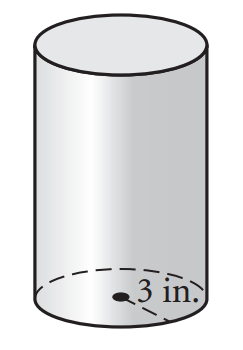
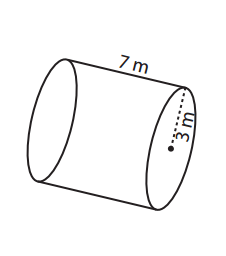
What does lateral mean when asked to find the lateral surface area?
Means the bases and no faces
Means just the faces
What is the difference between lateral area and total surface area?
Total surface area includes 1 base instead of 2 bases like lateral does
Lateral includes all the faces while total only includes the bases
Total surface area includes the base(s) and all the faces while lateral does not include the base(s)
Lateral just includes B, the area of the base while total does not
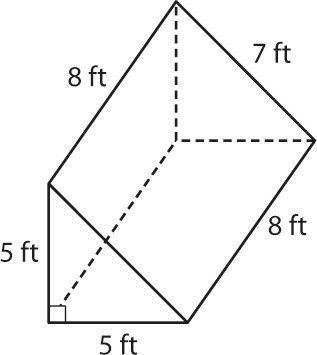

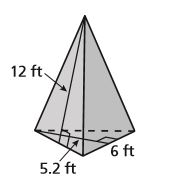
What is the slant height of the triangular pyramid?
12 feet
6 feet
5.2 feet

What is the lateral area of this shape?
150 ft2
360 ft2
225 ft2
250 ft2


