wayground logo

Free Printable Worksheets

NEW

Font size

S
M
L
XL
Worksheets

AP Human Geography, Units 1-4 Midterm Review

Total questions: 77

Worksheet time: 39mins

Name
Class
Date
1.
The location of a place using the latitude-longitude grid is called: 
a)
A.  referenced location 
b)
A.  central location
c)
A.  relative location
d)
A.  absolute location 
2.
The location of a place in relationship to other places or features around it is called: 
a)
absolute location
b)
relative location
c)
site
d)
situation
3.
Scale is…                                     
a)
the system used by geographers to transfer locations  from a globe to a map
b)
the extent of spread of a phenomenon over a given area
c)
 the difference in elevation between two points in an area
d)
 the relationship between the length of an object on a map and that feature on the landscape
4.
The process of the spread of an idea and/or dissemination of an innovation from its source area to other cultures, is the process of cultural: 
a)
diffusion
b)
simultaion
c)
adaptation
d)
movement
5.
The physical qualities of the original location for a city is referred to as the
a)
site
b)
situation
c)
relative location
d)
absolute location
6.
Billy thinks that in the south, everyone eats grits, eats fried chicken and watches football.  He would be creating what type of region of the south with these ideas?
a)
Formal
b)
Functional
c)
Perceptual
d)
Uniform
7.
Measuring the distance people are willing to travel to shop at a store would be creating what type of region for that store?
a)
Formal
b)
Perceptual
c)
Functional
d)
Uniform
8.
Geographers group like things together into regions in order to make them easier to study.  What type of region would a corn field be?
a)
Perceptual
b)
Formal
c)
Functional
d)
Vernacular
9.
The spread of ideas, inventions, or patterns of behavior is called ____.
a)
acculturation
b)
innovation
c)
cultural hearth
d)
diffusion
10.
Imaginary North-South line that passes through Greenwich, England, and has a value of 0 degrees
a)
latitude
b)
longitude
c)
relief
d)
scale
11.
What are lines on a globe drawn in an east-west direction and measured in degrees?
a)
longitude
b)
latitude
c)
grid
d)
equator
12.
Which of the following shows places on the Earth's surface the most accurately?
a)
thematic maps
b)
globes
c)
general-purpose maps
d)
physical maps
13.
The physical environment causes social and cultural development.
a)
Cultural Environmentalism
b)
Environmental Possibilism
c)
Environmental Determinism
d)
Cultural Possibilism
14.
Environment influences, but does not strictly determine, how a culture interacts with the environment.
a)
Environmental Determinism
b)
Environmental Possibilism
c)
Cultural Determinism
d)
Cultural Environmentalism
15.
This image demonstrates
a)
Regions
b)
Stimulus Diffusion
c)
Globalization
d)
None of the above
16.
Explain Thomas Malthus's population theory.
a)
He concluded that the world's population increase was higher than the development of food supplies.
b)
He concluded that crude birth rates must balance crude death rates.
c)
He concluded that population increased arithmetically while food production increased linguistically.
d)
He concluded that population growth was outpacing available resources in every country, according to algebraic calculations.
17.
Where are people most likely not to live?
a)
places that are too hot
b)
places that are too cold 
c)
places that are too high in elevation
d)
All the answers are correct
18.
What is the average number of births women bear in their lifetimes known as?
a)
total increase rate
b)
total fertility rate
c)
crude fertility rate
d)
crude birth rate
19.
What demographic feature has the most significant future implications?
a)
that the less developed countries have the highest combined crude death rate
b)
that the most rapid growth is occurring in the less developed countries
c)
that people are uniformly distributed across Earth
d)
that the natural increase rate is larger every year
20.

In what stage of the demographic transition are most European countries?

a)

1

b)

2

c)

3

d)

4

21.
What does an "upside down" population pyramid indicate?
a)
lots of children
lots of children
b)
lots of middle age people
c)
lots of elderly/older people
d)
lots of teens
22.
The ratio of people who are too young or too old to work compared to the working population is called the
a)
dependency ratio
b)
population pyramid
c)
interconnected ratio
d)
retirement ratio
23.

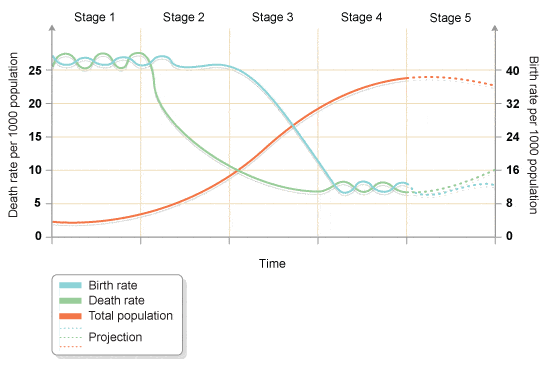
This caused a jump in the worlds' population in the late 1700's and helped send England into stage 2:

a)

the Renaissance

b)

the Industrial Revolution

c)

the Medical Revolution

d)

the Scientific Revolution

24.
The world's most populated region is 
a)
North America
b)
East Asia
c)
South Asia
d)
Africa
25.
A characteristic of stage 3 of the demographic transition shows
   
a)
High birth and death rates
b)
Low death and high birth rates
c)
Declining birth and death rates 
d)
High death and low birth rates
26.
What is the portion of earth's surface occupied by permanent human settlement?
a)
Ecumene 
b)
Census 
c)
Cohort 
d)
Pandemic
27.
Which of the following is a pull factor?
a)
Insufficient Food Supply
b)
High Crime Rate in Native Country
c)
Higher Paying jobs in New Country
d)
High Crime Rate in New Country
28.

Which of the following are part of EG Ravenstein’s (The Bloke with the cloke) Laws of Migration?

a)

most migrants are male

b)

most migrants move short distances

c)

most long distance migrants move to large urban areas

d)

all of the above

29.
According to Ravenstein’s Laws of Migration, which group is most likely to move?
a)
older adults
b)
younger adults
c)
children
d)
families
30.
What is the internal migration pattern as seen in the US?
a)
South and West
b)
North and East
c)
North and West
d)
South and East
31.
Which areas of the world generally have net out-migration?
a)
Asia and North America
b)
Africa and Europe
c)
Africa and Asia
d)
Latin America and Europe
32.
Most migrants move for 
a)
economic reasons
b)
cultural reasons
c)
environmental reasons
d)
persecution reasons
33.
Brain drain is
a)
when you can't come up with the answer on a test
b)
emigration from MDCs to LDCs
c)
emigration of talented and smart people
d)
forcing emigration for political reasons
34.

A country with a large amount of arable land and a small number of farmers will have a

a)

low arithmetic density

b)

high physiological density

c)

low agricultural density

d)

high agricultural density

35.

If the physiological density in a given country is very high and its arithmetic density is very low, then a country has

a)

too many people for the available resources, particularly in regards to agricultural land.

b)

too few farmers for the large area of land suitable for agriculture.

c)

a large number of farmers, although the number of farmers is not as great as the number of people living in the cities.

d)

a small percentage of land suitable for agriculture, even if there seems to be plenty of space available to live in.

36.

A decline in a country's crude birth rate would result in an increase in that country's

a)

life expectancy

b)

doubling time

c)

total fertility rate

d)

natural increase rate

37.

Which is an example of a custom?

a)

Alice prays before each of her AP Human Geography tests.

b)

Hindus making a pilgrimage to the Ganges River.

c)

Lucas and his friends watch cartoons afterschool.

d)

All Americans going to church on Sunday.

38.

Which is not a characteristic of folk culture

a)

homogeneous

b)

rural

c)

heterogeneous

d)

static

e)

diffuses slowly

39.

Rapid diffusion...

a)

causes major changes in folk culture.

b)

facilitates frequent changes in popular culture.

c)

has slowed the effects of globalization.

d)

has decreased the number of available hearths for popular culture.

40.

Which of the following concepts is represented by the image?

a)

distance decay

b)

sense of place

c)

globalization of culture

d)

economies of scale

41.

Which of the following is the best example of a cultural element being spread by stimulus diffusion?

a)

the outbreak of influenza in folk regions of Europe

b)

Walmart opening in metropolitan urban cores

c)

Rock and Roll music in the United Kingdom

d)

McDonald's in India serving Maharajah Macs

42.
Typically, popular culture
a)
originates in a number of locations at the same time.
b)
reflects the characteristics of a distinctive physical environment.
c)
experiences frequent changes through time and space.
d)
is practiced by small homogeneous groups.
43.
Folk cultures are spread primarily by
a)
contagious diffusion
b)
hierarchical diffusion
c)
relocation diffusion
d)
stimulus diffusion
44.

When languages are depicted as leaves on trees, the trunk of the tree represents

a)

dialects

b)

language groups

c)

language families

d)

creolized languages

45.

Which of the following was NOT a Germanic speaking people that influenced the English language?

a)

Angles

b)

Saxons

c)

Jutes

d)

Normans

46.

Why is English the most widely spoken language in Canada and the U.S.?

a)

The Norman Conquest

b)

Viking Explorations of the New World

c)

British Colonialism

d)

The Internet

47.

What branch of the Indo-European language family does English belong to?

a)

Germanic

b)

Romance

c)

Slavic

d)

Indo-Iranian

48.

What language family is French a member of?

a)

Sino-Tibetan

b)

Austronesian

c)

Indo-European

d)

Altaic

49.

What does Colin Renefrew claim is the reason the Indo-European language spread?

a)

war

b)

conquest

c)

farming

d)

disease

50.

What language is spoken in the northern part of Belgium?

a)

Flemish/Dutch

b)

French

c)

English

d)

German

51.

What is the second largest language family?

a)

Indo-European

b)

Afro-Asiatic

c)

Sino-Tibetan

d)

Austronesian

52.

As opposed to other languages that are phonetic, Chinese _____________ are not.

a)

isolines

b)

videograms

c)

logograms

d)

letters

53.
Cultural identity through shared traits such as language or religion
a)
Race
b)
Ethnicity
c)
Habit
d)
Culture
54.
A historical term used to reference where an ethnic minority is forced to live
a)
Concentration Camp
b)
Asylum
c)
Ghetto
d)
Prison
55.
Detroit is an example of this settlement
a)
Squatter Settlement
b)
Suburb
c)
Spatial divide
d)
Ethnic Enclave
56.
Classification system based on physical characteristics of humans
a)
Race
b)
Ethnicity
c)
Culture
d)
Statute
57.
The killing of a racial or ethnic group by another racial or ethnic group
a)
Ghetto
b)
Herbicide
c)
Centripetal Force
d)
Genocide
58.
In which of the following places has a genocide not been attempted?
a)
Rwanda
b)
Darfur
c)
Cambodia
d)
Mexico
59.
The study of human political organization of the Earth
a)
Cultural Geography
b)
Ethnography
c)
Deography
d)
Political Geography
60.
Creating ownership over a defined space, either personal, or publicly
a)
Sovereignty
b)
Territoriality
c)
Spatial Recognition
d)
Encomienda
61.
Internationally recognized control over people and territory
a)
Territoriality
b)
Spatial analysis
c)
Sovereignty
d)
Repartimiento
62.
Which of the following would best fit the description of a State?
a)
Alabama
b)
Hawaii
c)
The South
d)
Japan
63.
Which of the following is not a qualification of the State?
a)
Permanent population
b)
An effective government
c)
A working economy
d)
A killer soccer team
64.
Which of the following is not a part of the United Kingdom?
a)
England
b)
Ireland
c)
Scotland
d)
Wales
65.
The first types of "States" were
a)
Roman Empire states
b)
City-states
c)
Aztec provinces
d)
Chinese satraps
66.
Who was the developer of the Heartland Theory
a)
Nicolas Spykman
b)
Friedrich Ratzel
c)
Halford Mackinder
d)
James Monroe
67.
Who developed the Organic State Theory?
a)
Friedrich Ratzel
b)
Halford Mackinder
c)
Nicolas Spykman
d)
James Monroe
68.
Who developed the Rimland Theory?
a)
Halford Mackinder
b)
Friedrich Ratzel
c)
James Monroe
d)
Nicolas Spykman
69.
A region where boundaries are very thinly or weakly developed, zones where territoriality is unclear and not well established.
a)
Frontier
b)
Shatterbelt
c)
Buffer State
d)
Satellite State
70.
A state or group of states that exists within a sphere of competition between larger states and is often culturally, economically, and politically fragmented and splintered.
a)
Frontier
b)
Satellite States
c)
Shatterbelt
d)
Buffer State
71.
An independent country located between two larger countries that are in conflict.
a)
Satellite State
b)
Buffer State
c)
Shatterbelt
d)
Frontier
72.
A state with only one nation within its borders
a)
Stateless-Nation
b)
Nation-State
c)
Ethnocentric Nation
d)
Statehood
73.
A conflict that occurs between different nations
a)
Civil War
b)
Nation-State War
c)
Ethnocentrism
d)
Ethnonational Conflict
74.
a state that contains more than one ethnicity.
a)
United States
b)
Multi-Cultural State
c)
Multi-Ethnic State
d)
Nation-State
75.
a country that contains more than one ethnicity with traditions of self-determination.
a)
Multi-Ethnic State
b)
Multi-National State
c)
Stateless Nation
d)
Nationalism
76.
a sovereign state that comprises a town and the surrounding countryside.
a)
Nation-State
b)
City-State
c)
Stateless Nation
d)
National State
77.
The concept that ethnicities have the right to govern themselves.
a)
Self-determination
b)
Nationalism
c)
Predestination
d)
Nation-State