
 Worksheets
Geometry 1st Semester Review (through 5-3)
Total questions: 130
Worksheet time: 5hrs 2mins

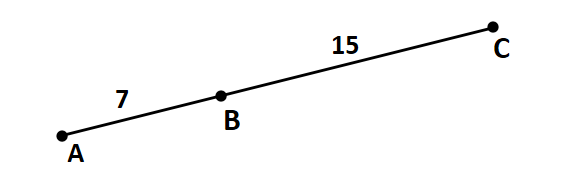
Let B be between A and C.
AC = 3x + 3 , AB = -1 + 2x, and
BC = 11. Find the value of x.
7
24
13
14


Find m∠NME.
50°
58°
115°
226°

Given m∠JHG = 161°.
m∠GHK = 80.5°,
m∠KHJ = 161°
m∠GHK = 161°
m∠KHJ = 80.5°
m∠GHK = 80.5°,
m∠KHJ = 80.5°
m∠GHK = 161°,
m∠KHJ = 161°


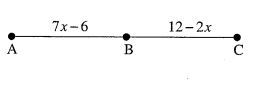

What is the midpoint between (3, -1) and (7, -5)?
(5, -2)
(10, -6)
(5, -3)
(2, -2)
If an obtuse angle is bisected, the resulting angles are ________
sometimes acute
always acute
always obtuse
right angles
1, 1, 2, 3, 5, 8, 13, ...

Which is a counterexample of:
The difference of two numbers is less than the greater number.
(5) - (2) = 3
(-5) - (4) = -9
(2) - 0 = 2
(3) - (3) = 0
If the nonshared sides of two adjacent angles form a pair of opposite rays, then the angles form _____________
vertical angles
complementary angles
acute angles
a linear pair


What is the hypothesis of the given Conditional Statement?
"If Jimmy goes on vacation, then he will go to Orlando. "
Jimmy will go to Orlando
Jimmy goes on vacation
Jimmy will go to Orlando
Who is Jimmy?
What is this statement: If the reception is at the country club, then Maria will be getting married.
Given, "If I have a Siberian Husky, then I have a dog."
Identify the inverse.
If I do not have a Siberian Husky, then I do not have a dog.
If I have a dog, then I have a Siberian Husky.
If I do not have a dog, then I do not have a Siberian Husky.
If I do not have a Siberian Husky, then I have a dog.
Given, "If I have a Siberian Husky, then I have a dog."
Identify the contrapositive.
If I do not have a Siberian Husky, then I do not have a dog.
If I have a dog, then I have a Siberian Husky.
If I do not have a dog, then I do not have a Siberian Husky.
If I do not have a Siberian Husky, then I have a dog.
Given, "If angles are congruent, then the measures of the angles are equal."
Identify the converse.
If the measures of the angles are equal, then the angles are congruent.
"If angles are not congruent, then the measures of the angles are not equal."
If the measures of the angles are not equal, then the angles are not congruent.
If the angles are not congruent, then the measure of the angles are equal.
Given, "If angles are congruent, then the measures of the angles are equal."
Identify the inverse.
If the measures of the angles are equal, then the angles are congruent.
"If angles are not congruent, then the measures of the angles are not equal."
If the measures of the angles are not equal, then the angles are not congruent.
If the angles are not congruent, then the measure of the angles are equal.
What is the contrapositive to this?
"If food is in the oven, then it will be cooked."
If the food is not cooked, then it is not in the oven.
If the food is not in the oven, then it is not cooked.
If the food is cooked, then its in the oven.
If food is not in the oven, then its cooked.
A biconditional statement..
is an "if/then" statement
uses the phrase "if and only if"
is the first part of a statement
is the second part of a statement
What is the biconditional that matches the statement:
"A right angle is an angle with 90 degrees."
If an angle has 90 degrees, then it is a right angle.
If an angle is a right angle, then it has 90 degrees.
An angle is a right angle if and only if it has 90 degrees.
Which type of reasoning is a process of reasoning using given and revious known facts to reach a logical conclusion.
A Proof
Intelligent Thought
Inductive Reasoning
Deductive Reasoning
Using the Law of Detatchment and the following true statements, what is a true conclusion.
*If you can play the piano, then you can play an musical instrument.
*Kiyo can play the piano.
Kiyo can play a musical instrument.
Kiyo can read music.
The piano is a musical instument.
Use the Law of Syllogism to write a true conditional statment given the two true statements.
If Zachary eats pasta for dinner, then he goes to bed early.
If it is Tuesday night, then Zachary eats pasta for dinner.
If it is Tuesday night, then Zachary goes to bed early.
If Zachary eats pasta for dinner, then is it Tuesday night.
If Zachary goes to bed early, then he goes to bed early.
Name the property that the statement illustrates.
If ∠A ≅ ∠B and ∠B ≅ ∠C, then ∠A ≅ ∠C.
Reflexive Property of Congruence
Transitive Property of Congruence
Definition of Congruence
Symmetric Property of Congruence
Name the property that the statement illustrates.
∠G ≅ ∠G
Symmetric Property of Congruence
Definition of Congruence
Reflexive Property of Equality
Reflexive Property of Congruence
Name the property that the statement illustrates.
If m∠A + m∠B = 70° and m∠B = 40°, then m∠A + 40° = 70°
Substitution Property
Transitive Property
Definition of Complementary Angles
Transitive Property
Name the property that the statement illustrates.
If ∠K ≅ ∠B, then ∠B ≅ ∠K
Symmetric Property
Definition of Congruence
Definition of Angle Bisector
Reflexive Property

Angles R and C are...
Alternate Interior Angles
Same-Side Interior Angles
Corresponding Angles
Alternate Exterior Angles
Angles D and P are...
Alternate Interior Angles
Same-Side Interior Angles
Corresponding Angles
Alternate Exterior Angles
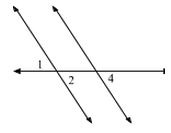
Given m∠ 1 = 27o, find m∠ 4
27o
153o
63o
90o
Angles C and P are...
Alternate Interior Angles
Same-Side Interior Angles
Corresponding Angles
Alternate Exterior Angles


Which reason explains why the two lines are parallel?
Corresponding Angles Converse
Alt. Interior Angles Converse
Alt. Exterior Angles Converse
Same-Side Interior Angles Converse
Not Enough Information to Prove Parallel

Which reason explains why the two lines are parallel?
Corresponding Angles Converse
Alt. Interior Angles Converse
Alt. Exterior Angles Converse
Not Enough Information to Prove Parallel
Vertical Angles Theorem
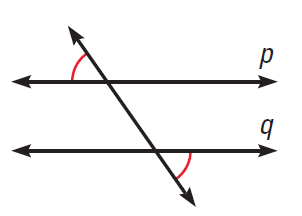
Which reason explains why the two lines are parallel?
Corresponding Angles Converse
Alt. Interior Angles Converse
Alt. Exterior Angles Converse
Same-Side Int. Angles Converse
Not Enough Information to Prove Parallel
Find the slope of the line that passes through
(-4, 7) and (-6, -4)
112
−112
211
−211
Tell whether the lines through the points are parallel, perpendicular, or neither.
Line 1: (3, 6) and (8, 10)
Line 2: (-4, 2) and (0, -3)
parallel
perpendicular
neither
Which line is perpendicular to y=2x−7 ?
y=−2x+8
y=21x−7
y=−21x+2
y=2x−3
Which line is parallel to y=2x−7 ?
y=−2x+8
y=21x−7
y=−21x+2
y=2x−3
What is the slope of the line with the given equation? 7x+5y=−10
7
−57
−75
-2
Write the equation of a line PARALLEL to y = 3x + 7 that passes through the point (1, 5).
y = 3x - 14
y = 3x + 2
y=31x+6
y=31x−4
Write the equation of a line PERPENDICULAR to y = -2x + 1 that passes through the point (2, 3).
y=−21x+21
y=21x+2
y=−2x+7
y=−2x+8


Find the indicated angle measure. (What is ?)
51°
37°
167°
41°

Find m∠A.
44o
96o
-14o
63o


The Base Angles Theorem (Isosceles Triangle Theroem) states:
If two angles of a triangle are congruent, then the sides opposite of those angles are congruent.
If two sides of a triangle are congruent, then the angles opposite of those sides are congruent.
If two triangles are congruent, then their corresponding sides and angles are congruent.
None of the above.


What is the m∠ 2?
50°
65°
115°

What is the value of x?
60
45
70
10

Complete the congruence statement.
∆JIK ≅
∆TRS
∆RST
∆STR
∆TSR

Complete the congruence statement
∆ISR ≅
∆TRS
∆RST
∆STR
∆TSR
Given: ΔPET≅ΔDOG
Which of the following are TRUE
∠P≅∠D
TE≅GO
∠T≅∠O
TP≅GD
TE≅OG

Given ∆JMT ≅ ∆HSP
m∠J =
73°
48°
59°

Given ∆JMT ≅ ∆HSP
JM ≅
HS
PH
PS

ΔABC≅ΔDEF. Find the value of y.
40
35
22.5
32.5


ΔABE ≅ Δ_____ by _____
ΔCDE , ASA
ΔEDC , AAS
ΔCDE , AAS
Cannot Be Determined

ΔWAT ≅ Δ_____ by _____
ΔTRE , ASA
ΔTER , ASA
ΔTER , AAS
Cannot Be Determined

ΔVWX ≅ Δ_____ by _____
ΔYZX by AAS
ΔYXZ by AAS
ΔYZX by ASA
ΔYXZ by ASA

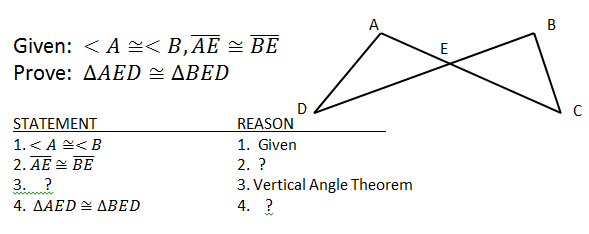
Which of the following is a correct statement and reason for the proof shown?
∠P≅∠Q ; SAS
∠P≅∠Q ; CPCTC
∠P≅∠Q ; SSS
∠P≅∠Q ; SSA


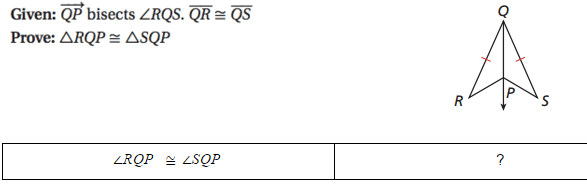

What is #2 Reason?
Perpendicular Lines
Perpendicular Bisector
Reflexive Property
Segment Bisector



How would you describe this tranformation?
rotation of 90 degrees
reflection across x-axis
reflection across y-axis
translation right 6
Translation, Reflection and Rotation are all ______ tranformations.
Rigid
Non-Rigid
The vertices of ΔABC are A(4, -4), B(-1, -2), and C(5, 4).
What are the coordinates of A', B ' and C ' after the tranlstion
T(−3,−5)(ΔABC)
(1, -9)
A'
(-4, -7)
B '
(2, -1)
C '


State the image of the point.


T<2, −1>
T<−1, 2>
T<1, −2>
T<−2, 1>

Two parallel lines are 7 units apart. If you reflect a figure over both lines how far apart will the pre-image and final image be?
7 units
14 units
4 units
2 units

T<-4,0> o Ry axis
T<0,-4> o Ry axis
Ry axis o T<0,-4>

How many lines of symmetry does this shape have?
This a regular octogon, an 8 sided figure.
2
4
6
8

How many lines of symmetry does this shape have?
4
5
6

What is the smallest degree of rotation that will map this shape onto itself?
(a)
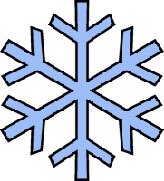
Determine whether the figure has line symmetry, rotational symmetry, both, or neither.
Rotational
Reflectional
Both
Neither


Find the measure of EH.
(a)
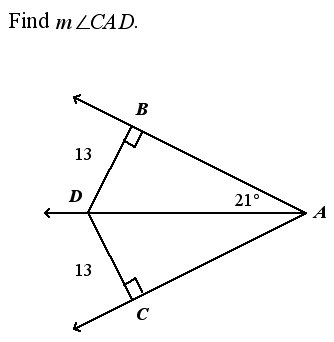
Find the measure of angle CAD.





Find BD.
BD = 20
BD = 2
BD = 4
BD = 10
If a point is equidistance from the endpoints of the segment, then it is on the perpendicular bisector of a segment.
True
False
What is the special property for circumcenters?
The circumcenter is equally distant to the sides of the triangle.
The circumcenter is equally distant to the midpoint of the sides of the triangle.
The circumcenter is at the center of the triangle.
The circumcenter is equally distant to the vertices.
Match the special segment with its point of concurrency.
Perpendicular Bisectors
Circumcenter
Angle Bisectors
Incenter
Medians
Centroid
Altitudes
Orthocenter


Find ZQ
9
4
15
18

P is the incenter of triangle JKL. Find OP.
8
13
17
4

