wayground logo

Free Printable Worksheets

Font size

S
M
L
XL
Worksheets

1st Semester Comprehensive Exam

Total questions: 50

Worksheet time: 3575secs

Name
Class
Date
1.

Movement of a substance from an area of high concentration to low concentration.

a)

Diffusion

b)

Hypotonic

c)

Isotonic

d)

Passive Transport

2.
DNA and RNA are examples of 
a)
Carbohydrates
b)
Lipids
c)
Proteins
d)
Nucleic Acids
3.
Osmosis is the movement of _____ across a membrane.
a)
food
b)
energy
c)
oxygen
d)
water
4.

What is the green pigment that "traps" sunlight?

a)

Chlorophyll

b)

Cellular respiration

c)

Photosynthesis

d)

ATP

5.
What is the ultimate ORIGINAL source of energy for living things
a)
Sugar
b)
Sun
c)
Moon
d)
Carbon Dioxide
6.

What gas do plants give off after conducting photosynthesis that humans/animals need in order to live?

a)

Oxygen

b)

Carbon

c)

Nitrogen

d)

Hydrogen

7.
A cell in an isotonic solution will
a)
swell
b)
shrink
c)
stay the same size
d)
impossible to tell
8.

Identify the cellular organelle that the process of cellular respiration occurs in:

a)

mitochondria

b)

chloroplast

c)

nucleus

d)

golgi

9.

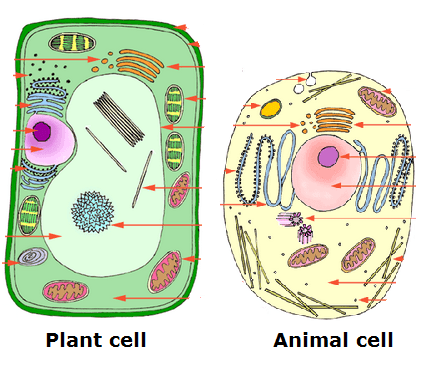
What distinguishes a plant cell from an animal cell? (How do you tell them apart) Hint: There's 3 ways (Check all 3)

a)

Central Vacuole

b)

Mitochondria

c)

Cell Wall

d)

Ribosomes

e)

Chloroplasts

10.
Robert Hooke, Anton van Leeuwenhoek, Theodor Schwann, Rudolf Virchow, and Matthias Schliden were all responsible for what theory?
a)
The Theory of Gravity
b)
The Theory of Relativity
c)
The Cell Theory
d)
The Theory of Continental Drift
11.
All cells come from___________ cells.
a)
pregnant
b)
pre-existing
c)
paternal
d)
pin size
12.
If you do not understand a direction or part of a lab procedure, you should
a)
figure it out as you do the lab
b)
try several methods until something works
c)
skip it and go to the next part
d)
ask your teacher
13.
The proper technique for smelling chemicals is ______________
a)
keeping your nose close to the glassware
b)
wafting
c)
to sniff only a small amount
d)
Trick question; you never are allowed to smell chemicals in class
14.

What does it mean for a tumor to metastasize?

a)

shrink

b)

spread

c)

to get better

d)

to repair cells

15.
Another name for a sex cell is a:
a)
gamete
b)
embryo
c)
bone cell
d)
muscle cell
16.
The process on the left is:
The process on the right is:
a)
Left: meiosis
Right: meiosis
b)
Left: meiosis
Right: cloning
c)
Left: mitosis
Right: meiosis
d)
Left: mitosis
Right: mitosis
17.

This cell is in which phase?

a)

prophase

b)

metaphase

c)

anaphase

d)

telophase

18.

A process where one cell forms two identical daughter cells is called

a)

mitosis

b)

interphase

c)

cytokinesis

d)

meiosis

19.

Agents that can cause cancer are called __________.

a)

Mutagen

b)

Carcinogen

c)

Oncogen

d)

Pathogen

20.

Which type of tumor is dangerous and spreads rapidly across bodily systems via blood and lymphatic systems?

a)

benign

b)

malignant

21.
What phase is this cell in ?
a)
telophase
b)
prophase
c)
metaphase
d)
ananphase
22.
How many chromosomes are in a healthy human body cell (not a sex cell)?
a)
8
b)
23
c)
46
d)
50
23.
Name the phase:
a)
Anaphase
b)
Telophase
c)
Metaphase
d)
Prophase
24.
Uncontrollable cell growth is known as _____
a)
obesity
b)
cancer
c)
diabetes
d)
hepatitis
25.
Structure B is pointing to the _____. 
a)
chromosome
b)
centromere
c)
DNA
d)
chromatid
26.
Structure C is pointing to one ____. 
a)
sister chromatid
b)
chromosome
c)
centromere
d)
gene
27.
The cell spends most of it's life in ________________.
a)
mitosis
b)
cytokinesis
c)
Interphase
d)
None of the above
28.

Cytokinesis is the complete division of the cytoplasm resulting in the creation of two identical cells called _____.

a)

children cells

b)

new cells

c)

daughter cells

d)

son cells

29.
Which of these phases of mitosis take place first?
a)
anaphase
b)
telophase
c)
prophase
d)
metaphase
30.
a)
Anaphase
b)
Cytonkinesis
c)
Interphase
d)
Prophase
31.
Structure (a) is a ____.
a)
chromosome
b)
chromatid
c)
centromere
32.
The daughter cells in mitosis are...
a)
Identical
b)
Unique
33.
Sperm and Egg cells are produced using which process?
a)
Mitosis
b)
Meiosis
c)
Binary Fission
d)
None of these
34.
Doctor who specializes in treating cancer.
a)
Oncologist
b)
Epidemiologist
c)
Dermatologist
d)
Neurologist
35.

These are examples of:


  • Surgery
  • Chemotherapy
  • Radiation
a)

Treatments for Cancer

b)

Mutations

c)

Examples of Asexual Reproduction

d)

Types of Tumors

36.

The structure that X is pointing to is called a ________.

a)

centriole

b)

centromere

c)

chromosome

d)

anaphase

37.

Why do cells go through mitosis?

a)

to make food from sunlight

b)

to get air into the cells

c)

to create proteins

d)

to grow, repair, and replace cells

38.

What is the major difference between a prokaryote and a eukaryote?

a)

prokaryotes do not have a nucleus

b)

prokaryotes do not have ribosomes.

c)

prokaryotes do not have a cell membrane.

d)

prokaryotes do not contain DNA

39.
What organelle is responsible for energy production?
a)
nucleus
b)
mitochondria
c)
ribosome
d)
cell membrane
40.

The function of flagella is:

a)

Movement

b)

Provide Energy

c)

Protection

d)

Make Proteins

41.

If the lysosome were a part of the city it would be the:

a)

Mayor - controls the cell

b)

Waste management - digests cell waste and cleans up

c)

Farms- synthesizes proteins

d)

Water tower - stores water

42.
An autotroph is an organism that can ?
a)
make its own food.
b)
grow its own food
c)
kill and eat other organisms.
d)
play ball with you. 
43.
Waxes, oils and fats are examples of
a)
Carbohydrates
b)
Lipids
c)
Proteins
d)
Nucleic Acids
44.
What are the four macromolecules?
a)
proteins, nucleic acids, carbohydrates, and lipids
b)
monosaccharides, lipids, polysaccaharides, and proteins
c)
RNA, DNA, proteins, and carbohydrates
d)
proteins, DNA, RNA, and steroids
45.
What do all viruses need to reproduce?
a)
They need host genetic material
b)
They need a host cell
c)
They need bacteria
d)
They need insulin
46.
What structure is responsible for making proteins?
a)
Nucleus
b)
Mitochondria
c)
Golgi Apparatus
d)
Ribosome
47.
What is the difference between rough and smooth Endoplasmic Reticulum?
a)
There is no difference.
b)
Plants have rough ER, animals have smooth ER.
c)
What type of injuries the Doctors treat.
d)
Rough has ribosomes, smooth does not.
48.

Which process does not require the use of cellular energy to transport materials into or out of a cell?

a)

cellular respiration

b)

active transport

c)

passive transport

d)

vacuole

49.
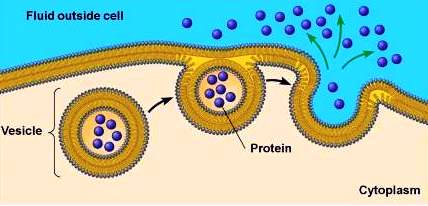
Which form of active transport is being shown?
a)
Pinocytosis
b)
Endocytosis
c)
Exocytosis
d)
Osmosis
50.

The maintenance of an organism’s internal environment so that it remains stable is called:

a)

compensating

b)

homeostasis

c)

balancing

d)

routine