
 Worksheets
Semester Test
Total questions: 125
Worksheet time: 7hrs 29mins
Name the 3 subatomic particles
Proton, Neutron, Quantum
Proton, Neutron, Electron
Negative, Positive, Neutral
Walter White, Rutherford, Coach Reid
A proton has a __________ charge.
positive
negative
neutral
An electron has a ______________ charge.
Positive
Negative
Neutral
A neutron has a ____________ charge
positive
negative
neutral
___________________ discovered the proton.
Chadwick
Dalton
Rutherford
_________________ discovered the electron.
Thompson
Dalton
Walter White
________________ discovered the neutron.
Walter White
John Smith
Chadwick.
This subatomic particle identifies the element.
Proton
Neutron
Megatron
This subatomic particle, in particular the ones in the outer shell determine reactivity.
Proton
Neutron
Electron
The gold foil experiment determined that___________
the nucleus is large
that electrons are negative
the nucleus is small, dense, and positively charged.
A cathode ray tube was used to discover this subatomic particle.
Proton
Mega
Electron
In a stable element the number of _____________ equals the number of ______________.
protons, electrons
neutrons, electrons
protons, neutrons
The atomic number represents the number of ______________
protons plus neutrons
neutrons
protons
The mass number is the number of ___________ plus ___________.
protons, neutrons
protons, protons
electrons, protons
An isotope has different number of__________________.
neutrons
protons
electrons
Electrons in the outermost shell are called _______________.
lost electrons
neutral electrons
reactive electrons
valence electrons
_________________ invented the periodic table.
Bohr
Dalton
White
Mendelev
The modern periodic table is arranged by this subatomic particle.
proton
neutron
electron
A _______________ runs horizontally(left to right) on the periodic table
Period
Group
Neutron
A _____________ runs up and down on the periodic table.
Group
Period
Sub Shell
Elements in a group react similarly because they have the same number of_______________.
Protons
Shells
Valence Electrons
Another name for a group is a ________________.
Period
Quantum
Family
Group 1 elements are called___________________.
Non Metals
Alkali Earth
Alkali
Group 18 elements are called___________________.
Noble Gases
Alkali
Halogens
Transition Metals
Group 2 elements are called__________________.
Alkali Earth
Protons
Stable
Halogens
Group 17 elements are called_______________.
Halogens
Noble Gases
Alkali
Metals
The most reactive elements are in groups___________
2 and 18
17 and 18
1 and 2
1 and 17
The most stable elements are in group______.
1
5
13
18
How many valence electrons are in group 18?
Full or 8
Full or 1
7
18
A ion is an atom with a ___________________.
Proton
Electron
Charge
A cation has a ______________ charge
positive
neutral
negative
An anion has a _____________ charge.
positive
negative
neutral
A metal tends to lose electrons and will have a ____________ charge.
positive
no charge
negative
A non-metal tends to gain electrons and will have a ___________ charge.
positive
negative
neutral
In which group would an element that is not reactive most likely be located?
1
2
16
18
KF
Cr3+ O2-
K1+ S2-
How many valence electron does Oxygen (O) have?
2
8
6
7
What is the charge of Sodium (Na)?
+1
-1
0
+2
What is the charge of Chlorine (Cl)?
+1
-1
0
-2

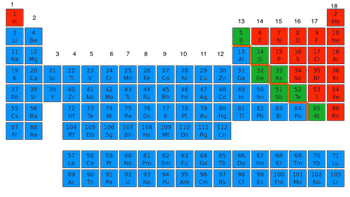
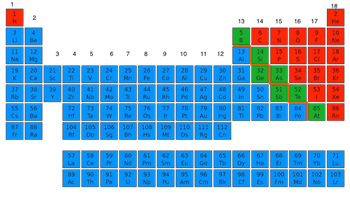
Which element has 3 valence electrons?
A
B
E
C

Which element has the highest electronegativity?
In which group would an element that is a gas most likely be located?
1
3
12
18


This is a picture of a
Beaker
Graduated Cylinder
Test tube
Flask

What kind of physical property is this? Density
intensive
extensive
What kind of physical property is this? Volume
intensive
extensive

Tearing paper into small pieces is an example of a
Mixture
Physical change
Chemical change
Which of the following is a chemical change?
Cutting bread
Slicing carrots
Melting butter
Soured milk
Which of the following is a physical change?
Ice melting
Baking potatoes
Rusty nail
Rotting wood
Identify the following compound as ionic or covalent: MgO
ionic
covalent
Identify the following compound as ionic or covalent: Na2SO4
ionic
covalent
Identify the following compound as ionic or covalent: CF4
ionic
covalent
Identify the following compound as ionic or covalent: CO
ionic
covalent
When naming covalent compounds...
You need roman numerals and no prefixes
You do not need roman numerals or prefixes
You need roman numerals and prefixes
You do not need roman numerals but you do need prefixes


The nucleus of an atom contains which subatomic particles?
protons and electrons
protons and neutrons
electrons and neutrons
protons, electrons, and neutrons
A substance that is 3 on the pH scale would be a(n):
acid
base
neutral
solute
Neutral solutions have a pH of:
0
1
7
14

Vinegar is an example of:
An acid.
A base.
Neither an acid nor a base.
H3PO4
hydrophsophorus acid
phosphoric acid
hydrogen phosphorous
phosphori hydroxide
1s2 2s2 2p6 3s2
Fe(NO3)2
2Fe2O3 + 3C --> 4Fe + 3 CO2
When wavelength increases...
energy decreases
energy increases
As wavelength decreases...
energy increases
energy decreases
the distance between peaks of electromagnetic waves is called:
wavelength
frequency
energy
Planck's Constant
Which type of electromagnetic energy carries the least energy?
X-Rays
Visible Light
Ultraviolet
Microwaves
How are the elements on the periodic table arranged?
Atomic mass
Atomic number
State of matter
Type of element (metal, nonmetal, metalloid)
Which of the following elements has 7 valence electrons?
Sodium (Na)
Aluminum (Al)
Fluorine (Fl)
Calcium (Ca)
Which of the following is a metal?
Calcium (Ca)
Neon (Ne)
Oxygen (O)
Sulfur (S)
Which of these is a transition metal?
Sodium
Copper
Argon
Aluminium
Transition metals usually only form 1 type of ion - true or false?
True
False


How do you find out the number of neutrons in an atom?
atomic number
atomic mass - valence electrons
charge
mass number - atomic number
The central region of an atom where its neutrons and protons are is its
nucleus
electron cloud
core
center

