wayground logo

Free Printable Worksheets

Font size

S
M
L
XL
Worksheets

Biology Final Exam Review 2

Total questions: 55

Worksheet time: 2hrs 50mins

Name
Class
Date
1.

Which organelle is responsible making food (Glucose) using sunlight?

a)

Ribosomes

b)

Nucleus

c)

Chloroplast

d)

Mitochondria

2.

Select all that are reactants for Photosynthesis.

a)

Water

b)

Carbon Dioxide

c)

Oxygen

d)

Sunlight (Light Energy)

e)

Glucose (Sugar/food)

3.

Select all that are products of Photosynthesis.

a)

Water

b)

Carbon Dioxide

c)

Oxygen

d)

Sunlight (Light Energy)

e)

Glucose (Sugar/food)

4.
Why do plants conduct photosynthesis?
a)
To make light
b)
To make mitochondria
c)
To make glucose
d)
To release carbon dioxide
5.
Which of these conditions would decrease the rate of photosynthesis in a plant?
a)
Above average precipitation
b)
Changing the daylight hours from 14 hrs to 10 hrs
c)
Changing the CO2 concentration from 380 ppm to 410 ppm
d)
All of these choices
6.
Which choice correctly shows the gases that enter and exit plants during photosynthesis?
a)
Enter: Oxygen
Exit: Carbon dioxide
b)
Enter: Water vapor
Exit: Glucose
c)
Enter: Carbon dioxide
Exit: Oxygen
d)
Enter: Light
Exit: Water vapor
7.

Which of the following is the correct equation for Photosynthesis?

a)

light + carbon dioxide + water → glucose + oxygen

b)

carbon dioxide + sugar + water → oxygen + light

c)

oxygen + light + water → carbon dioxide + sugar

d)

carbon dioxide + oxygen + water → Light+ Sugar

8.
Which organisms perform Photosynthesis?
a)
Only Autotrophs
b)
Only Heterotrophs
c)
Autotrophs and Heterotrophs
9.

What is the source of energy for living things

a)

Sugar

b)

Sun

c)

Moon

d)

Carbon Dioxide

10.
What is the pigment in chloroplasts that performs photosynthesis?
a)
Chlorosynthesis
b)
Chlorophyll
c)
ADP
d)
Electron Transport
11.
What is photosynthesis?
a)
The process in which humans eat their food
b)
When a photographer takes a photo.
c)
To get your pictures from the photo lab.
d)
The process in which plants make their food.
12.
What is one of the reactants of cellular respiration?
a)
energy
b)
glucose
c)
carbon dioxide
d)
water
13.
In which way are photosynthesis and cellular respiration different?
a)
Cellular respiration stores ATP, while photosynthesis releases ATP.
b)
Cellular respiration produces oxygen, while photosynthesis uses oxygen.
c)
Photosynthesis releases energy, while cellular respiration stores energy.
d)
Photosynthesis used carbon dioxide, while cellular respiration produces carbon dioxide.
14.

What is the correct equation for cellular respiration?

a)

6O2 + C6H12O6 → 6CO2 + 6H2O + Energy

b)

6O2 + C6H12O6 + Energy → 6CO2 + 6H2O

c)

6CO2 + 6H2O → 6O2 + C6H12O6 + Energy

d)

6CO2 + 6H2O + Energy → 6O2 + C6H12O6

15.
Cellular Respiration's goal is to
a)
make water
b)
make ATP
c)
make glucose
d)
make  oxygen
16.
What gas is released into the air during cellular respiration?
a)
oxygen
b)
carbon dioxide
c)
water 
d)
glucose
17.
What are the reactants in cellular respiration?
a)
glucose and oxygen
b)
glucose and carbon dioxide
c)
water and carbon dioxide
d)
oxygen and glucose
18.
What are the products in cellular respiration?
a)
water and carbon dioxide
b)
water and glucose
c)
carbon dioxide and oxygen
d)
glucose and oxygen
19.

Which of the following organelles is responsible for cellular respiration?

a)

Mitochondria

b)

Nucleus

c)

Endoplasmic Reticulum

d)

Ribosome

20.
______________ produces the most ATP.
a)
photosnthesis
b)
aerobic respiration
c)
anaerobic respiration
d)
glycolysis
21.
Where does glycolysis take place?
a)
Cytoplasm
b)
Stroma
c)
Thylakoid
d)
Mitochondria
22.
What is the name of the 1st step of cellular respiration?
a)
Glycolysis
b)
Kreb's Cycle
c)
ETC
d)
Anaerobic respiration
23.
What is the net gain of ATP during glycolysis?
a)
1
b)
2
c)
4
d)
34
24.
Which type of respiration occurs in the presence of oxygen?
a)
Aerobic
b)
Anaerobic
25.
Which of the following processes creates the most ATP during aerobic cellular respiration?
a)
glycolysis
b)
fermentation
c)
electron transport chain
d)
Kreb's cycle
26.
After intense activity, your muscles feel sore because of 
a)
the accumulation of NAD+
b)
the accumulation of lactic acid 
c)
the accumulation of ATP
d)
the accumulation of carbon dioxide
27.
What phase of mitosis is shown in the picture?
a)
Prophase
b)
Anaphase
c)
Telophase
d)
Metaphase
28.

In what phase of mitosis do chromatid pairs line up in the middle of the cell?

a)

Metaphase

b)

Telophase

c)

Anaphase

d)

Interphase

29.
What phase of mitosis is shown in the picture?
a)
Prophase
b)
Anaphase
c)
Telophase
d)
Metaphase
30.
What phase of mitosis is shown in the picture?
a)
Prophase
b)
Anaphase
c)
Telophase
d)
Metaphase
31.

In what phase of mitosis do chromatid pairs separate and move to opposite ends of the cell?

a)

Metaphase

b)

Telophase

c)

Interphase

d)

Anaphase

32.

In what phase of mitosis do chromosomes duplicate, the cell grows and develops?

a)

Metaphase

b)

Telophase

c)

Interphase

d)

Anaphase

33.
What phase of mitosis is shown in the picture?
a)
Prophase
b)
Anaphase
c)
Telophase
d)
Metaphase
34.
Which of the following lists, in order, the phases of mitosis?
a)
interphase, metaphase, anaphase, telophase
b)
prophase, metaphase, anaphase, telophase
c)
prophase, metaphase, anaphase, interphase
d)
prophase, anaphase, metaphase, telophase
35.
How many daughter cells are produced in mitosis?
a)
1
b)
2
c)
4
d)
6
36.
During interphase the cell ___________.
a)
divides into two cells
b)
divides its nucleus
c)
replicates its DNA
d)
replicates the organelles within the cell
37.
What does DNA stand for?
a)
DeNatured Acid
b)
DomiNant Acid
c)
DeoxyriboNucleic Acid
d)
DiriboNucleic Acid
38.

DNA replication is when __________.

a)

the cell makes a copy of its DNA in nucleus

b)

the cell forms 2 identical cells

c)

the cell produces 2 sets of organelles

d)

the cell continues to complete the same function

39.

Where does DNA replication occur within the cell?

a)

in the cytoplasm

b)

in the nucleus

c)

in the ribosome

d)

in the chromatin

40.
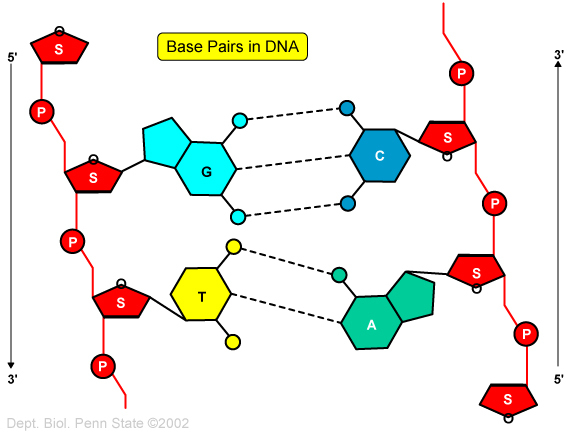
Which 2 molecules form the sides (backbone) of the DNA ladder?
a)
deoxyribose sugar and adenine
b)
deoxyribose sugar and a hydrogen bond
c)
deoxyribose sugar and the nucleus
d)
deoxyribose sugar and phosphate
41.
Nitrogenous bases are joined by which type of bond?
a)
polar bonds
b)
ionic bonds
c)
covalent bonds
d)
hydrogen bonds
42.
What are the three components of a nucleotide?
a)
sugar, hydrogen, nitrogen base
b)
sugar, oxygen, nitrogen base
c)
sugar, phosphate, nitrogen base
d)
sugar, phosphate, protein
43.

In DNA Cytosine always pairs with

a)

Adenine

b)

Thymine

c)

Uracil

d)

Guanine

44.

In DNA Guanine bonds with ______________.

a)

Adenine

b)

Guanine

c)

Cytosine

d)

Thymine

45.
Which of the following is not a nitrogen base found in DNA?
a)
Thymine
b)
Uracil 
c)
Guanine
d)
Adenine
46.
The enzyme that unwinds the DNA to prepare for replication
a)
helicase
b)
replicase
c)
polymerase
d)
synthase
47.
DNA replication results in two DNA molecules,
a)
each one with two original strands
b)
each one with two new strands
c)
each one with one new strand and one original strand
d)
one with two new strands and the other with two original strands
48.

In what process is mRNA synthesized?

a)

Transcription

b)

Translation

c)

DNA Replication

d)

Mitosis

49.

Where does TRANSCRIPTION occur?

a)

Nucleus

b)

Ribosome

c)

Cytoplasm

d)

Mitochondria

50.
The function of _____ is to transport amino acids in the cytoplasm to the ribosome.
a)
rRNA
b)
tRNA
c)
mRNA
d)
DNA
51.
The process of going from DNA to mRNA is called
a)
Transcription
b)
Translation
c)
Transportation
d)
Transient
52.
The function of ______ is to combine with proteins to form ribosomes.
a)
rRNA
b)
tRNA
c)
mRNA
d)
DNA
53.
The process where mRNA is read and made into an amino acid chain.
a)
Transcription
b)
Translation
c)
Transportation
d)
Transient
54.
Which of these nitrogenous bases is NOT in RNA?
a)
Uracil
b)
Thymine
c)
Cytosine
d)
Guanine
55.

What is the location in the cell for translation?

a)

nucleus

b)

mitochondria

c)

cytoplasm

d)

chloroplast