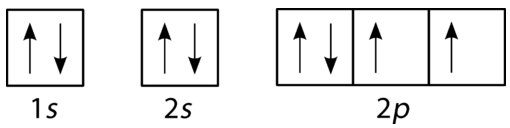
Worksheets
Unit 1 (Part 1) - The Atom (Chem B)
Total questions: 47
Worksheet time: 25mins
Who developed the first atomic theory based on scientific evidence and research?
John Dalton
Democritus
JJ Thomson
Rutherford
Who studied cathode ray tubes and discovered the electron?
Rutherford
JJ Thomson
John Dalton
Democritus
Who conducted a gold foil experiment and discovered the nucleus?
John Dalton
JJ Thomson
Democritus
Rutherford
The nucleus of an atom contains...
protons and neutrons
electrons and protons
neutrons and electrons
protons
Different ions contain different numbers of...
protons
neutrons
electrons
quarks
Different isotopes contain different numbers of...
protons
neutrons
electrons
quarks
Which subatomic particle determines what an element is?
proton
neutron
electron
quark
Phosphorus has an average atomic mass of 30.947 amu and an atomic number of 15. Which isotope of phosphorus is the most common?
phosphorus-15
phosphorus-30
phosphorus-31
phosphorus-30.947
How many protons are in an atom of strontium (atomic #38)?
38
87
88
50
An atom of aluminum has 13 protons, 10 electrons, and 14 neutrons. What is the charge?
-3
+3
+4
-1
+1
Arsenic-75 (atomic number 33) has _______ neutrons.
75
33
40
42
Who discovered that electrons move in energy levels? He studied line emission spectra.
Niels Bohr
Erwin Shrodinger
John Dalton
Ernest Rutherford
Who discovered that the solar system model is incorrect, and electrons actually move in 3-D orbitals (not orbits).
Niels Bohr
Democritus
Erwin Schrodinger
John Dalton

Which orbital has this shape?
s
p
d
f

Which orbital has this shape?
s
p
d
f
Which subatomic particle has a positive charge?
proton
neutron
electron
Which subatomic particle has a negative charge?
proton
neutron
electron
Which subatomic particle has no charge (neutral)?
proton
neutron
electron
What is the center of the atom called?
proton
nucleus
electron
neutron
Which element has this electron configuration: 1s22s22p63s23p2
aluminum
chlorine
calcium
germanium
titanium

Which letter shows the mass number?
A
B
C
D

Which letter shows the atomic number?
A
B
C
D

Which letter shows the charge?
A
B
C
D
What is the mass number of the most common (or most abundant) isotope of krypton (atomic number 36)?
36
84
83
52
83.798

Whose model for the atom is shown?
Bohr's
Dalton's
Rutherford's
Thomson's

Look at the chart. What is the atomic number of particle 3?
3
5
6
11

Which particles are isotopes of the same element?
1 and 2
2 and 3
2 and 4
3 and 4

Which particle is an ion?
1
2
3
4

What does the atomic number tell you?
The number of neutrons
The number of protons
The number of protons + neutrons
True or False: The number of protons and neutrons are always the same
False
True
Cobalt has 27 protons, 32 neutrons, and 27 electrons. What is the atomic number?
32
59
27
5

What is the mass number of the most common isotope of Phosphorous (P)?
15
30
31
16

How many protons does an atom of Sodium (Na) have?
12
11
23
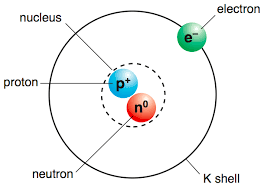
Atoms of the same element with different masses are referred to as ______ ? C-14 and C-12 are examples
ions
isotopes
valence
ground
An ____ is a particle that has a positive or a negative charge due to the loss or the gain of one or more electrons (e-).
ion
isotope
valence
electron

How many protons are in the nucleus of the element shown?
19
9
10
28
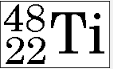
How many neutrons does this isotope of titanium have?
48
22
26
70
What is the largest element found in stars?
iron
hydrogen
helium
tungsten
What must happen to a star in order for elements larger than iron to form?
a supernova (explosion)
the star must collapse
the star must collide with another star
the mass of the star has to be greater than a black hole
How can scientists know what stars are made of?
By measuring their age.
By sending a probe to collect a sample to be analyzed.
By studying the light given off by the star.
It is impossible to know the age of a star.
What process makes elements in stars?
nuclear fusion
fission
orbital structures
spectroscopy