wayground logo

Free Printable Worksheets

NEW

Font size

S
M
L
XL
Worksheets

Mr. Lao/ Mrs. O break review homework

Total questions: 70

Worksheet time: 54mins

Name
Class
Date
1.

Which star has a surface temperature most similar to the surface temperature of Alpha Centauri?

a)

Polaris

b)

Betelgeuse

c)

Procyon B

d)

Sirius

2.

Which star is hotter, but less luminous, than Polaris?

a)

Deneb

b)

Aldebaran

c)

Sirius

d)

Pollux

3.

Which two stars are most similar in luminosity?

a)

Betelgeuse and Barnard's Star

b)

Procyon B and Proxima Centauri

c)

Polaris and the Sun

d)

Alpha Centauri and Sirius

4.

Compared the the Sun, the star Betelgeuse is

a)

less luminous and warmer

b)

less luminous and cooler

c)

more luminous and warmer

d)

more luminous and cooler

5.

Which of the following are characteristic of the surface temperature and luminosity of some white dwarf stars?

a)

Surface Temperature: 5,000 K Luminosity: 100

b)

Surface Temperature: 5,000 K Luminosity: 0.001

c)

Surface Temperature: 10,000 K Luminosity: 100

d)

Surface Temperature: 10,000 K Luminosity: 0.001

6.

Which star is more massive than our Sun but has a lower surface temperature?

a)

40 Eridani B

b)

Sirius

c)

Aldebaran

d)

Barnard's Star

7.

The approximate age of the universe is estimated to be

a)

4.6 million years

b)

4.6 billion years

c)

13.8 million years

d)

13.8 billion years

8.

The theory that the universe is expanding is supported by data from the

a)

nuclear decay of radioactive materials

b)

nuclear fusion of radioactive materials

c)

blue shift of light from distant galaxies

d)

red shift of light from distant galaxies

9.

Which evidence best supports the theory that the universe was created by an explosion called the Big Bang?

a)

impact craters found on Earth

b)

cosmic background radiation

c)

the different compositions of terrestrial and jovian planets

d)

the blue shift of light from distant galaxies

10.

What is the period of revolution of Mercury?

a)

88 days

b)

59 days

c)

57.9 days

d)

224.7 days

11.

Saturn is how many millions of km away from the sun?

a)

1426.7 million km

b)

2871.0 million km

c)

778.4 million km

d)

227.9 million km

12.

What is the period of rotation for the Earth’s moon?

a)

27.3 days

b)

149.6 days

c)

27.0 days

13.

Which planets orbit most eccentric?

a)

Neptune

b)

Mars

c)

Earth

d)

Jupiter

14.

What is the density of Neptune?

a)

1.8 g/cm3

b)

5.4 g/cm3

c)

1.4 g/cm3

d)

1.3 g/cm3

15.

Which planet is the largest?

a)

Saturn

b)

Uranus

c)

Neptune

d)

Jupiter

16.

Which planets period of revolution is shorter than its period of rotation?

a)

Jupiter

b)

Mercury

c)

Earth

d)

Venus

17.

Which planet is the most dense?

a)

Venus

b)

Neptune

c)

Earth

d)

Saturn

18.
Which pie graph correctly shows the percentage of elements by volume in Earth's troposphere?
a)
1
b)
2
c)
3
d)
4
19.
If the air temperature is 20°C and the relative humidity is 58%, what is the dewpoint?
a)
5°C
b)
12°C
c)
15°C
d)
38°C
20.
An air temperature of 30°C is equal to
a)
–22°F
b)
–2°F
c)
74°F
d)
86°F
21.
A barometric pressure of 1021.0 millibars is equal to how many inches of mercury?
a)
29.88
b)
30.15
c)
30.25
d)
30.50
22.
Which characteristic of the planets in our solar system increases as the distance from the Sun increases?
a)
equatorial diameter
b)
period of rotation
c)
eccentricity of orbit
d)
period of revolution
23.
Which two characteristics do all Jovian planets have in common?
a)
small diameters and low densities
b)
large diameters and low densities
c)
small diameters and high densities
d)
large diameters and high densities
24.
On a test, you are given the following question: Which NY State landscape region is located at 44⁰ N and 75⁰ W?
Which page of the Earth Science Reference Tables would you use to answer this question?
a)
Page 2
b)
Page 3
c)
Both page 2 and page 3
d)
Page 5
25.
Which NY State landscape region is located at 44⁰ N and 75⁰ W?
a)
Allegheny Plateau
b)
Erie-Ontario Lowlands
c)
Tug Hill Plateau
d)
Adirondack Mountains
26.
At which latitude would an observer on Earth find the altitude of Polaris to be 37 degrees?
a)
37 degrees North
b)
37 degrees South
c)
55 degrees North
d)
55 degrees South
27.

What factor from the choices below determines whether a star will evolve into a white dwarf, a neutron star, or a black hole?

a)

Mass

b)

Percentage of helium

c)

Percentage of carbon

d)

Apparent brightness

28.
What causes warm air to rise?
a)
the fact that it's less dense than cold air 
b)
The fact that it weighs more than cold air 
c)
The fact that it has higher pressure than cold
d)
the fact that its more dense than cold air 
29.
What causes wind to blow?
a)
Differences in longitude 
b)
Shock waves from clouds 
c)
Differences in air temperature and pressure 
d)
The rotation of the earth
30.
What creates the air pressure difference between the equator and the poles?
a)
The length of the seasons
b)
The shape of the earth 
c)
the duration of the solar year
d)
The amount of direct sunlight each area receives 
31.
How are the winds in the northern hemisphere different from winds in the southern hemisphere? 
a)
Winds int he northern hemisphere are deflected right; winds int eh southern hemisphere are deflected left
b)
winds in the northern hemisphere are deflected south; winds in the southern hemisphere are deflected north 
c)
winds in the northern hemisphere are deflected eart; winds in the southern hemisphere are deflected west
d)
winds in the northern hemisphere are deflected left; einds in the southern hemisphere are deflected right 
32.

Which of the following does NOT determine the strength of gravitational pull between two objects?

a)

mass

b)

distance

c)

velocity

33.

Which kind of planets are more dense?

a)

Terrestrial

b)

Jovian

34.

Which kind of planets have larger diameters?

a)

Terrestrial

b)

Jovian

35.

Which model of the solar system has the Sun at the center?

a)

geocentric

b)

heliocentric

36.
Why is the Equator warmest?
a)
Because it is closest to the sun.
b)
Because it receives the most direct sunlight
c)
Because no clouds form here.
d)
Because it is far from the sun
37.
The term equinox means....
a)
equal amount of day light and equal amount of night
b)
Equal amount of winter and summer
c)
Equal amounts of hot dogs for everyone
d)
The longest day of the year
38.
Which season is taking place in the Southern Hemisphere in Position 1?
a)
Winter
b)
Spring
c)
Summer
d)
Fall
39.
Which season is taking place in the Northern Hemisphere in Position 1?
a)
Winter
b)
Spring
c)
Summer
d)
Fall
40.
Which season is taking place in the Northern Hemisphere in Position 2?
a)
Winter
b)
Spring
c)
Summer
d)
Fall
41.
Which season is taking place in the Northern Hemisphere in Position 3?
a)
Winter
b)
Spring
c)
Summer
d)
Fall
42.
Which season is taking place in the Northern Hemisphere in Position 4?
a)
Winter
b)
Spring
c)
Summer
d)
Fall
43.
What are the reasons for the season?
a)
Earth's tilt & rotation
b)
Earth's tilt & revolution
c)
Earth's rotation & rovolution
d)
Earth's tilt & resolution
44.
What is this diagram showing?
a)
tides
b)
lunar eclipse
c)
revolution
d)
solar eclipse
45.
What is this diagram showing?
a)
tides
b)
solar eclipse
c)
lunar eclipse
d)
rotation
46.

What time is at position 3?

a)

12 p.m. (noon)

b)

9 a.m.

c)

3 p.m.

d)

6 p.m.

47.

How many degrees per hour does the Sun appear to move across the sky?

a)

41 degrees

b)

23.5 degrees

c)

90 degrees

d)

15 degrees

48.
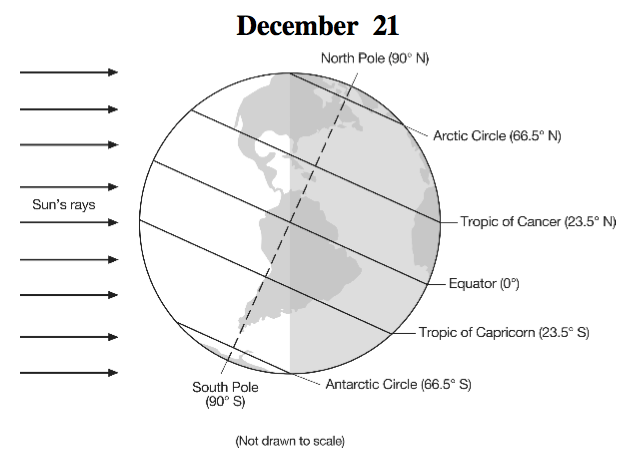
What Latitude experiences direct Sun Rays on December 21st?
a)
23.5°N
b)
0° (Equator)
c)
23.5° S
d)
66.5° S
49.
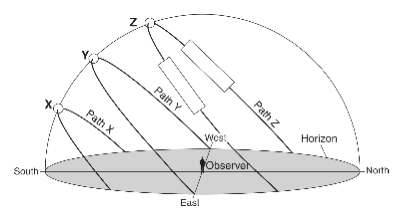
State the day represented by Sun's Path Z.
a)
September 23
b)
December 21
c)
March 20
d)
June 21
50.

Polaris is also known as the...

a)

Big Dipper

b)

Little Dipper

c)

North Star

d)

South Star

51.

Polaris is found on the end of the...

a)

Big Dipper

b)

Little Dipper

c)

Galaxy

52.
Planets orbit the Sun in a shape called a(n)
a)
circle
b)
ellipse
c)
focus
d)
perihelion
53.
An ellipse is drawn around two points called
a)
aphelion
b)
perihelion
c)
foci
d)
axis
54.
The place where a planet is closest to the Sun as it orbits the Sun is called the
a)
perihelion
b)
aphelion
55.
The place where a planet is farthest away from the Sun in its orbit around the Sun is called the
a)
aphelion
b)
perihelion
56.
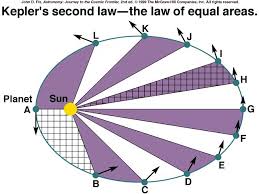
Where is the planet moving faster
a)
Position A to B
b)
Position B to C
c)
Position H to I
d)
Position I to J
57.
What has an eccentricity of zero
a)
a straight line
b)
a large ellipse
c)
a circle
d)
a small ellipse
58.
What does a barometer measure?
a)
temperature
b)
air pressure
c)
dew point
d)
humidity
59.
At the beach in the summertime, the transfer of heat from the sand to the bottoms of your feet is called
a)
radiation
b)
fission
c)
conduction
d)
convection
60.
Practically all clouds & storms occur in this layer of the atmosphere.
a)
Stratosphere
b)
Thermosphere
c)
Troposphere
d)
Mesosphere
61.
Air that has a 100 percent relative humidity is said to be
a)
stable
b)
dry
c)
saturated
d)
unstable
62.

Low-pressure systems are usually associated with ________ weather.

a)

cold and dry

b)

cloudy and rainy

c)

sunny and dry

d)

warm and humid

63.
Low air pressure moves towards high air pressure.
a)
true
b)
false
64.
Lines on a weather map that connect equal points of air pressure
a)
Dew point
b)
Fronts
c)
Air masses
d)
Isobars
65.
High pressure creates sunny, clear skies.
a)
True
b)
False
66.
The temperature at which air becomes saturated
a)
Humidity
b)
Front
c)
Dew Point
d)
Cold Front
67.
As altitude increases, pressure __________.
a)
increases
b)
decreases
c)
stays the same
d)
rises
68.
The amount of water in the air
a)
Dew point
b)
Rain
c)
Isobar
d)
Humidity
69.
Wind is caused by
a)
differences in altitude
b)
difference in pressure
c)
differences in temperature
d)
differences in latitude
70.
Less dense air rises.
a)
True
b)
False