wayground logo

Free Printable Worksheets

NEW

Font size

S
M
L
XL
Worksheets

First Semester Review

Total questions: 65

Worksheet time: 2hrs 20mins

Name
Class
Date
1.
How many states does a solid go through before it is a plasma?
a)
3: Liquid, Gas, Plasma
b)
2: Plasma, Gas
c)
4: Solid, Gas, Liquid, Plasma
d)
600: Spider-Cam, Thor, Hulk, etc.
2.

The state of matter that has no definite size or shape is

a)

Solid

b)

Liquid

c)

Gas

3.

Definite shape and definite volume

a)

Solid

b)

Liquid

c)

Gas

4.

Has a definite volume but not a definite shape

a)

Solid

b)

Liquid

c)

Gas

5.
Mass, relative density, solubility, color, texture, state of matter, conductivity, etc.
a)
Physical state
b)
Insulators
c)
Physical Properties 
d)
Inferences
6.
Which of the following is NOT an example of matter?
a)
sun
b)
air
c)
snow
d)
thoughts
7.
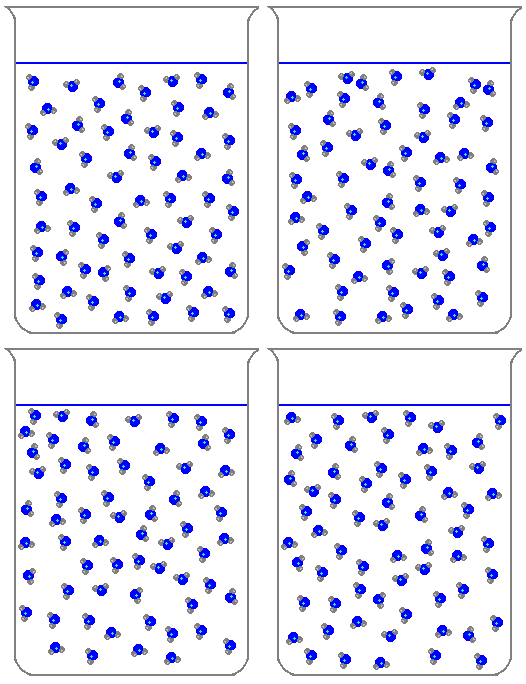
What state of matter does this picture show?
a)
Gas
b)
Solid
c)
Matter
d)
Liquid
8.
A physical change is...
a)
a change that doesn't change the identity
b)
a change that makes something new.
c)
a chemical reaction
9.
A chemical change
a)
doesn't really change much.
b)
creates a new substance
c)
is a change in the state of matter
10.

Biomass burns in a fire.

a)

Physical change

b)

Chemical change

11.

You split logs into pieces with an axe before burning them.

a)

Physical change

b)

Chemical change

12.

When a yellow/orange liquid is added to a creamy white liquid, it turns purple/black.

a)

Physical change

b)

Chemical change

13.
Cookies and cream ice cream would be classified as
a)
A homogenous mixture
b)
A heterogenous mixture
c)
An element
d)
A compound
14.
Two substances physically combined and that appears the same throughout is classified as
a)
A homogeneous mixture
b)
A heterogeneous mixture
c)
An element
d)
  A compound
15.
This particle is found in the nucleus and has no charge
a)
Neutron
b)
Proton
c)
Electron
d)
Orbital
16.
This is a negatively charged particle found outside the nucleus
a)
Electron
b)
Proton
c)
Neutron
d)
Orbital
17.
The central region of an atom where its neutrons and protons are is its 
a)
Nucleus 
b)
Electron Cloud
c)
Core 
d)
Center 
18.
A neutral atom of the isotope 2612Mg would consist of
a)
12 protons, 26 neutrons, 26 electrons
b)
26 protons, 12 neutrons, 26 electrons
c)
26 protons, 14 neutrons, 14 electrons
d)
12 protons, 14 neutrons, 12 electrons
19.
Iron-60 (atomic number 26) is an isotope that is often used to study meteorites.  How many neutrons does iron-60 have?
a)
26
b)
60
c)
34
d)
86
20.

Maximum number of ELECTRONS that can be placed in an s orbital.

a)

2

b)

6

c)

10

d)

14

21.

The maximum number of ELECTRONS that can be placed in an p orbital.

a)

2

b)

6

c)

10

d)

14

22.

The maximum number of ELECTRONS that can be placed in an d orbital.

a)

2

b)

6

c)

10

d)

14

23.

The maximum number of ELECTRONS that can be placed in an f orbital.

a)

2

b)

6

c)

10

d)

14

24.

What is the maximum number of ELECTRONS that an orbital (box) can have?

a)

1 electron

b)

2 electrons

c)

3 electrons

d)

4 electrons

25.

What is the Aufbau principle?

a)

electrons always spin right

b)

electrons always pair up

c)

electrons always enter the HIGHER energy orbitals first

d)

electrons always enter the LOWER energy orbitals first

26.

What is Hund's Rule?

a)

electrons always pair up first

b)

electrons must equally distribute between orbitals before pairing up

c)

electrons always spin right

d)

electrons must go to the nucleus for instructions

27.

Which colored area represent the p orbitals?

a)

blue

b)

red

c)

orange

d)

green

28.

Which colored area represent the s orbitals?

a)

blue

b)

red

c)

orange

d)

green

29.
What atom matches this electron configuration?
1s22s22p63s23p64s23d10
a)
Zinc
b)
Copper
c)
Nickel
d)
Germanium
30.
Which electron configuration belongs to Chlorine (Cl)?
a)
1s2s2p3s3p5
b)
1s2s2p3s3p6
c)
1s2s2p3s3p7
31.
What is the name of this element?
a)
Helium
b)
Hydrogen
c)
Argon
d)
Silver
32.
What is the name of this element?
a)
Beryllium
b)
Boron
c)
Barium
d)
Bromine
33.
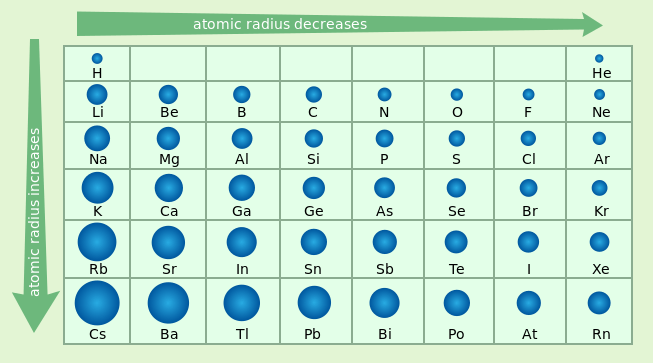
As you move down the periodic table atoms get bigger.  This is because ____________.
a)
The atoms have more mass.
b)
The atoms have more protons.
c)
The atoms have more energy levels
d)
The atoms have more nuetrons
34.
As you move across the periodic table atoms tend to get smaller because, ______________.
a)
the atoms have more mass.
b)
the atoms have less mass
c)
the atoms have more protons.
d)
the atoms have less electrons.
35.
The atom with the largest atomic radius in Group 18 is - 
a)
Ar
b)
He
c)
Kr
d)
Rn
36.
Which periodic group has the smallest atomic radius?
a)
Alkali metals
b)
Halogens
c)
Noble Gases
d)
Transition metals
37.
Ionization energy is...
a)
the energy required to add an electron to a specific atom
b)
how much energy it takes to remove an electron from an atom
c)
the energy required to shield the outer electrons from the nucleus
d)
a measure of the ability of an atom to attract electrons
38.
Atoms that have a high electronegativity, _______________.
a)
give up their electrons more easily.
b)
hold on to their electrons more tightly.
c)
have more electron shells.
39.
As you move down a group, atomic radius increases because - 
a)
you add more and more neutrons
b)
you add more and more protons
c)
you add more and more shells (energy levels)
d)
you add more atomic mass
40.
As you move across the periodic table from left to right, the atomic radius decreases.  This is because - 
a)
the number of protons increases, so attraction to electrons increases
b)
the number of energy levels increases
c)
the number of electrons increases
d)
the atomic mass increases
41.
ammonium phosphate
a)
(NH4)3PO4
b)
NPO4
c)
NH4PO4
d)
NH4(PO4)3
42.
Ca(CN)2
a)
Calcium Cyanide
b)
Calcium Dicyanide
c)
Calcium Dicarbon Dinitrogen
d)
Calcium Thiocyanate
43.
Na2S
a)
Sodium Sulfide
b)
Sodium Sulfate
c)
Sodium Sulfite
d)
Disodium Sulfide
44.
What is the formula for copper(I) sulfate?
a)
CuSO3
b)
CuSO4
c)
Cu2SO3
d)
Cu2SO4
45.
Write the formula for copper(I) phosphide
a)
Cu3P
b)
CuP
c)
Cu1P
d)
CuP3
46.
Name this compound:
NiPO4
a)
Nickel (I) phosphate
b)
Nickel (II) phosphate
c)
Nickel (IV) phosphate
d)
Nickel (III) phosphate
47.
If my charge becomes 2+ what does that say about me?
a)
I am stealing 2 electrons
b)
I am losing 2 electrons
c)
I am in period 2
d)
I have an atomic # of 2
48.
If I gain electrons I become
a)
Positive because I've added to my atom
b)
negative because I've added electrons
c)
same because i'm balanced
d)
equal because now I have electrons
49.

Name the following ionic compound: BeCl2

a)

beryllium chlorine

b)

beryllium II chloride

c)

beryllium chloride

d)

beryllium dichloride

50.
What two types of atoms make a covalent bond?
a)
2 Nonmetals
b)
1 Nonmetal and 1 Metal
c)
2 Metals
d)
2 Noble Gases
51.
Name CCl4
a)
carbon carbon tetraiodide
b)
carbon tetrachloride
c)
monocarbon tetrachloride
d)
water
52.
Give the formula for oxygen dichloride
a)
OCl2
b)

O2Cl2

c)
OCl
d)
O2Cl
53.
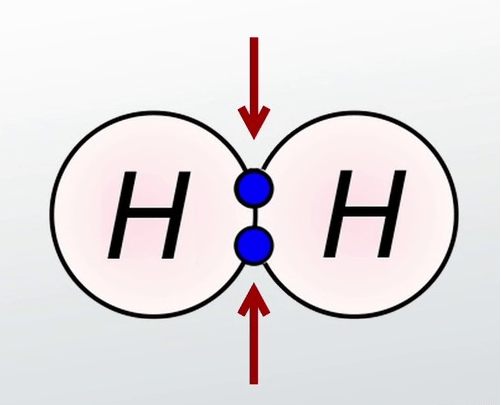
What type of bond is shown in this image?
a)
Ionic
b)
Polar Covalent
c)
Nonpolar Covalent
d)
Van der Waals Force
54.
What is the formula for this Compound
a)
PCl
b)
PCL5
c)
PCl5
d)
Phosphorous Penta Chloride
55.
Which type of bond has an unequal sharing of electrons?
a)
Polar Covalent 
b)
Non Polar Covalent
c)
Ionic
d)
Metallic
56.
Which type of bond has an equal sharing of electrons?
a)
Polar Covalent 
b)
Non Polar Covalent
c)
Ionic
d)
Metallic
57.

How many total valence electrons are participating in bonding in the molecule above?

a)

8

b)

4

c)

2

d)

3

58.
Which of the following is the correct Lewis dot structure for the molecule fluorine (F2)?
a)
A
b)
B
c)
C
d)
D
59.

Which is the correct molecular structure for carbon dioxide?

a)
b)
c)
d)
60.
What is the name of PS3?
a)
phosphorus trisulfide
b)
phosphorus chloride
c)
phosphide trisulfide
d)
phosphate
61.

What kind of reaction is this:

4Fe + 3O2 → 2Fe2O3

a)

Synthesis

b)

Decomposition

c)

Single Displacement

d)

Combustion

62.

What kind of reaction is this:

2C3H7OH +9O2 -> 6CO2 + 8H2O

a)

Double Displacement

b)

Combustion

c)

Decomposition

d)

Synthesis

63.

What kind of reaction is this:

Fe + CuSO4 -> Cu + FeSO4

a)

Double Displacement

b)

Single Displacement

c)

Decompostition

d)

Synthesis

64.

The reaction below is an example of?

AgNO3 + NaCl → AgCl + NaNO3

a)

Decomposition

b)

Single Displacement

c)

Double Displacement

d)

Synthesis

65.

This type of reaction has one reactant yield multiple products.

a)

Decomposition

b)

Synthesis

c)

Single replacement

d)

Combustion