wayground logo

Free Printable Worksheets

NEW

Font size

S
M
L
XL
Worksheets

7th Grade Social Studies Exam Review (Midterm)

Total questions: 80

Worksheet time: 1hrs 18mins

Name
Class
Date
1.

The government is controlled by a small group of people and the citizen has very limited role. This is an example of which type of government?

a)

monarchy

b)

oligarchy

c)

totalitarian

2.

How did Tigris and Euphrates Rivers impact the surrounding areas?

a)

The flooding of the rivers made it possible for the earliest humans to farm the land since the soil was fertile. As a result humans were able to create civilizations.

b)

The barriers of the rivers created a secure environment for the earliest humans to build homes. As a result, humans were able to create a society.

c)

The soil around those rivers were not very fertile. As a result, the earliest humans migrated south and settled near the Jordan River.

3.
Mesopotamian farmers developed a system of __________ to control the flow of the Tigris and Euphrates Rivers.
a)
Irrigation 
b)
Cuneiform 
c)
Aqueducts
d)
Terraced Farming
4.
Before 8000 B.C.E, humans found food by hunting animals. They also gathered nuts and fruits. What practice later replaced hunting and gathering for finding food? 
a)
building fires
b)
raising families 
c)
growing crops
d)
owning stores 
5.
Which river did the Egyptians live along?
a)
MIssissippi River
b)
Amazon River 
c)
Nile River
d)
Danube River 
6.
What happened to wealthy Egyptians after they died?
a)
They were mummifed
b)
They were buried in a casket
c)
They floated down the Nile River
d)
They were burned
7.
Land around the Nile River was _____________________________.
a)
dry and sandy
b)
wet and swampy
c)
fertile farming land
d)
snow covered mountains
8.
The definition of Monotheistic means believing in ?
a)
Many Gods
b)
Sea Gods and Sun Gods
c)
Two Gods
d)
One God
9.
The Minoans traded_______?
a)
Pottery
b)
Gold
c)
Silver
d)
All 3
10.
The most common of the various titles for ancient Egyptian monarchs
a)
King
b)
Queen
c)
Sphinx
d)
Pharoh
11.

All of the following are depicted on the map EXCEPT--

a)

Greek city-states

b)

Persian territory

c)

The Ionian League

d)

Macedonia

12.

The ancient Mespotamians established a civilization near which location?

a)

1

b)

2

c)

3

d)

4

13.

Which number represents the location of ancient Athens?

a)

1

b)

2

c)

3

d)

4

14.

How did geography play a key role in the early development of civilizations?

a)

Societies developed near oceans.

b)

Societies developed in river valleys.

c)

Societies developed in the desert.

d)

Societies developed in the tundra.

15.

Because of intense farming, civilizations required more people to live in an area, which of the following developed:

a)

Culture

b)

Law

c)

Written Language

d)

All of these

16.

What does polytheistic mean?

a)

Worshipping or believing in more than one god.

b)

A person who was able to read and write, allowing for the creation of written records and messages.

c)

Large groups of domesticated animals like sheep or goats.

d)

A series of rulers in a particular place considered members of the same family.

17.

People developed better technology because they needed to solve new problems such as how to farm more efficiently, or how to better fight to defend a city.

a)

True

b)

False

18.
What is a direct democracy?
a)
A form of government in which the public will is translated directly into law.
b)
Government controlled by one person.
c)
A form of government in which elected leaders make decisions for the public.
d)
A state ruled by the noble class.
19.
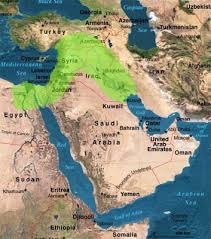
What is the area in green named?
a)
The Valley
b)
Egypt
c)
fertile land
d)
Fertile Crescent 
20.
What did they call the the area between the two rivers?
a)
Mesopotamia
b)
Iraq
c)
Turkey
d)
Home
21.
What are the names of the two rivers?
a)
Tigres and Nile
b)
Amazon and Nile
c)
Euphrates and Tigres
d)
Euphrates and Nile
22.
Skilled workers who made metal, cloth, or pottery products were called
a)
Priests
b)
Artisans 
c)
Scribes
d)
Heros
23.
Where did the first civilizations arise because of farming conditions?
a)
in the mountains
b)
near the sea
c)
in river valleys
d)
n the desert
24.
The word "Mesopotamia" means
a)
middle of the fertile crescent
b)
land in the middle of the desert 
c)
land between the rivers
d)
land north of the sea
25.
What modern day country is Mesopotamia mostly in?
a)
India
b)
Egypt
c)
China
d)
Iraq
26.
Which of the following is a long-lasting achievement of the Ancient Athenians?
a)
spreading Christianity
b)
establishing democracy
c)
ending citizenship
d)
creating a new religion
27.
Who were the only citizens allowed to vote in Ancient Athens?
a)
married males, slave, no land owned
b)
women born in Athens, slave, owned land
c)
adult free male, owned land, trace roots back to Athens
d)
married women, military men, no land owned
28.
Greece was surrounded by water on 3 sides.  What is this landform called?
a)
an island
b)
a peninsula
c)
a port
d)
a natural harbor
29.
Greek philosophers believed one thing was more important than anything else.  What was it?
a)
using the human mind to think and understand
b)
helping others to be happy and be comfortable
c)
encouraging people to worship the gods
d)
understanding how the human body works
30.
Early Greek philosophers were important. What were they the first to do?
a)
Ignore their fellow man's responsibility
b)
study and analyze the world around them using logic and reason.
c)
describe why the Greek gods were to be worshipped
d)
help the Greek people make good decisions in daily life
31.
Why were many Greek achievements important?
a)
They helped Greece become a military power.
b)
They showed the curiosity of the Greek mind.
c)
They strongly shaped Western culture.
d)
They encouraged people to use reason.
32.
Which classic civilization is known for this type of architecture?
a)
Sumerian
b)
Harappan
c)
Chinese
d)
Greek
33.
Ancient Greek city-states remained independent from each other due to which geographic features?
a)
many islands
b)
peninsulas
c)
rocky coastlines
d)
vast deserts
34.
Which statement summarizes the teaching style of Socrates?
a)
He made the students take notes to make them think deeper.
b)
He sang all his ideas to his students to entertain them through song.
c)
He answered a question with a question to encourage deeper thinking.
d)
He knew all the answers to every question and told them they were wrong.
35.
What type of government developed in Athens?
a)
oligarchy
b)
direct democracy
c)
monarchy
d)
tyranny
36.
Which of the following bodies of water does NOT surround Greece?
a)
Aegean Sea
b)
Black Sea
c)
Ionian Sea
d)
Mediterranean Sea
37.
What did the Greeks use for transportation?
a)
Land
b)
Chariot
c)
Water
d)
Air 
38.
Which civilization was the first to arise in Greece?
a)
Minoans
b)
Mycenaeans
c)
Greeks
d)
Hoplites
39.
The Minoan civilization collapsed. Historians believe undersea earthquakes caused this, and others think the Mycenaeans invaded and took over.
a)
True
b)
False
c)
.
40.
How did the Minoans make their wealth?
a)
War
b)
Taxes
c)
Stores
d)
Trade
41.
Which civilization was originally from central Asia?
a)
Minoans
b)
Mycenaeans
c)
Greeks
d)
Hoplites
42.
What was the Dark Ages?
a)
A time when trade slowed and poverty took place.
b)
A time when people stopped teaching each other craft work.
c)
A time when people stopped teaching each other how to write, and they forgot their written language.
d)
All of the above
43.
Who were the hoplites?
a)
Army of citizens
b)
Heavily armed citizens who carried round shields, short swords, and 9-foot spears.
c)
Good soldiers because they took pride in fighting for their city-state.
d)
All of the above
44.
Greece is a peninsula that has a southern peninsula called
a)
Athens
b)
Sparta
c)
Peloponnesus
d)
Phoenicia
45.
The ruler of the Greek gods was called 
a)
Ares
b)
Athena
c)
Prometheus
d)
Zeus
46.
The Greeks believed that the gods lived in
a)
Athens
b)
Cyprus
c)
Mount Olympus
d)
Mount Etna
47.
Stories that portray Greek Gods and goddesses are called 
a)
essays
b)
fables
c)
histories
d)
myths
48.
In Greek, the word for a city-state was 
a)
civitas 
b)
barracks 
c)
democracy
d)
polis
49.
Helots were 
a)
citizens
b)
oligarchs
c)
slaves
d)
merchants
50.
Spartan boys lived in military houses called
a)
acropolises 
b)
agoras
c)
barracks
d)
stoas
51.
What word best describes the land of the Greek peninsula?
a)
rocky and mountainous
b)
flat
c)
desert
d)
rolling plains
52.
Greece is a peninsula which means
a)
a mountain range with a river running through it. 
b)
land surrounded by water on three sides
c)
an area with major rivers running through it
d)
a very mountainous region
53.
One of the most famous ancient Greek poets who wrote the Iliad was...
a)
Homer.
b)
Athena.
c)
Sandburg. 
d)
Pericles
54.
Greek has many _________that are like mini countries.
a)
counties
b)
city-states
c)
provinces
d)
parishes
55.
A militaristic city-state where boys were trained from an early age to fight.
a)
Athens
b)
Delphi
c)
Corinth
d)
Sparta
56.
Who was the leader of Athens after the defeat of the Persians and took Athens into a "Golden Age" of prosperity and achievement?
a)
Pericles
b)
Leonidas
c)
Themistocles
d)
Socrates
57.
A city-state which favored democracy and a well-rounded education. 
(Also, the largest city-state by a wide margin)
a)
Sparta
b)
Athens
c)
Delphi
d)
Corinth
58.
Who was the Babylonian King who created the earliest known collection/ code of laws?
a)
Sargon
b)
Hammurabi
c)
Eannatum
d)
Nebuchadnezzar
59.
What is the term for the writing system developed by the Sumerians that used wedge-shaped marks made in soft clay?
a)
writing
b)
monotheism
c)
cuneiform
d)
fertile crescent
60.
What did King Nebuchadnezzar build for one of his wives? 
a)
Written Laws
b)
A Ziggurat
c)
Hanging Gardens
d)
Calendars
61.
a long poem that records the deeds of a legendary or real hero
a)
myth
b)
caravans
c)
bazaar
d)
epic
62.
Professional writers
a)
Mesopotamia
b)
pictographs
c)
scribes
d)
stylus
63.
What 3 major civilizations occupied the Fertile Crescent during Ancient Mesopotamia?
a)
Seminoles, Sioux, and Fox
b)
Sumerians, Babylonians, and Assyrians
c)
Chinese and Japanese and British
d)
Egyptians, Africans ,and Spanish
64.
A group of merchants traveling together for safety, usually with a large group of camels
a)
caravan
b)
posse
c)
entourage
d)
security detail
65.
Egyptians made paper from:
a)
papyrus
b)
grains
c)
corn
d)
sheep's wool
66.
Who owned everything in Ancient Egyptian kingdoms?
a)
The Pharoah
b)
Vizier
c)
Slaves
d)
Priests
67.

Rapids along a river

a)

noble

b)

cataract

c)

ka

d)

obelisk

68.

Series of rulers from the same family

a)

pharaoh

b)

dynasty

c)

noble

d)

delta

69.

Huge triangular tomb built by the Egyptians

a)

delta

b)

Red Land

c)

Rosetta Stone

d)

pyramid

70.

Period from 2700 to 2200 BC in Egyptian history that began shortly after Egypt was unified.

a)

Old Kingdom

b)

Middle Kingdom

c)

New Kingdom

d)

Ancient Kingdom

71.

Ancient Egyptian writing system that used picture symbols

a)

sphinx

b)

Rosetta Stone

c)

hieroglyphics

d)

papyrus

72.

Triangle-shaped area of land made from soil deposited by a river

a)

obelisk

b)

papyrus

c)

delta

d)

spinx

73.

The Egyptian invention to prevent the pharaoh’s body from decomposing was

a)

creating a dummy stuffed with straw.

b)

the act of embalming.

c)

surveying the pyramid.

d)

removing only the eyes.

74.

Hatshepsut was Pharaoh along side who?

a)

Her husband Thutmose II

b)

Her father Amon

c)

Her step-son Thutmose III

d)

Her grandson Amenhotep II

75.

King Tut, along with many Pharaohs of the New Kingdom was buried where?

a)

In a pyramid

b)

In the Valley of the Kings

c)

In the Nile River Valley

d)

In a secret tomb

76.

What is a Theocracy?

a)

A ruler controls both religious and political affairs.

b)

Power is passed down from father to son.

c)

Rulers are voted on by the public.

d)

Representatives are elected from each region.

77.

What made the rocky rapids called the Nile cataracts important?

a)

Egyptians couldn't trade with countries on the Mediterranean Sea

b)

Nubians were skillful sailors

c)

ships couldn't travel upstream from Egypt

d)

silt would not build up at the mouth of the Nile

78.

Who was the first pharaoh and leader who united the Kingdoms of Egypt?

a)

Hatshepsut

b)

Menes

c)

Ramses II

d)

Seth

79.

Who was the most important god in Egypt?

a)

Amon-Re

b)

Horus

c)

Isis

d)

Osiris

80.

Yay! You made it the end of the review! How are you going to do on the exam?

a)

Awesome!

b)

Great!

c)

An A for sure!

d)

What exam?