wayground logo

Free Printable Worksheets

Font size

S
M
L
XL
Worksheets

3rd Grade Energy Review

Total questions: 77

Worksheet time: 4hrs 9mins

Name
Class
Date
1.

When the sun gets higher in the sky, shadows get ______.

a)

longer

b)

gone

c)

shorter

d)

darker

2.

When the sun gets lower in the sky, shadows get______.

a)

longer

b)

gone

c)

shorter

d)

darker

3.

When an object blocks the path of light, what is formed?

a)

A problem

b)

A fog

c)

A reflection

d)

A shadow

4.

When an object moves closer to a light source, its shadow...

a)

Gets smaller

b)

Gets bigger

c)

Changes shape

d)

Stays the same size

5.

When the Sun is behind you, your shadow is ...

a)

behind you

b)

in front of you

c)

at the side of you

d)

not there

6.
Which light source causes shadows in the outdoor environment? 
a)
The Sun
b)
The Lightbulb
c)
The House
d)
The School
7.

12.Translucent is?

a)

When light bounces off an object

b)

Material that only allows a little light to pass through

c)

Our main source of light

8.

Transparent is?

a)

A material that allows light to pass through

b)

The colors of the rainbow

c)

Light made by man

9.

True or false?

Heat is a source of energy.

a)

false

b)

true

10.

A mirror _________________ light.

a)

absorbs

b)

reflects

c)

refracts

11.

An object that blocks all of the light from passing through is...

a)

transparent

b)

clear

c)

opaque

d)

translucent

12.
Rubbing your hands together is a way of producing heat.
a)
True
b)
False
13.
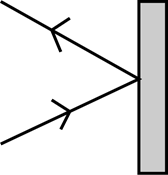
The illustration shows a light ray striking an object.
In the illustration, the light ray striking the object is-
a)
absorbed
b)
stopped
c)
reflected
d)
refracted
14.
The bouncing off of light rays from the surface of an object such as a mirror or other shiny surface is called:
a)
mirror
b)
laser
c)
reflection
d)
refraction
15.

Choose the three sources of heat

a)

burning fuels

b)

friction

c)

moon

d)

electricity

e)

mirror

16.

Light travels in ________ lines.

a)

space

b)

directions

c)

bounces

d)

straight

17.

A red object _________

a)

reflects all the colors

b)

reflects the colors red, blue and green

c)

reflects no colors

d)

reflects the color red

18.

Things that produce heat is called … .

a)

sources of heat

b)

sources of sound

c)

sources of light

19.

People using heat from other sources for ... .

a)

cooking, keeping warm, and drying

b)

keeping warm, drying, and giving out light

c)

drying, giving out light, and cooking

20.
To make things move, you need a −
a)
force.
b)
strong magnet.
c)
metal object.
d)
helper.
21.
A force is a −
a)
push.
b)
pull.
c)
magnet.
d)
push or pull.
22.
Which of the following is a force that pulls?
a)
magnetism.
b)
gravity.
c)
friction.
d)
all of the above.
23.
a)
light bulb
b)
phone
c)
fire house
d)
bowling
24.
The dirt road rubs against the tires of the motorcycle and most likely causes it to ―
a)
go faster because of friction     
b)
change directions
c)
go slower because of friction     
d)
win a race
25.

What is mechanical energy?

a)

Objects that are burning up in the sky.

b)

The ability to do work or cause change.

c)

A state of matter such as solid, liquid or gas

d)

An electric current that travel through a circuit.

26.

The football player uses the body to play the sport. Which type of energy does a carpenter use with her body to get the job done?

a)

Mechanical

b)

Electrical

c)

Light

d)

Solar

27.

Which of the following actions does not require mechanical energy to function?

a)

Sharpen a pencil.

b)

Riding a bike.

c)

Rotating a motor.

d)

Melting ice.

28.

1 Mechanical energy is the energy is the ability to cause ________or do __________.


Which list contains the correct words to complete the sentence above?

a)

change, work

b)

damage, work

c)

work, everything

d)

effect, motion

29.
When light strikes the wall of a building it will? 
a)
Absorb (take in)
b)
Reflect (bounce back)
c)
Refract (bend)
d)
Transmit(go thru)
30.
Light always travels in a...
a)
Curved line
b)
Zig Zag line
c)
Up and down
d)
Straight line
31.
What will happen when a pencil is placed in water? 
a)
Reflect
b)
Refract
c)
Absorb
d)
Transmit
32.
If an object makes sound it is because the waves are...
a)
Stopped
b)
Vibrating
c)
Motionless
d)
Not moving
33.
This is an example of? 
a)
Absorption
b)
Reflection
c)
Refraction
d)
Transmit
34.
What materials refract light? 
a)
Mirrors
b)
Sun glasses 
c)
Lenses
d)
Shiny metals
35.
This is an example of ? 
a)
Absorb
b)
Reflect
c)
Refract
d)
Transmit
36.
This is an example of? 
a)
Absorb
b)
Reflect
c)
Refract
d)
Transmit
37.

What is absorption?

a)

The bending of light when it moves through one kind of matter to another

b)

The bouncing of light off an object

c)

The taking in of light by a material

38.

What is reflection?

a)

The bending of light when it moves through one kind of matter to another

b)

The bouncing of light off an object

c)

The taking in of light by a material

39.

What is refraction?

a)

The bending of light when it moves through one kind of matter to another

b)

The bouncing of light off an object

c)

The taking in of light by a material

40.

Light is a kind of ____.

a)

color

b)

reflection

c)

energy

d)

heat

41.

What happens to light after it hits a mirror?

a)

It bounces off the mirror.

b)

It goes around the mirror.

c)

It goes straight through the mirror.

d)

It goes through the mirror and bends.

42.

Which of these describes how light travels through an empty space?

a)

It travels straight but may change direction to avoid objects.

b)

It changes direction often even if there are no objects.

c)

It comes to a stop after it travels a certain distance.

d)

It travels in a straight line without stopping.

43.

What does the pencil in this picture show about light?

a)

Light is refracted when it hits a curved object.

b)

Light is reflected when it hits a curved object.

c)

Light is refracted when it passes from air into water.

d)

Light is reflected when it passes from air into water.

44.

What kind of surface best reflects light?

a)

dull

b)

shiny

c)

clear

d)

black

45.

What happens to light when it passes through a prism? Select all that apply.

a)

The light is refracted (bends) as it passes through the prism.

b)

All of the light is reflected off the surface of the prism.

c)

Each color that makes up the light bends a different amount.

d)

The light does not pass through the prism.

e)

The light breaks into the colors of the rainbow.

46.

How is refraction different from reflection?

a)

Refraction is the taking in of light, while reflection is the bouncing of light off an object.

b)

Refraction is the bouncing of light off an object, while reflection is the bending of light when it moves through one kind of matter to another.

c)

Refraction is the bending of light when it moves through one kind of matter to another, while reflection is the taking in of light.

d)

Refraction is the bending of light when it moves through one kind of matter to another, while reflection is the bouncing of light off an object.

47.

These cars have been parked outside for a long time on a sunny day. What is the name of the process that affects the cars' temperatures?

a)

reflection

b)

refraction

c)

absorption

48.

These cars have been parked outside for a long time on a sunny day. Which car will be the hottest?

a)

The black car

b)

The white car

c)

The red car

49.

These cars have been parked outside for a long time on a sunny day. Which car will be the coolest?

a)

The black car

b)

The white car

c)

The red car

50.
The energy of moving particles
a)
heat
b)
thermal energy
c)
school
d)
temperature
51.
Is a measure of how hot or cold something is 
a)
Cold
b)
Heat
c)
Temperature
d)
Thermal Energy 
52.
An instrument used to measure heat
a)
Thermometer 
b)
Fahrenheit 
c)
Celsius 
d)
Cold 
53.
Any material that does not allow heat to pass through it easily 
a)
Friction
b)
Conductor
c)
Insulator
d)
Magnet
54.
The movement of energy by waves 
a)
Wave
b)
Solar Energy
c)
Heat Waves 
d)
Radiation 
55.
Energy from the sun
a)
Solar Energy 
b)
The Sun
c)
Heat 
d)
Miss Hightower
56.
A force that occurs when one object rubs against another object
a)
Heat 
b)
Friction
c)
Solar Things
d)
Polar Eclipse 
57.
The flow of thermal energy from warmer objects to cooler objects 
a)
Ice Cold
b)
Heater
c)
Heat
d)
Convection 
58.
Any material that allows heat to move through it easily 
a)
conduction
b)
convection
c)
heat
d)
conductor
59.
When Water Turns into gas it is called?
a)
Water Vapor
b)
Darth Vapor
c)
Melts
60.
Water will _________ when it gets cold enough, changing it from a LIQUID to a SOLID
a)
Melt
b)
Freeze
c)
Boil
61.
We measure ______ with Celsius or Fahrenheit degrees.
a)
Temperature
b)
Thermometer
c)
Barometer
62.
When a SOLID changes to a LIQUID, it
a)
Freezes
b)
Boils
c)
Melts
63.
When water is heated and CHANGES INTO A GAS it___________ 
a)
Boils
b)
Evaporates
c)
insulates
64.
When a liquid SLOWLY changes into a gas it_________
a)
Condenses
b)
Evaporates
65.
Which color absorbs the most light ?
a)
Light Blue
b)
White
c)
Black
66.
When an object is heated, it)_______
a)
Drops in temperature
b)
Gains Energy
c)
Its particles slow down
67.
Which of these has the slowest moving particles
a)
Ice
b)
Lava
c)
Gas
68.
What happens when Gas condenses?
a)
It becomes hot
b)
It becomes a liquid
69.
What are the the 3 states of matter?
a)
Solid, Liquid, Gas
b)
Gas, Gas, chaha
c)
Ice, Lava, Sunlight
d)
Emrys, Freya, Yukikawa
70.
All sounds are made by ____ objects.
a)
warm
b)
cold
c)
reflecting
d)
vibrating
71.
Sound is a kind of energy that travels in ___.
a)
waves
b)
currents
c)
wires
d)
groups
72.
___ is a measure of how high or low a sound is.
a)
pitch
b)
amplitude
c)
temperature
d)
length
73.
A sound reflection, in which sound bounces off of an object, is called an ___.
a)
eardrum
b)
echo
c)
refraction
d)
sound wave
74.
__________ is the loudness or softness of a sound. 
(Hint: Think about our sound song.)
a)
Echo
b)
Volume
c)
Pitch
d)
Vibration
75.
__________ means to move back and forth quickly.
a)
Pitch
b)
Amplitude
c)
Vibration
d)
Echo
76.

What is energy?

a)

moving energy

b)

stored energy

c)

renewable energy

d)

The ability to do work.

77.
What does friction produce?
a)
light
b)
sound
c)
heat
d)
gravity