
 Worksheets
5.1-5.2 Energy and Ecosystems
Total questions: 74
Worksheet time: 1hrs 12mins
Organisms that make their own food
Producer
Consumer
Decomposer
Organisms that obtain energy by feeding on other organisms
Producer
Consumer
Decomposer
Organisms that break down wastes and dead organisms and return the raw materials to the environment
Producer
Consumer
Decomposer
Consumers that eat only plants
Carnivores
Omnivores
Herbivores
Scavengers
Consumers that eat only animals
Carnivores
Omnivores
Herbivores
Scavengers
Consumers that eat both plants and animals
Omnivores
Carnivores
Herbivores
Scavengers
Consumers that feed on the bodies of dead organisms
Carnivores
Omnivores
Herbivores
Scavengers
A food _______ is a series of events in which one organism eats another and obtains energy.
chain
web
pyramid
plate
A food _______ consists of many overlapping food ________.
web, chains
chain, webs
pyramid, webs
web, pyramids
As you work your way up the energy pyramid, what happens to the energy?
It increases
It decreases
It stays the same
Nothing

In the food web above, what eats the rabbit?
Fox
Hawk
Vole
Grass

In the food web above, what organism is missing from this food chain:
Grass --> Slug --> ________ --> Hawk
Vole
Frog
Insect
Thrush

In the energy pyramid, what is the bottom level composed of?
Producers
First-Level Consumers
Second-Level Consumers
Third-Level Consumers
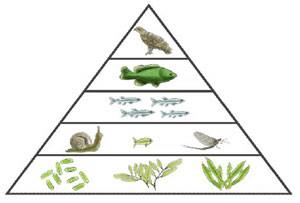
In the energy pyramid, what comes after the producers?
Producers
First-Level Consumers
Second-Level Consumers
Third-Level Consumers
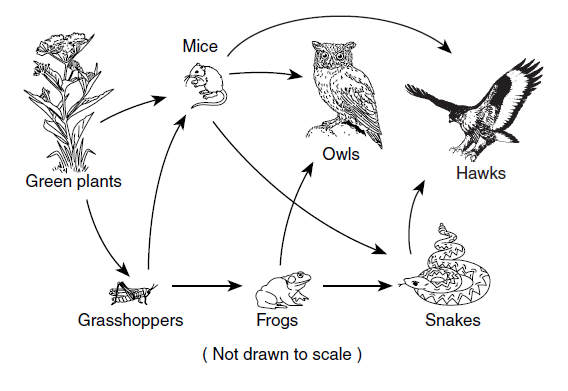
Which group of organisms is missing from the food web above?
Carnivore
Herbivore
Omnivore
Decomposer

Looking at the chart below what type of organism is the Alaskan brown bear?
Carnivore
Herbivore
Omnivore
Decomposer
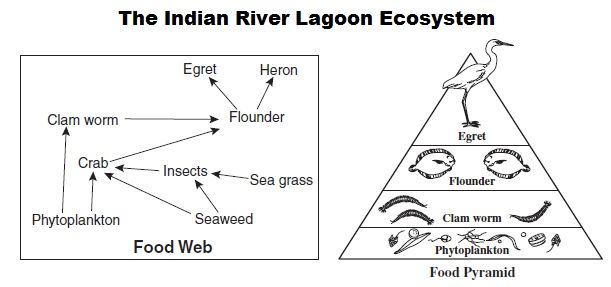
Which of the following has the largest population in the Indian River Lagoon system?
Crab
Egret
Flounder
Phytoplankton

How much energy will be available for the flounder if the plankton at the bottom of this pyramid is able to produce 10,000 kcal of energy from the photosynthesis?
1000
100
10
1
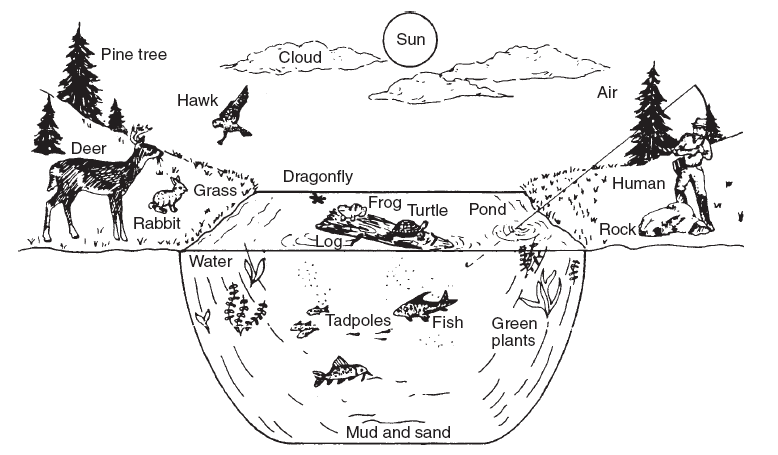
What is the primary source of energy for the ecosystem pictured above?
Grass and Green plants
Hawks and Deer
Tadpoles and Fish
Sun

Observe the food chain below. What would be the result of disease killing off most of the mouse population?
All populations would be relatively unaffected
The grasshoppers would become extinct
The grasshopper population would decrease; the owl population would increase
The grasshopper population would increase and the owl population would decrease

Which type of interaction exists between shrimp and blue crabs in this food web?
Blue crabs prey on shrimp.
Shrimp compete with blue crabs for food.
Shrimp help blue crabs filter polluted water.
Shrimp decompose matter for blue crabs.
Where do producers get energy?
consumers
producers
sunlight
predators
Which of the following is an example of two consumers?
grass and grasshopper
flower and turtle
berries and deer
rabbit and owl
Which statement is true?
Only animals depend on sunlight
Producers depend on consumers
Plants and animals depend on sunlight
Only plants depend on sunlight
How do consumers gain energy?
They eat producers and other consumers
They make their own food
They eat only producers
They eat only other consumers
How is energy supplied to a food web?
Scavengers eat dead organisms
Decomposers release nutrients
Plants carry out photosynthesis
Predators consume prey
How is energy supplied to a food web?
Scavengers eat dead organisms
Decomposers release nutrients
Plants carry out photosynthesis
Predators consume prey
In which order is energy transferred through a food chain?
Sun to plants to animals
Sun to animals to plants
plants to animals to sun
plants to Sun to animals
Which group lists only decomposers?
tadpoles, frogs, and algae
bacteria, mushrooms, and earthworms
shrimp, crayfish, and turtles
What is the role of a producer in a food chain?
preys on animals
makes food
eats decayed animals
eats plants
Which organisms are producers?
frogs
eagles
crickets
green plants
Wolves and cougars were nearly hunted to extinction long ago. Their natural prey are deer and elk. Which most likely happened to the deer and elk populations?
They stayed the same
They moved away
They increased
They decreased
Which is NOT a way organisms use energy?
Plants use energy to make food
Birds use energy to make their own food
Animals use energy for all life's activites
Plants use energy to make food
Why are decomposers important in any ecosystem?
They cause dangerous illnesses in humans
They kill scavengers which are harmful to an ecosystem
They remove nutrients and organic matter from the soil
They break down dead organisms into simpler materials
What is the role of a producer in a food chain?
preys on animals
makes food
eats decayed animals
eats plants
Which of the following is NOT provided by a nonliving thing?
food
air
water
sunlight
If the sun were completely blocked so that it no longer provided energy to the plants in a lake, what would happen to the remaining life in the lake?
All of the carnivores would die
All of the organisms in the lake would die
Only the animals that eat the plants would die
Only the plants would die
If the number of frogs decreases, which population will most likely increase?
crickets
eagles
snakes
green plants
Which pair of organisms has a predator and prey relationship?
squirrel and rabbit
corn plant and crow
flowering plant and bee
mouse and snake
What happens to an apple that has been left in a lunch box over several weeks?
Consumers are eating it
The apple is photosythesizing
Scavengers are eating the apple
The apple is decaying
If a black bear which eats rabbits is taken out of the food chain, what will happen to the rabbit?
The number of rabbits would increase
The number of rabbits would decrease
The number would stay the same
The rabbits would move

A diagram that shows the transfer of energy in an ecosystem by using several food chains.
ecosystem
food web
environment
food chain

A diagram that shows the transfer of energy from one organism to another (who is eaten by what).
ecosystem
environment
food chain
food web

All the green plants that provide the energy for consumers.
consumers
producers
decomposers
herbivores
Plants, animals, and decomposers (which consume dead things) are in a forest ecosystem. Scientists are studying photosynthesis in the forest. Which group or groups of organisms should they study?
all organisms in the forest
animals and decomposers
plants and decomposers
plants
Giant pandas live wild in the mountains in China, where they eat bamboo from its forests. The number of molecules that store energy has decreased in both the bamboo and the pandas. What has happened to the amount of carbon in the bamboo and the pandas?
The amount of carbon in the bamboo and pandas . . .
has not changed.
is not related to the number of molecules that store energy.
has increased.
has decreased.
Climbing ivy grows on the sides of buildings. The ivy on one building has been taking in carbon from the air for several hours.
Is the ivy in sunlight? What has happened to the number of molecules that store energy in the ivy plants?
The ivy . . .
is in sunlight. The number of molecules that store energy in the ivy has decreased.
is in sunlight. The number of molecules that store energy in the ivy has increased.
is not in sunlight. The number of molecules that store energy in the ivy has decreased.
is not in sunlight. The number of molecules that store energy in the ivy has increased.
Carbon dioxide enters a plant through its ___________.
stem
roots
chloroplast
stomata
Plants breathe out ___________ which humans and animals breathe in.
carbon dioxide
oxygen
nitrogen
hydrogen
What is passed from producers to various consumers in a food chain?
adaptation
fungi
diseases
energy
_____________ factors are living things in an ecosystem like grass.
Biotic
Abiotic
___________ factors are nonliving things in an ecosystem like temperature.
Biotic
Abiotic
___________________ are decomposers.
Bananas
Mushrooms
Green peppers
Peanuts
_____________ are producers because they make their own food using energy from the sun.
Animals
Humans
Plants
Decomposers
A species is considered to be extinct when
The last member of that species has disappeared
All of that species' habitat has disappeared
Only a few members of that species is left
There is an abundance of that species



