
 Worksheets
Semester 1 Cumulative Science Exam
Total questions: 60
Worksheet time: 41mins
In heat transfer, heat always flows from the _______________ substance to the _______________ substance.
hotter to colder
colder to hotter
hotter to hotter
colder to colder

Which direction will the heat flow while these ice cubes melt?
there is no heat transfer
from the ice cubes to the water
from the water to the ice cubes
When you touch the metal leg of your chair, it feels cool. Which way is the heat moving moving?
Cold is moving from the chair leg to the hand.
Heat is moving from the hand to the chair leg by conduction.
Heat doesn't move.
Heat is radiating into the chair leg.

Heat transfers from the water to the spoon until...
they reach thermal equilibrium and are the same temperature.
the water runs out of heat.
the spoon is as hot as the water was to start.
the molecules stop moving.

This is an example of how you release...
Nuclear Potential Energy
Chemical Potential Energy
Gravitational Potential Energy
Elastic Potential Energy
Energy
When you break the bonds holding molecules together it releases ______________________.
nuclear potential energy
gravitational potential energy
chemical potential energy
elastic potential energy
What is the gravitational potential energy (GPE) of a 1 kilogram book that is 10 meters above the ground?
PE = m g h
g = 9.8 m/s2
9.8 Joules
1.0 Joule
98 Joules
11.8 m/s2
What is the value of the Earth's acceleration due to gravity (g)?
9.8 m/s2
100 m/s2
25 m/s2
3.14 m/s2

You throw a ball into the air as shown in the diagram. At what point does the ball have the most potential energy?
W
X
Y
Z
Velocity describes which two things about an object?
gravity and height
height and direction
speed and height
speed and direction
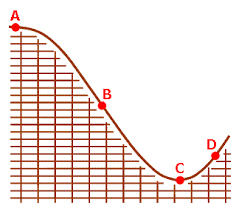
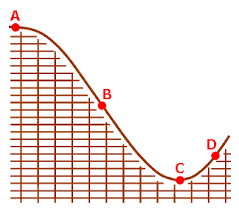
At which point(s) on the roller coaster is the potential energy at its maximum?
A
B
C
D

Jim's pet ferret ran through your yard. The ferret has a mass of 10 kg. He is running at a speed of 8 m/s. What is the kinetic energy of the ferret as he runs?
160 J
640 J
80 J
320 J
Explain what happens to the potential energy of a ball as it rolls off the edge of a table and begins falling to the floor.
The kinetic energy decreases as the potential energy increases.
The kinetic energy decreases as the potential energy decreases.
The potential energy decreases as the kinetic energy increases.
The potential energy decreases as the kinetic energy decreases.
If all objects are moving as the exact same speed, which would have the greatest kinetic energy?
baseball
football
ping pong ball
bowling ball
The calculate the kinetic energy of an object you must know its...
mass and height
height and speed
mass and velocity
mass and force
How many atoms of hydrogen are in C6H12O6?
1
6
12
24
How many atoms of iron are in 3Fe2O3?
3
6
2
3
Why do the noble gases not react with other elements?
They don't want to
They need too many electrons
Their valence electrons are complete
Their protons and electrons are balanced
How many total atoms are in the molecule of baking soda, (NaHCO3) ?
1
4
6
7

A proton has a ___ charge.
positive
negative
no charge
it depends

An electron has a ___ charge.
no charge
positive
negative
it depends
Covalent bonds ______________ valence electrons.
give
take
keep
share
An ionic bond forms when atoms ___________ .
both gain electrons
share electrons
both lose electrons
transfer electrons
Why does an atom tend to chemically bond with another atom?
To become more stable
To remain on its present state
To maintain its energy
To decrease its stability

What is the number of valence electrons for Oxygen?
1
2
6
4
__________are formed when two or more atoms bond by sharing or transferring electrons.
protons
elements
molecules
ions

When the pressure on a liquid is lowered, it...
turns into a solid
will boil slower
lowers the boiling point so water boils at a cooler temperature and foods need to cook longer
raises the boiling point so water needs to be hotter before it boils

Sprinkling salt on icy roads helps to melt the ice because...
it lowers the temperature at which water will freeze/melt.
it raises the temperature at which water will freeze/melt
it becomes less slippery
it heats up the ice


What is the change of state from a gas to a liquid called?
deposition
sublimation
evaporation
condensation
What causes molecules to slow down?
Heating them up
Cooling them down
Decreasing the pressure on them

State of matter with a definite volume but no definite shape
solid
liquid
gas
Mississippi
This type of matter contains only one kind of atom.
element
compound
mixture
water
Suppose you put a teaspoon of sugar into a glass of water and stir. The sugar seems to disappear, but you can still taste it when you drink the water. What have you created?
a suspension
a compound
a solution
an element
When it rains, the combination of water and soil creates mud. Since the water and soil do not chemically combine, mud is considered to be:
an element
a compound
a molecule
a mixture

A bottle of clear hand sanitizer has a list of ingredients that includes water, ethyl alcohol, isopropyl alcohol, glycerol, and fragrance. What can you infer about the material in the bottle from this label and the appearance of the liquid?
It is a pure substance.
It is a compound.
It is a heterogeneous mixture.
It is a homogeneous mixture.

You fill a jar with muddy brown river water and set it on a picnic table. When you come back 2 hours later the bottom of the jar is filled with a layer of sand and silt and the water is clear above that. What is this an example of?
a colloid
a suspension
a solution
a compound
An example of a heterogeneous mixture is...
Coffee
Kool-Aid
Italian Salad Dressing
Salt Water
Carbon Dioxiden (CO2) is a ______
compound
element
mixtures
colloid
These are mixtures that are not the same throughout.
homogeneous mixtures
heterogeneous mixtures
solutions
water
The air in our atmosphere is a(n) _________.
element
mixture
compound
energy
An example of a homogeneous mixture is...
Pizza
Granite
Italian Salad Dressing
Salt Water
Which of the following is not an acid?
lemon juice
vinegar
ammonia
sour candy
Which of the following is a characteristic property of iron?
mass
volume
reacts with oxygen
shape

Aluminum is a metal that can be flattened and molded into different shapes. It shows high ...
Magnetism
Hardness
Reactivity
Malleability
The boiling point of water is...
32 degrees Celsius
109 degrees Celsius
100 degrees Celsius
-29 degrees Celsius
Physical properties....
change the matter when studied
can be observed and measured without changing the matter being studied
include the ability to burn and rust
are useless unless studied in a lab
An apple turns brown when in contact with oxygen in the air: Chemical or Physical Property
Chemical Property
Physical Property
______________________ can only be recognized when substances react or do not react chemically with one another.
Physical properties
Chemical properties
Flammable properties
Colorful properties
Which of the following items is NOT matter?
a candy cane
a beam of sunlight
a snowflake
a star

