wayground logo

Free Printable Worksheets

Font size

S
M
L
XL
Worksheets

Electrostatics

Total questions: 30

Worksheet time: 22mins

Name
Class
Date
1.

If the electrostatic force on an object is originally 10 N and the distance between the objects doubles, what is the value of the new force

a)

20 N

b)

40 N

c)

5 N

d)

2.5 N

2.
Two like charges
a)
 neutralize each other.
b)
repel each other. 
c)
must be neutrons. 
d)
attract each other.
3.
The charge of an electron is 
a)
positive. 
b)
negative. 
c)
Electrons have no charge
4.
An atom loses an electron.  What type of charge does it have now?
a)
positive
b)
negative
5.
An atom gains an electron.  What type of charge does it have now?
a)
positive
b)
negative
c)
No charge
6.
Charged objects are not attracted to neutral objects
a)
True
b)
False
7.
When a balloon is rubbed on clothes it acquires a charge by ___________
a)
Induction
b)
reduction
c)
friction 
d)
concuction
8.
Which of the following is not a good conductor of electricity?
a)
copper
b)
silver
c)
Glass
d)
aluminum
9.
Which of the following is not a good insulator?
a)
Copper
b)
Glass
c)
rubber
d)
wool
10.
If two balloons have the same charge, what will happen if you place them close to each other?
a)
Nothing
b)
They will be attracted
c)
They will pop
d)
They will push each other away.
11.
What is the name of this device that is used to detect charges?
a)
beaker
b)
electroscope
c)
van de graff generator
d)
chargometer
12.
Insulators are different than conductors in that insulators ____.
a)
do not contain electrons or protons 
b)
 do not contain any charge
c)
have a weaker affinity for electrons 
d)
do not allow charge to freely move 
13.
Two electrically neutral metal spheres, A and B, on insulating stands are placed in contact with each other. A negatively charged rod is brought near, but does not touch the spheres, as shown in the diagram below. How are the spheres now charged?
a)
A is positive and B is positive.
b)
A is negative and B is positive.
c)
A is positive and B is negative.
d)
A is negative and B is negative.
14.

After a balloon is rubbed against wool, the two objects will ________ each other because they have ___________ charges

a)

attract; like

b)

attract, opposite

c)

repel; like

d)

repel; opposite

15.
If a negatively charged rod touches a conductor, the conductor will be charged by what method? 
a)
Friction
b)
Conduction
c)
Induction
d)
Convection
16.
An object becomes negatively charged by
a)
losing protons
b)
gaining electrons
c)
losing electrons
d)
gaining protons
17.
What variable is a Coulomb the unit for?
a)
Charge
b)
Force
c)
Distance
d)
Mass
18.
What happens to the force between two charged objects when you double the distance between them?
a)
2X
b)
1/2X
c)
4X
d)
1/4X
19.

The image shows two charged particles with a force of 2.4 N. What would you predict the force of interaction would be when the magnitude of charge on q2 doubles?

a)

9.6 N

b)

4.8 N

c)

1.2 N

d)

.6 N

20.
What method of charging is depicted here?
a)
Induction
b)
Conduction
c)
Reduction
d)
Friction
21.

Use the following information to answer the question:

Object A is NEGATIVELY charged.

Object A and Object B attract.

Object B and Object C repel.

Object C and Object D attract.

What type of charge could Object D possess?

a)

ONLY Positive

b)

ONLY Negative

c)

Positive or Neutral

d)

Negative or Neutral

e)

Positive or Negative or Neutral

22.
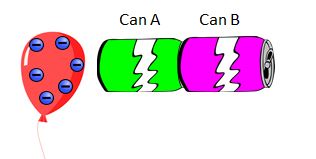
The negatively charged balloon is brought near the two cans. What happens?
a)
The negative charges in Can B move towards the balloon
b)
The negative charges in Can A move away from the balloon
c)
The positive charges in Can B move towards the balloon
d)
The positive charges in Can A move away from the balloon
23.
The cans are separated while the balloon is still near. What charge does each can have?
a)
Can A and Can B are neutral
b)
Can A is negative while Can B is positive
c)
Can A is positive while Can B is negative
d)
Both cans are positive
24.

What is the difference between a conductor and an insulator?

a)

An insulator allows electrons to flow through it easily and a conductor does not

b)

A conductor allows electrons to flow through it easily and an insulator does not.

c)

An insulator is magnetic and a conductor is not

d)

A conductor is magnetic and an insulator is not
25.
When you charge a balloon by rubbing it on your hair this is an example of what method of charging?
a)
Friction
b)
Conduction
c)
Grounding
d)
Induction
26.
Neutral atoms contain equal numbers of positive __ and negative __.
a)
Electrons and Protons
b)
Protons and Electrons
c)
Neutrons and Electrons 
d)
Protons and Neutrons
27.

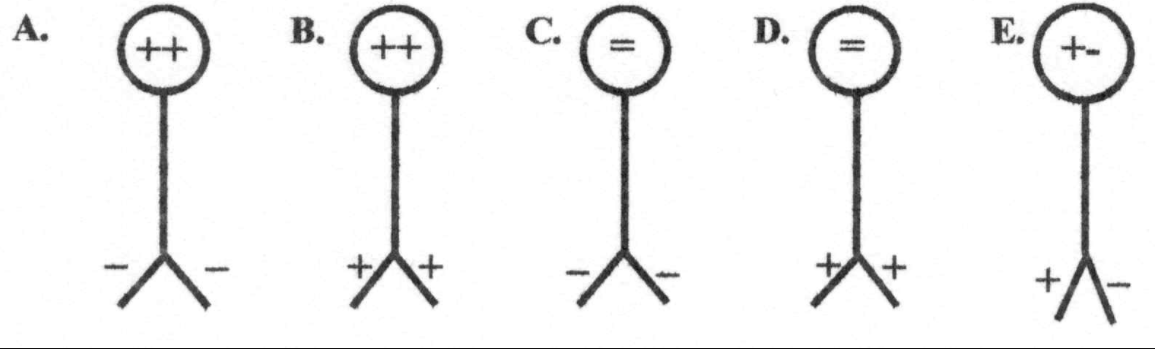
A negatively charged rod is touched to the top of an electroscope

a)

A

b)

B

c)

C

d)

D

28.
Which of these is the best definition of polarization?
a)
The object gains a positive or negative charge from another object.
b)
The charges in a neutral object separate due to a nearby charged object.
c)
Charges on a neutral object jump off onto a charged object due to attraction of opposite charges.
d)
Two objects attract each other because they are both charged.
29.
As a pair of charges is brought close together, the force between them
a)
Increases
b)
Decreases
c)
Increases only if they are the same sign
d)
Increases only if they are the opposite sign
30.

What is the triboelectric series?

a)

Like the World Series: objects compete for electrons

b)

A series of events that create a static charge

c)

A list of materials arranged by strength of electron affinity

d)

A number to show how well an object conducts electrons