wayground logo

Free Printable Worksheets

Font size

S
M
L
XL
Worksheets

DNA, Transcription, & Translation Review

Total questions: 40

Worksheet time: 36mins

Name
Class
Date
1.
Which of the following best describes a DNA molecule?
a)
double helix
b)
contains ribose
c)
made of amino acids
d)
contains Uracil
2.
Why is DNA important?
a)
it is very small and very complicated
b)
it's in everything
c)
it serves as the blueprint for traits of all living things
d)
because we eat it every day for energy
3.
What are the 4 nitrogen bases in DNA?
a)
adenine, thymine, cytoplasm, and guanine
b)
adenine, thymine cytosine, and guanine
c)
adenine, thymine, cytosine, and gylcerol
d)
adenine, thymine, cytosine, and glucose
4.

What is the term for a three base sequence that codes for an amino acid? For example: AUG

a)

Nitrogen base

b)

Codon

c)

Amine

d)

Phosphate group

5.
During TRANSLATION
a)
DNA makes RNA
b)
DNA makes DNA
c)
RNA makes PROTIENS
d)
RNA makes RNA 
6.
During TRANSCRIPTION
a)
DNA makes RNA 
b)
DNA makes DNA
c)
RNA makes Protiens 
d)
RNA makes RNA 
7.
Adenine bonds with ______________.
a)
Guanine
b)
Thymine
c)
Cytosine
d)
Adenine
8.
Guanine bonds with ______________.
a)
Adenine
b)
Guanine
c)
Cytosine
d)
Thymine
9.
Which organelle is DNA usually found in?
a)
cell membrane
b)
vacuole
c)
chloroplast
d)
nucleus
10.
Which sequence of DNA bases would pair with this partial strand
ATG TGA CAG
a)
ATG TGA CAG
b)
TAC ACT GTC
c)
GTA AGT GAC
d)
CAT TCA CTG
11.

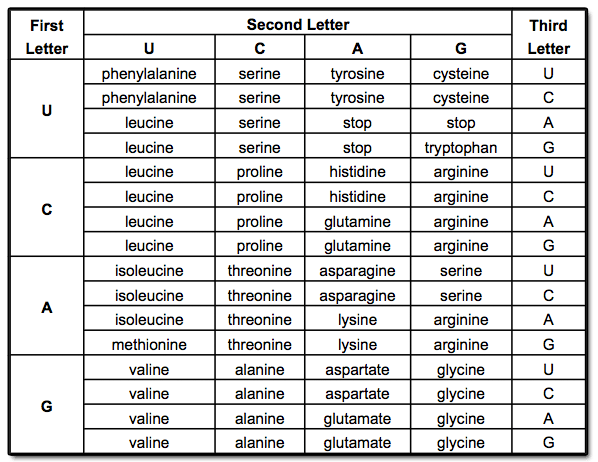
What is the correct amino acid sequence for the mRNA code AUG-CCA-GUA-UGA? (use the chart)

a)
Met-Pro-Ala-Val
b)

Met-Pro-Val-Stop

c)

Met-Pro-His-Stop

d)
Tyr-Gly-Arg-His
12.

In RNA the base T is replaced with

a)

U

b)

G

c)

C

d)

A

13.
What will the matching sequence be on a strand that reads AAGCTAT?
a)
AACGATA
b)
TTCGTTA
c)
CCTGATA
d)
TTCGATA
14.

The process where DNA copies itself:

a)

transcription

b)

translation

c)

replication

15.

The process where proteins are made from a strand of mRNA

a)

replication

b)

transcription

c)

translation

16.
In the DNA 'ladder', which is the correct combination?
a)
A&T G&C
b)
G&K K&A
c)
T&C G&E
d)
A&G  C&T
17.
order of replication
a)
3, 2, 1, 4
b)
2, 1, 4, 3
c)
2, 3, 1, 4
d)
3, 4, 1, 2
18.

Who was responsible for determining the structure of DNA? (you may click on more than one)

a)

Watson and Crick

b)

Chargaff

c)

Rosalind Franklin

d)

All of the above

19.

How many codons are coded for by this sequence of bases:

ATG GGA ACT CCA? (think how many bases you need to to use your chart)

a)

4

b)

2

c)

6

d)

12

20.
Rosalind Franklin's "Photo 51" allowed Watson and Crick to determine the ___ of DNA.
a)
Shape
b)
Backbone
c)
Nitrogen bases
d)
Hydrogen bonds
21.

Which organelle's job is to make protein?

a)

Cytoplasm

b)

Nucleus

c)

Ribosome

d)

ER

22.
Once replication in a DNA molecule is complete, each new DNA molecule contains 
a)
two new strands.
b)
3 exact copies of strands.
c)
one new strand and one old.
d)
two old strands.
23.

Genes contain the instructions for building:

a)

Protein

b)

Purines

c)

Pyrimidines

d)

DNA

24.

What is Replication?

a)

Creates Proteins

b)

Creates mRNA

c)

DNA is copied

d)

DNA is translated

25.

Genes determine _____________by coding for ___________

a)

proteins, traits

b)

traits, proteins

c)

nitrogenous bases, amino acids

d)

amino acids, proteins

26.
Which RNA bases would pair with TACGAA in transcription
a)
AUGCUU
b)
ATGCTT
c)
GCATCC
d)
GCAUCC
27.

Which amino acid is made from the RNA codon UUA?

a)

Phenylalanine

b)

Leucine

c)

Serine

d)

Tyrosine

28.

Using the codon identify the amino acid sequence:

AUG-CCA-GUA-GGG-UAA

a)

MET-HIS-ALA-GLY-STOP

b)

MET-PRO-GLY-VAL-STOP

c)

MET-PRO-VAL-GLY-STOP

d)

MET-THR-SER-ASP-STOP

29.
The nitrogen bases found in DNA are represented by the letters
a)
T, U, G, A, and C
b)
T,A, P and C
c)
A, U, G, and C
d)
A, T, G, and C
30.

At which position are hydrogen bonds found?

a)

Position 1

b)

Position 2

c)

Position 3

d)

Position 4

31.

What process is shown here?

a)

Mitosis

b)

DNA replication

c)

Protein synthesis

d)

Mutations

32.
If we think of DNA as a ladder, which parts are the steps of the ladder?
a)

the base pairs

b)
the phosphate-sugar backbone
c)
the genes
d)
the phospholipid bilayer
33.
If we think of DNA as a ladder, which parts are the sides of the ladder?
a)
the nitrogenous base pairs
b)
the phosphate-sugar backbone
c)
the genes
d)
the phospholipid bilayer
34.

_____________ are subunits that make up DNA.

a)

protein

b)

nucleotides

c)

amino acids

d)

traits

35.

During DNA replication, what is happening?

a)

The DNA is being deleted.

b)

The DNA is being copied.

36.

What are the parts of a nucleotide. (Choose 3)

a)

a sugar

b)

a phosphate

c)

a sulfate

d)

a nitrogen base

37.

This part of the DNA molecule represents the _______.

a)

sugar

b)

phosphate

c)

nitrogen base

d)

hydrogen bond

38.

This part of the DNA molecule represents the _______.

a)

sugar

b)

phosphate

c)

nitrogen base

d)

hydrogen bond

39.

What is the nitrogen base that belongs here?

a)

A

b)

T

c)

C

d)

G

40.

What does DNA stand for?

a)

don't know

b)

deoxyribose sugar

c)

deoxyribonucleic sugar