wayground logo

Free Printable Worksheets

Font size

S
M
L
XL
Worksheets

Midterm Review

Total questions: 138

Worksheet time: 3hrs 33mins

Name
Class
Date
1.
Which of the following is a testable hypothesis?
a)
Roses are more beautiful than violets 
b)
A plant needs at least five hours of sunlight per day to grow
c)
 Ice cream is delicious
d)
Humans will someday land on Mars 
2.
Evolution is one example of a theory. From what you know about the scientific method, what can you conclude about this biological theory? 
a)
It's been tested many times
b)
Scientists don't need to test it anymore
c)
No one is allowed to test whether it's true or not 
d)
There is very little evidence to support it 
3.
What might cause a theory to change over time? 
a)
New laws passed by the government
b)
 New but untestable ideas
c)
Changes in public opinion 
d)
 The discovery of new evidence
4.
What's the difference between a hypothesis and a theory? 
a)
"Theory" is another word for "fact;" "hypothesis" is another word for "guess"
b)
Hypotheses can't be proven; theories can
c)
Theories have been confirmed through tests; hypotheses haven't
d)
Theories contain many hypotheses; a hypothesis only contains one theory
5.
What must you do before you make a hypothesis?
a)
Run an experiment 
b)
Make observations 
c)
 Form a theory 
d)
Draw conclusions 
6.
If you were running an experiment to determine the temperature at which beans sprout the fastest, what would be the independent (manipulated) variable? 
a)
The number of beans you plant 
b)
The height of the sprouts you grow
c)
The amount of water you give the beans
d)
The temperature at which each bean is kept
7.
Mrs. R sets up an experiment to see how the mass of a ball affects the distance it rolls off a ramp.  Identify the responding variable (dependent variable).
a)
height of the ramp
b)
 distance traveled by the ball
c)
mass of the ball
d)
weight of the ball
8.
Experimenting on plant growth, a scientist uses three of the same type of plants, two different fertilizers,  an equal amount of daylight, and an equal amount of water. What type of variable is the fertilizer?
a)
Responding or Dependent
b)
Manipulated or Independent
c)
Control
d)
Compound
9.
A student hypothesized that robins prefer large birdhouses to small ones. He builds four birdhouses of different sizes to test his hypothesis. What is the independent variable?
a)
The size of the birdhouse
b)
The number of birds in the house
c)
The location of the birdhouse
d)
The season of the year
10.
A group of middle school students was given a short course in speed reading.  The teacher was curious of money could influence their performance on a test taken at the end of the course.  Half the students were offered $5 for a getting a certain percentage better at speed reading, the other half was offered no money.  Which is the dependent variable?
a)
Students being offered money or not.
b)
Their test  scores.
c)
Their age in school years.
d)
The length of the course.
11.
A student wanted to see which color board reflects more light.  They test this by taking the temperature of the board. The board that reflects the most light will have the lowest temperature.  They use 2 whiteboards, one with light and one without, and 2 blackboards, one with light and one without.
What is the control variable?
a)
The color of the board
b)
The amount of light reflected
c)
The boards with light
d)
The boards with no light
12.
Mrs. Goodwyn wants to see if studying time affects test scores...She gives all 6 classes the same assignment but assigns different study times. Which of the choices is a constant?
a)
Study  Times
b)
Test Scores
c)
Same Assignment
13.
What is the volume of the glue?
a)
10 mL
b)
13 mL
c)
8 mL
d)
21 mL
14.
What is the volume of the liquid in this graduated cylinder?
a)
8.6 mL 
b)
86 mL 
c)
8.06 mL 
d)
.86 mL
15.
What is the volume of the liquid in the cylinder?
a)
14 mL
b)
16 mL
c)
15 mL
d)
12 mL
16.
What kind of clouds are associated with thunderstorms?
a)
stratus
b)
nimbostratus
c)
cumulus
d)
cumulonimbus
17.
The typical weather pattern of a location over many years is called its
a)
weather
b)
Coriolis effect
c)
weather tendency
d)
climate
18.
It is possible for a location at 0 degrees latitude to have snow if
a)
it is surrounded by water
b)
it is at a high enough elevation
c)
the angle of insolation is high
d)
it is at sea level
19.
Thunderstorms are mainly associated with which type of front?
a)
occluded front
b)
stationary front
c)
warm front
d)
cold front
20.
Which piece of information below would not be recorded in a station model?
a)
type of front
b)
cloud cover
c)
wind speed
d)
precipitation type
21.
On a weather map, which lines connect locations that have the same air pressure?
a)
isotherms
b)
contour lines
c)
isobars
d)
hachure marks
22.
Which of the following has the least effect on an area's climate?
a)
elevation
b)
longitude
c)
proximity to a large body of water
d)
latitude
23.
What is the basic cause of all weather?
a)
incoming solar radation
b)
water vapor in Earth's atmosphere
c)
convection in Earth's atmosphere
d)
latitude
24.
What do most methods of cloud seeding have in common?
a)
all add water vapor to the air mass
b)
they are effective on all types of clouds
c)
all use silver iodide crystals
d)
all add particles to clouds to serve as condensation nuclei
25.
What is represented by this symbol?
a)
cold front
b)
warm front
c)
stationary front
d)
occluded front
26.
Which best describes a solar eclipse?
a)
moon's shadow falls on the Earth
b)
Earth's shadow falls on the moon
c)
Sun's shadow falls on the Earth
d)
Earth's shadow falls on the sun
27.
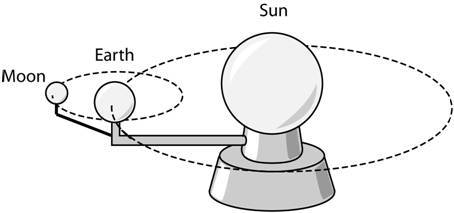
This model can be used to show some relationships between the Earth, Sun, and Moon.
The model shows all of the following EXCEPT –
a)
the relative sizes of the Moon and Earth
b)
the way the Moon revolves around the Earth
c)
the composition of the Moon, Earth, and Sun
d)
how the Moon and the Earth revolve around the Sun
28.
The time it takes the Moon to go from a new moon to a full moon and back to a new moon is about
a)
1 day
b)
14 days
c)
28 days
d)
365 days
29.
Earth has water in all three states (solid, liquid, and gas). This water is transported via the water cycle through Earth's hydrosphere, atmosphere, biosphere, and lithosphere. What allows Earth to be unique in this way?
a)
the length of its rotation
b)
the tilt of its axis
c)
its distance from the Sun
d)
the presence of oxygen in its atmosphere
30.
What moon phase is at position 7? 
a)
1st quarter 
b)
3rd quarter
c)
waning gibbous 
d)
waning crescent 
31.
What moon phase is at position 5? 
a)
waxing crescent 
b)
waxing gibbous
c)
full moon
d)
waning crescent 
32.
What is the correct order of the moon phases?
a)
new, full, 1st quarter, 3rd quarter
b)
new moon, 1st quarter, full moon, 3rd quarter
c)
1st quarter, 3rd quarter, new moon, full moon
d)
new, 1st quarter, 3rd quarter, full
33.
Which type of eclipse is shown in this picture?
a)
Solar Eclipse
b)
Orbit
c)
Lunar Eclipse
d)
Total Eclipse
34.
We do not have a solar or lunar eclipse each month because...
a)
The tilt of the moon's orbit is at 5 degrees
b)
The moon is too small
c)
The moon's orbital distance changes
d)
All choices
35.
The outer planets are largely composed of
a)
magnesium and iron
b)
hydrogen and helium
c)
oxygen and carbon dioxide
d)
nitrogen and oxygen
36.
What caused inner planets to lose hydrogen and helium as they formed?
a)
hydrogen and helium were not in the solar nebula
b)
hydrogen and helium sank to the core of inner planets
c)
fusion of hydrogen to form helium
d)
energy from the sun blew the lighter gases to space
37.
99% of Earth's atmosphere is composed of which two gases?
a)
nitrogen and oxygen
b)
hydrogen and helium
c)
oxygen and carbon dioxide
d)
hydrogen and oxygen
38.
Which planet spins backward and is the slowest of all the planets?
a)
Mars
b)
Neptune
c)
Venus
d)
Earth
39.
The right combination of temperature, water, and oxygen
a)
affects Neptune’s orbit.
b)
supports life on Earth.
c)
causes gas giants to form.
d)
results in storms on Jupiter.
40.
Which are the inner planets?
a)
Mercury, Mars, Earth, and Venus
b)
Earth, the Moon, Mars
c)
Neptune, Pluto, Earth
d)
:)
41.
How many planets are there all together in our solar system?
a)
10
b)
9
c)
8
d)
7
42.
What are the reasons for the seasons?
a)
Earth's tilt and rotation.
b)
Earth's rotation and revolution.
c)
Earth's tilt and revolution.
d)
Earth's tilt and resolution
43.
In this diagram, the motion of the Earth can best be described as -
a)
Rotation
b)
Revolution
44.
Day and night are caused by - 
a)
Rotation
b)
Revolution
45.
Earth and Mars have similar seasons because their axis is tilted to nearly the same degree. What can be inferred about a planet without a tilted axis? 
a)
Its temperatures are more extreme throughout the year.
b)
It has more seasons than Earth.
c)
It does not revolve around the Sun.
d)
It does not have seasons.
46.
Which of the following is true about the way planets in our solar system revolve around the sun?
a)
all are revolving clockwise around the sun
b)
all are revolving counterclockwise around the sun
c)
there is no pattern to the direction planets revolve
d)
we cannot determine the direction of revolution for some planets
47.
Which of these satellites first orbited Earth?
a)
Voyager
b)
Mercury
c)
Skylab
d)
Sputnik
48.
Which of these satellites orbited Earth most recently?
a)
Voyager
b)
Mercury
c)
Sputnik
d)
Skylab
49.
The timelines below list several events in space exploration. Which order is correct?
a)
Apollo 11 lands on Moon - Sputnik launch - Mercury orbits Earth - Viking I lands on Mars
b)
Mercury orbits Earth - Sputnik launch - Apollo 11 lands on Moon - Viking I lands on Mars
c)
Sputnik launch - Mercury orbits Earth - Apollo 11 on the Moon - Viking I lands on Mars
d)
Sputnik launch - Apollo 11 - Mercury orbits Earth - Viking I lands on Mars
50.
Which of these is a list of technologies that developed through our research designed to help us explore space?
a)
freeze-dried food, lightweight fabrics, medical monitoring devices
b)
adjustable beds, GPS, better rockets
c)
radio communication, reflective material, plastic
d)
plastic, compact disks, Bluetooth
51.
Density can be calculated, but cannot be measured directly. This is because it expresses a relationship between two variables that can be measured. What relationship does density describe?
a)
relationship between the control and constant
b)
relationship between the independent variable and the dependent variable
c)
relationship between mass and volume
d)
relationship between the state of matter and volume
52.
What property do these tools measure?
a)
volume
b)
mass
c)
length
d)
temperature
53.
An object that floats in water is _____________
a)
Less dense than water
b)
More dense than water
c)
Same density as water
54.
Put the liquids in order from most dense to least dense.
a)
4, 3, 2, 1
b)
1, 2, 3, 4
c)
3, 4, 2, 1, 
d)
4, 3, 1, 2
55.
Find the volume of this piece of brass.  
a)
50 g
b)
10 cm
c)
6 cm3
d)
12 cm3
56.
The density of this material is 2 g/cm3.
There are 24 cm3  Find the total mass.
a)
12 grams
b)
48 grams
c)
12 g/cm3
d)
48 g/cm3
57.
Which box has a higher density?  
a)
Box A
b)
Box B
c)
cannot be determined
d)
they are the same
58.
Find the density of a 2 cm x 2 cm x 2 cm cube with a mass of 64 g.
a)
6 cm3
b)
12 g/cm3
c)
128 g/cm3
d)
8  g/cm3
59.
What units are used to measure volume of a liquid?
a)
cm
b)
cm3
c)
g/cm3
d)
mL
60.
What is the formula for density?
a)
density = mass x volume
b)
density = mass / volume
c)
density = mass + volume
d)
density = mass - volume
61.
The Gulf stream carries _____________ water from the east coast of The United States to the West coast of Europe.
a)
Cold
b)
Warm 
c)
Freezing
d)
Fresh
62.
Two types of water currents are
a)
local and global
b)
sea and land
c)
surface and deep
d)
warm and cold
63.
What process brings the deep cold ocean currents up to the surface?
a)
Conduction
b)
Global Wind Patterns
c)
Convection Currents
d)
Temperature and salinity
64.
Ocean water with a high salinity is...
a)
more dense and sinks
b)
less dense and floates
c)
more dense and floats
d)
less dense and sinks
65.
Surface currents are a result of
a)
Global Wind Patterns
b)
Earth's Rotation
c)
Density
d)
All of the above
66.
What is an upwelling?
a)
wind current push away surface water, allowing deep water to flow up
b)
warm rainwater mixes with surface water
c)
cold surface water from the poles sinks
d)
surface runoff from rivers causes warm water to sink
67.
What do you call an underwater mountain?
a)
trench
b)
abyssal plain
c)
seamount
d)
volcanic island
68.
What is a deep, underwater valley or canyon on the ocean floor?
a)
seamount
b)
trench
c)
continental rise
d)
continental slope
69.
As you go from the continental shelf to the abyssal plain, the water temperature gets _____________
a)
warmer
b)
colder
70.
A steep drop after the continental shelf is the continental...
a)
slope
b)
shelf
c)
rise
71.
Mountain ranges in the ocean
a)
mid -ocean ridge
b)
trenches
c)
rift
d)
ocean basin
72.
Which section represents the continental rise?
a)
Section 2
b)
Section 5
c)
Section 3
d)
Section 1
73.
Briefly describe the overall relationship between temperature and density.
a)
Lower temperature water has higher density, warmer water has lower density
b)
Lower temperature water has lower density, warmer water has higher density
74.
The measure of the amount of dissolved salts in a given amount of liquid
a)
salinity
b)
deep-ocean basin
c)
thermocline
d)
mid-ocean ridge
75.
How does excess (too much) carbon dioxide in the atmosphere change the ocean?
a)
it reduces the pH of the water
b)
it makes the water warmer
c)
it makes the water cooler
d)
it raises the pH of the water
76.
The food web in the ocean can be disrupted by changes in the gas concentrations in the atmosphere, such as carbon dioxide.
a)
true
b)
false
77.
Which changes temperature more quickly?
a)
water
b)
land
78.
What is the main way energy is transferred (moved around) in the ocean?
a)
conduction
b)
radiation
c)
convection
d)
whales mix it up
79.
How is sonar used to study the ocean?
a)
another way to measure water temperature
b)
used to measure the salinity, or salt content, of the water
c)
uses sound waves to detect radioactive material on the seafloor
d)
measure the time it takes for sound waves to return from the seafloor; can map the seafloor
80.
in what formation must the Earth Sun and Moon be for a neap tide to occur? 
a)
a right angle
b)
a straight line
c)
an obtuse angle
d)
an acute angle
81.
What is a difference between spring and neap tides?
a)
Spring tides occur when the earth and sun are IN LINE with the new or full moon. 
b)
Spring tides occur when moon in 3rd or 1st quarter phases
c)
Spring tides are LOWER than neap tides
d)
Spring tides occur in Spring and neap tides can occur in any season
82.
Which body has the greater effect on Earth's tides?
a)
Sun
b)
Saturn
c)
Moon 
d)
Venus
83.
How can ocean surface currents affect continents?
a)
draw water away from the land
b)
cause more frequent precipitation
c)
cause more frequent flooding
d)
make the coast warmer or cooler depending on whether the current is warm or cool
84.
This image demonstrates that air pressure is greater close to Earth's surface because
a)
the air is less dense at lower altitudes
b)
the air molecules are larger near the surface
c)
the air is more dense near the surface
d)
warm air is more dense than cold air
85.
Which of these is least likely to occur due to increased carbon dioxide in the atmosphere?
a)
drought and loss of crops like corn
b)
decrease in evaporation
c)
polar ice caps melt
d)
sea level rises
86.
Which planet has the greatest greenhouse effect?
a)
Earth
b)
Mars
c)
Mercury
d)
Venus
87.
Which planet out of the choices below has the least greenhouse effect?
a)
Venus
b)
Jupiter
c)
Earth
88.
Which gas, when added to Earth's atmosphere from volcanic eruptions, allowed it to hold heat?
a)
nitrogen
b)
hydrogen
c)
carbon dioxide
d)
oxygen
89.
Of the following gases, which became abundant in Earth's atmosphere only recently?
a)
oxygen
b)
nitrogen
c)
carbon dioxide
d)
water vapor
90.
Which of the following best decribes how Earth's atmosphere and that of Venus compare to each other?
a)
Earth has less carbon dioxide than Venus
b)
Earth has less oxygen than Venus
c)
Earth has more carbon dioxide than Venus
d)
Earth's atmosphere is more dense than Venus' atmosphere
91.
What percentage of Earth's atmosphere is nitrogen?
a)
21%
b)
less than 1%
c)
1%
d)
78%
92.
What percentage of Earth's atmosphere is a mix of trace gases (meaning they are found in only tiny amounts)?
a)
1%
b)
21%
c)
78%
d)
50%
93.
What do scientists study to learn more about Earth's ancient atmosphere?
a)
rocks
b)
dinosaur fossils
c)
ice cores
d)
mammal fossils
94.
Which gas was not abundant in Earth's atmosphere soon after the formation of Earth's moon (Earth's second atmosphere)?
a)
water vapor
b)
nitrogen
c)
carbon monoxide
d)
hydrogen
95.
Where did cyanobacteria form?
a)
in Earth's early atmosphere
b)
in Earth's early ocean
c)
in Earth's first rock layers
d)
in the nebula that later formed our solar system
96.
How do blue-green algae get food?
a)
they consume oxygen during respiration
b)
they consume oxygen during photosynthesis
c)
they consume carbon dioxide during respiration
d)
they consume carbon dioxide during photosynthesis
97.
Which pie chart describes the composition of Earth's atmosphere?
a)
A
b)
B
c)
C
d)
D
98.
If something is "abundant," it means
a)
it is rare
b)
there is a lot of it
c)
it is unusual in some way
d)
there is very little of it but it is very valuable
99.
What evidence is there for the time frame of when oxygen became common in Earth's atmosphere?
a)
we have an abundance of fossil fuels
b)
rocks containing iron oxidized, or rusted
c)
moon rocks have a similar composition to Earth's seafloor
d)
comets contain frozen water
100.
Burning fossil fuels and combustion may cause
a)
more oxygen to form in Earth's atmosphere
b)
more carbon dioxide to enter the atmosphere
c)
more nitrogen to remain in the atmosphere
d)
more water vapor to enter the atmosphere
101.
The stratosphere is where you can find
a)
the ozone layer
b)
weather
c)
meteors burning up
d)
auroras
102.
What role did volcanic eruptions play in the formation of Earth's atmosphere?
a)
removed oxygen
b)
removed carbon dioxide
c)
released oxygen 
d)
released gases like water vapor, carbon dioxide, and carbon monoxide
103.
In the troposphere as altitude increases, temperature_____
a)
increases
b)
decreases
c)
stays the same
104.
The layers of the atmosphere are based on:
a)
Temperature
b)
Altutude
c)
Density
105.
Where is the air pressure the greatest?
a)
1
b)
2
c)
3
d)
4
106.
What does this diagram illustrate?
a)
Ozone Layer
b)
The Greenhouse Effect
c)
Ultraviolet Radiation
d)
Layers of the atmosphere
107.
What is the only layer of the atmosphere that contains water vapor, therefore the only layer that experiences weather?
a)
Thermosphere
b)
Troposphere
c)
Stratosphere
d)
Mesosphere
108.
What is the function of the ozone layer?
a)
to allow UV rays to get to Earth
b)
to block UV rays from getting to Earth
c)
To keep oxygen in
d)
to allow meteors to get to Earth
109.
Which of the following is the correct order of the atmosphere layers from Earth to space?
a)
troposphere, stratosphere, mesosphere, thermosphere, exosphere
b)
troposphere, mesosphere, thermosphere, exosphere, stratosphere
c)
thermosphere, stratosphere, mesosphere, troposphere, exosphere
d)
troposphere, stratosphere, mesosphere, exosphere, thermosphere
110.
Convection in the atmosphere causes
a)
wind
b)
tides
c)
solar wind
d)
ozone depletion
111.
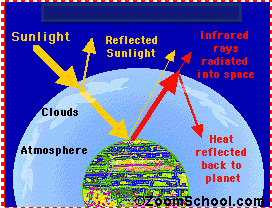
Which characteristic of the atmosphere is represented by the numbers on this map, such as '1024'?
a)
low humidity
b)
high humidity
c)
low air pressure
d)
high air pressure
112.

Why are regions near 0 degrees latitude always warm and near 90 are always cold, while those at middle latitudes have more variable, seasonal temperatures?

a)

at 0 degrees latitude, they are always near the warmer ocean

b)

the equator always receives about the same amount of radiant energy

c)

there are no mountains near 0 degrees latitude

d)

the equator does not have seasons since Earth's axis isn't tilted there

113.
Hurricanes are rotating storms that form in the tropical climate zone, with very low air pressure readings and strong winds. What happens to such a storm as it moves toward higher latitudes?
a)
it weakens, losing energy
b)
it strengthens, gaining wind speed
c)
it begins to circulate in the opposite direction
d)
it causes water spouts and tornadoes to form
114.

Which of the following is not associated with thunderstorm formation?

a)

cumulonimbus clouds

b)

colder air moving in and pushing up the warmer air mass previously in place

c)

cold fronts

d)

high air pressure in the area

115.
How are weather and climate related?
a)
weather happens over the long term, but climate occurs at one point in time
b)
weather and climate have opposite meanings
c)
weather and climate are synonyms
d)
the average weather conditions for an area are called its climate
116.

What kind of weather conditions would be possible in an area located near this symbol on a weather map?

a)

warm temperatures behind the symbol and possibly heavy rain

b)

cold temperatures behind the symbol and possibly thunderstorms

c)

plenty of sunshine and warm temperatures

d)

high humidity and high air pressure

117.
What kind of weather should you expect in a location near this symbol on a weather map?
a)
overcast conditions but no precipitation
b)
low humidity and low air pressure 
c)
cold temperatures and snow in areas behind the symbol on the map
d)
warm temperatures and possibly steady rain along the symbol on the map
118.
What does this symbol mean on a weather map?
a)
the warm air mass is moving faster and overtaking the cold air mass
b)
there is more warm air than cool air in the location
c)
neither the cold air mass nor the warm air mass is advancing; it's a stationary front
d)
the cold air mass is weakening as the warm air advances past i
119.
Winds always blow from
a)
higher pressure to lower pressure
b)
water to land
c)
warmer temperature to cooler temperature
d)
north to south
120.
The equator runs through which climate zone?
a)
polar
b)
central
c)
tropical
d)
temperate
121.
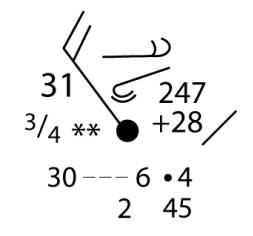
What is the wind direction at this station?
a)
Wind is blowing from the north
b)
Wind is blowing to the East
c)
Wind is blowing from the East
d)
Wind is blowing to the North
122.
What is the wind speed at this station
a)
3 knots
b)
15 knots
c)
25 knots
d)
30 knots
123.
Why do land breezes occur at night?
a)
Land cools off slower than water, so the air above water is cooler.
b)
Water cools off faster than land, so the air above land is warmer.
c)
Land heats up slower than water, so the air stays cooler during the day.
d)
Water cools off slower than land, so the air above water is warmer.
124.
What is the cloud coverage at this station?
a)
Not cloudy
b)
Partially cloudy
c)
Overcast
d)
Stormy
125.
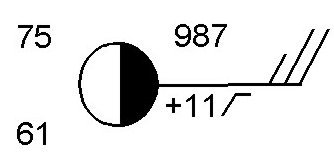
What is the temperature at this station
a)
75 degrees
b)
61 degrees
c)
987 degrees
d)
11 degrees
126.
Identify the type of front that is shown in the image.
a)
Occluded Front
b)
Cold Front
c)
Stationary Front
d)
Warm Front
127.
Which of the following technological advancements has most improved our ability to predict storms and therefore save lives, money and property?
a)
tornado intercept vehicles
b)
anemometers
c)
weather satellites
d)
weather maps
128.
During which month does Rome receive the most precipitation, on average?
a)
August
b)
October
c)
July
d)
January
129.

A rotating weather system that forms over the ocean off the west coast of Africa is most likely

a)

a hurricane in the Atlantic ocean

b)

a typhoon in the Pacific ocean

c)

a tsunami

d)

a nor'easter

130.

This weather instrument is a(n)...

a)

anemometer

b)

barometer

c)

wind vane

d)

thermometer

131.
If a rain gauge has 4 cm of precipitation before a storm and 7 cm after a storm, how much rain fell during the storm?
a)
7 cm
b)
4 cm
c)
3 cm
d)
11 cm
132.

Which of the following is not true of air pressure?

a)

it is the weight of molecules in the atmosphere as they are pulled downward by Earth's gravity

b)

a value of 980 is considered high pressure

c)

a value of 950 is considered low pressure

d)

when air pressure is observed to be increasing over several hours, it signals weather conditions are improving

133.

__________ a two-thermometer instrument slung around a rod or pole that is also referred to as a wet-dry bulb; used to measure relative humidity.

a)

thermometer

b)

barometer

c)

sling psychrometer

d)

anemometer

134.

Because Earth rotates on its axis:

a)

global wind belts curve

b)

Earth experiences seasons

c)

convection currents form

d)

Earth experiences tides

135.
A front is
a)
where warm air is cooling at earth's surface
b)
a line where hot and cold air are separating
c)
a line where two different air masses meet
d)
where cold air is rising and forming rain clouds
136.
Which most likely produces clear, cool weather?
a)
zero air pressure
b)
stable air pressure
c)
a low pressure system
d)
a high pressure system
137.
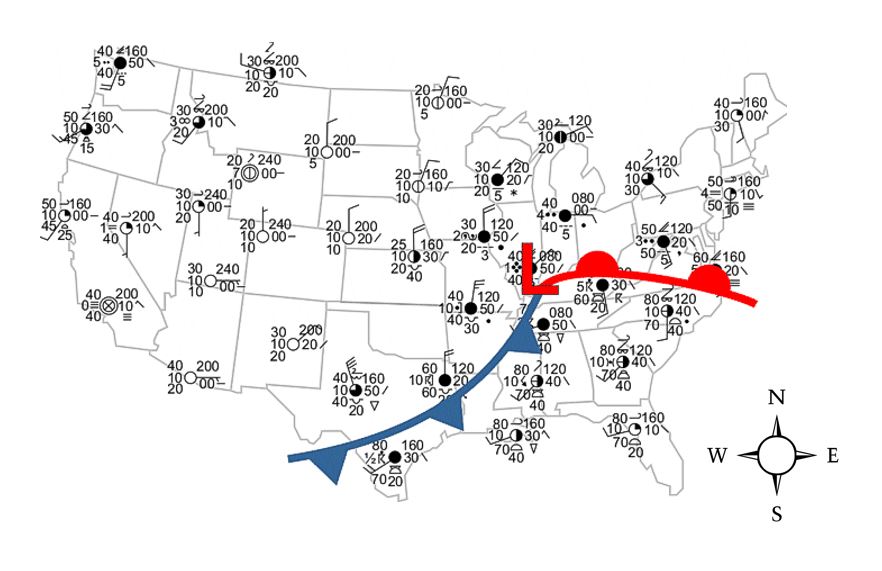
What direction is the cold front moving on the map? 
a)
Southwest
b)
Northwest
c)
Southeast
d)
Northeast
138.

Which one shows a warm front?

a)
b)
c)
d)