
 Worksheets
PRE Constitution Review
Total questions: 66
Worksheet time: 2hrs 41mins

What were the Articles of Confederation?
meaningless pieces of paper
a paper copy of letters sent between the states
the United States' first attempt at a written government

What did Shays' Rebellion show the need for?
a strong central government
more jail cells
more money printed

The Articles of Confederation gave the states more power than the central government.
True
False

What two houses make up Congress?
Senate
Jury
House of Representatives
Supreme Court

How much did the delegates decide slaves counted for?
half a person
three-fifths of a person
a whole person

What region includes present day Illinois, Indiana, Michigan, Ohio, and Wisconsin?
New England
Northeast Territory
Louisiana Territory
Northwest Territory

not allowing Congress to force soldiers to the army


Which of the following is the best summary of Shay's Rebellion?
Armed rebellion by English Loyalists in Rhode Island who wanted to return to British rule
Armed rebellion by Massachusetts farmers against taxes and the seizing of their farms
Armed rebellion by slaves in Georgia against their master, Mr. Shay
Armed rebellion by Native Americans from the Shay tribe to regain land they'd lost to American settlers


The Northwest Ordinance of 1787 (the rules for the settlement of the Northwest Territory) represented...

The main cause for many of the rules in the Articles of Confederation was that the delegates at the Continental Congress...
did not want to give the states too much power because they'd proven they were willing to rebel against a government.
wanted to create a government that was identical to England's government.
were concerned about giving the central government too much power because the King had used his power unfairly.
wanted to unify the states together, which included creating one army and one type of currency.


One major problem with the Articles of Confederation is that Congress could not force the citizens to ____________.
pay taxes
go on vacation
vote for president
move west of the Appalachian Mountains


How many states had to agree in order to amend the Articles of Confederation?
13
8
9
6

Which of the following was true about the Northwest Ordinance?
Slavery was allowed in the Northwest Ordinance.
A territory could petition to become a state when their population hit 6,000
Each new state would have the same rights and privileges of the other 13 states
Each territory did not guarantee freedom of religion and trial by jury


In what house of Congress does each state have equal representation?
Senate
House of Representatives
General Assembly
House of Commons

Every slave was counted.
Out of 4 slaves, only 3 were counted.
Out of 100 slaves, only 3 were counted.
Out of 5 slaves, only 3 were counted.

Representation in Congress was based upon population.
Two houses were created, one with equal representation and the other with representation based on population
Representation in Congress was equal.
Two houses were created, both with representation based on population.

Part of the compromise on slavery was that the slave trade would not end until at least
1776
1800
1808
1812

According to the Northwest Ordinance of 1787, one section of land in each township was set aside for...
farms
a school
a courthouse
a jail

How many sections were in a township?
5
36
18
101

In the Northwest Territory, land was to be divided into 6 by 6 sq mile sections called ??
counties
sections
townships
regions

Ohio
Pennsylvania
Indiana
Illinois

To approve, agree

In the Northwest Territory, did new states have more or less power than the original 13 states?
New states had more power so they could get more people to move there.
New states had less power since they didn't have as much exeprenice.
New states had the same amount of power as older states.

Where did Shay's Rebellion take place?
New York
Massachussetts
Virginia
Indiana

Farmers rebelled and shut down the courts because
they did not want to lose their farms
they wanted to rewrite the constitution

Who came up with the idea for townships?
George Washington
Thomas Jefferson
Alexander Hamilton
Ben Franklin

Some states refused to ratify the Articles of Confederation unless other states ceded their land claims. What does 'cede' mean?
develop into cities
build a school on it
give up
plant crops

What is currency?
a vegetable
money
a section of land
a cancellation

Who is called the Father of the Constitution?
George Washington
Thomas Jefferson
Alexander Hamilton
James Madison

What does bicameral mean?
Two months
Two people
Two house legislature
Two days

Which of the following is NOT a power of the federal government under the Articles of Confederation?
create an army
force citizens to pay taxes
manage relations with Native Americans
create treaties

Who was the presiding officer (leader) at the Constitutional Convention?
Thomas Jefferson
George Washington
John Adams
Ben Franklin

Which state did NOT send delegates to the Constitutional Convention?
Virginia
New Jersey
Rhode Island
Massachusetts

True or False: After the Revolution, Americans trusted their government.
True
False

The message of this cartoon is that the government under the Articles of Confederation is doing well.
true
false

What do the people in the boat represent?
soldiers
states
kings
slaves

What do the rocks in the river represent?
obstacles or problems
states
countries
nothing, it's just art

Which geographic features are the borders of the Northwest Territory?
The Ohio River and the Mississippi River
The Great Miami River and the Ohio River
The Muskingham River and the Mississippi River
The Mississippi River and the Scioto River

The Declaration of Independence was America's first plan of government.
true
False

When the population of a territory reached _______________, the people could apply for statehood.
10,000
60,000
100,000
600,000

Men who wrote the Constitution are called:
senators
representatives
founding fathers
buccaneers

Where was the Constitution written?
Washington, D.C
Boston, Massachusetts
Philadelphia (Independence Hall)
New York City

The __________________ plan wanted votes to be dependent on the population of the state. The more people you have in your state, the more votes you get in Congress.
Virginia
Massachusetts
New Jersey
New York

The __________________ plan proposed all states would have the same number of votes, one vote from each state.
Massachusetts
New Jersey
New York
Virginia

The _____________________ Compromise determined that the legislative branch would have two houses, with representation in one based on population, and in the other established at two representatives per state
Independence
Superior
Great
Smart


Ratify means
A tax on goods/products
To approve
Money that is owed
A legislature, or lawmaking group
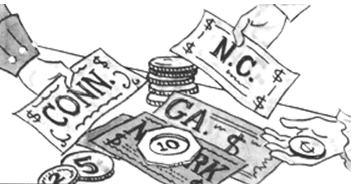
no national currency (money)
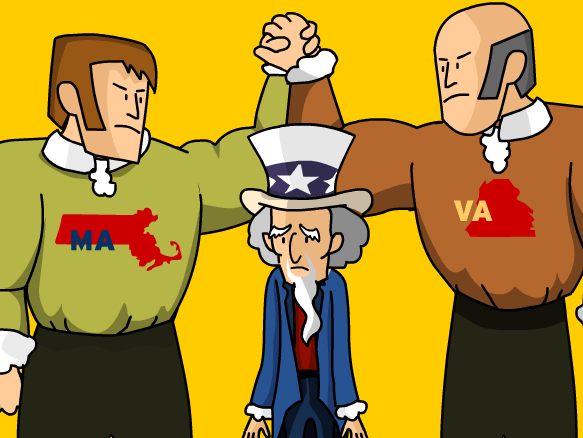
What event showed congress how weak the Articles of Confederation was?
Bacon Rebellion
American Revolution
Shay's Rebellion
Constitution

Why did Daniel Shays and other farmers rebel and start a fight in 1786?
they were angry that the country didn't write a better Constitution
they were in debt, their land was being taken and they were being thrown in prison
they were angry that George Washington was leading the Congress
None of the above

The Articles of Confederation were...
the King's plan for how to govern the newly freed colonies
the first Constitution
the first government of the U.S.
George Washington's plan for taking power as the new King

Under the Articles of Confederation who had the most power?
The states
The central government

The United States had a HUGE amount of debt after the Revolutionary War.
True
False

What is a republic?
A government with a King or Queen
A law about taxes
Where people elect leaders to represent them

After Shay's Rebellion, the Congress met to try to fix the Articles of Confederation. What document did they create instead that fixed the weaknesses in the Articles?
The United States Constitution
The Mayflower Compact
The English Bill of Rights
They didn't change the Articles

