wayground logo

Free Printable Worksheets

NEW

Font size

S
M
L
XL
Worksheets

Unit 5 - Hon Chem - Counting Particles (moles EF/MF)

Total questions: 70

Worksheet time: 2hrs 58mins

Name
Class
Date
1.
What is the molar mass of B2(CO3)3?
a)
81.632 g/mol
b)
94.842 g/mol
c)
38.822 g/mol
d)
201.648 g/mol
2.
What is the percent by mass of magnesium in MgO?
a)
20%
b)
40%
c)
50%
d)
60%
3.

What is the molar mass of one molecule of Nitrogen gas?

a)

14.01 amu

b)

14.01 g

c)

28.02 g

d)

28.02 amu

4.
If I filled up a container with a gas and that container could only fit 2 moles how much volume would it have of that gas?
a)
22.4L
b)
44.8L
c)
67.2L
d)
11.2L
5.
The number atoms of all kinds represented by the formula (NH₄)₂SO₄ is
a)
4
b)
10
c)
12
d)
15
6.
The molar mass of Cu₂CO₃ is
a)
123.5 g/mol
b)
155.0 g/mol
c)
187.0 g/mol
d)
211.0 g/mol
7.

“Empirical” means

a)

Simplest ratio based on experimental data

b)

hypothetical

c)

theoretical

d)

acquired by armed conflict

8.
What mass of argon gas contains the same number of atoms as 24.3 g of
magnesium?
a)
18 g
b)
39.9 g
c)
79.8 g
d)
none of these
9.
Calculate the relative mass of a dime as compared to the lightest.
a)
1
b)
2.18
c)
1.09
d)
2.46
10.
Calculate the relative mass of a nickel as compared to the lightest.
a)
1
b)
2.18
c)
1.09
d)
2.46
11.
Explain the connection between the relative mass calculations of the coins and the atomic masses in the Periodic Table.
a)
All element masses are relative to the lightest element H, which was assigned a mass of 1 amu.
b)
A mole of dimes has the same mass as a mole of Hydrogen.
c)
Dalton assigned the relative masses to the elements on the periodic table according to the mass of one dime.
d)
The element's masses are equal to the number of protons it has.
12.
What is the mass of 0.015 moles of Na₂SO₄?
a)
142 g/mol
b)
21.3 g
c)
2.13 g
d)
142 g
13.
How many moles of gold are contained in 0.650 grams of gold?
a)
0.0330 mol
b)
303 mol
c)
197 g/mol
d)
128 mol
14.

A 15.33 g sample of BaO is found to contain 13.73 g of barium. What is the percent by mass of the barium in this compound?

a)

1.6 %

b)

89.6 %

c)

29.06

d)

10.4 %

15.
A 15.33 g sample of BaO is found to contain 13.73 g of barium. What is the percent by
mass of the OXYGEN in this compound?
a)
1.6 %
b)
89.6 %
c)
29.06
d)
10.4 %
16.

What is the empirical formula if you have a compound has 81.82g carbon and 18.18 grams hydrogen?

a)

C3H8

b)

CH4

c)

C2H2

d)

C4H10

17.
What is the molecular formula if the empirical formula is CH2O and the molecular molar mass is 180.18?
a)
CH2O
b)
C2H4O2
c)
C4H8O4
d)
C6H12O6
18.

When calculating the empirical formula the mole ratio is given as follows: 1 Hydrogen to 3.5 Oxygen

What is the correct empirical formula?

a)

H1O3.5

b)

HO3.5

c)

HO4

d)

H2O7

19.

Compound contains 42.05 g of nitrogen and 95.95 g of oxygen. What is the empirical formula?

a)

NO

b)

NO2

c)

N2O

d)

N2O4

20.

2.40 g of an explosive, J, contains 0.473 g of nitrogen. J also contains 33.8% carbon and 1.41% hydrogen by mass. The remainder of J is oxygen.


What is the empirical formula of J?

a)

C4HNO2

b)

CH2N2O

c)

C2HNO2

d)

CHNO

21.

What charge does an atom have when it GAINS electrons?

a)

Positive

b)

Negative

c)

Neutral

22.

What is a representation of an ion?

a)

Li

b)

Na-22

c)

O-2

23.

What is the mass number of bromine?

a)

35

b)

45

c)

80

d)

79.904

24.

How many neutrons does this bromine atom have?

a)

35

b)

45

c)

80

25.

What type of atom is this?

a)

Neutral atom

b)

Cation

c)

Anion

d)

Isotope

26.

What two particles determine the mass number?

a)

Protons and electrons

b)

Electrons and neutrons

c)

Protons and neutrons

27.

What type of atom is this?

a)

Normal Atom

b)

Cation

c)

Anion

d)

Isotope

28.

What is the mass number of this Neon atom?

a)

10

b)

11

c)

21

d)

20

29.

How many electrons does this magnesium ion have?

a)

24

b)

12

c)

10

d)

14

30.

What does it change in an ion?

a)

The number of electrons

b)

The number of protons

c)

The number of neutrons

31.

What is the representation of an isotope?

a)

N-3

b)

Al+3

c)

Si

d)

P-33

32.

How many neutrons does this Neon atom have?

a)

21

b)

11

c)

10

d)

12

33.

What type of atom is element C?

a)

Normal atom

b)

Ion

c)

Isotope

34.

What is the mass number of this element?

a)

12

b)

24

c)

23

d)

11

35.

What element is this?

a)

Chromium

b)

Sodium

c)

Magnesium

36.
The atomic number is equal to _.
a)
the number of protons and electrons
b)
the number of neutrons only
c)
the total number of protons and neutrons
d)
the number of protons neutrons and electrons
37.
What is the charge on a lithium atom that looses 1 electron?
a)
+1
b)
0
c)
-1
d)
-2
38.
Helium (He atomic number 2) has 2 protons, 2 neutrons, and 2 electrons) is the He element shown above an atom, an element, or an isotope?
a)
atom
b)
cation  (+ ion)
c)
isotope
d)
anion (-)
39.
The atomic mass is equal to _.
a)
the number of protons only
b)
the number of neutrons only
c)
the total number of protons and neutrons
d)
the number of protons, neutrons, and electrons.
40.
What is the net charge on the element shown above? 
(Calcium - atomic number 20)
a)
cation +1 charge
b)
cation +2 charge
c)
anion -1 charge
d)
anion -2 charge
41.
What element is this?  What is the mass number of this atom?
a)
sodium, 23
b)
magnesium, 23
c)
magnesium, 12
d)
sodium, 11
42.
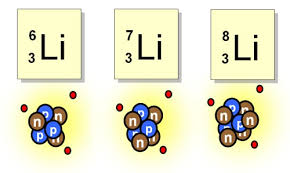
Which atom has  4 neutrons?
a)
Li-6
b)
Li-7
c)
Li-8
d)
they have the same # of neutrons
43.
How many neutrons does B (Boron) contain?
a)
5
b)
11
c)
6
d)
10.811
44.
Carbon has an atomic number of 6 and an atomic mass of 12. Which elements are considered isotopes of carbon?
a)
Carbon-12
b)
Carbon-13
c)
Carbon-14
d)
Both Carbon-13 and Carbon-14
45.
Two atoms that have different numbers of protons are 
a)
Different ions
b)
Different isotopes
c)
Different elements
46.
If neutral copper atom (atomic number 29) becomes an ion that has a charge of 2+, how many electrons does the resulting ion have?
a)
27
b)
28
c)
29
d)
31
47.
Two neutral atoms that have the same atomic number and different mass numbers are
a)
Ions
b)
Isotopes
c)
Alpha particles
d)
Different elements
48.
Which phrase describes two atoms that are isotopes
a)
Same mass number, same atomic number
b)
Same mass number, different atomic number
c)
Different mass number, same atomic number
d)
Different mass number, different atomic number
49.
An ion that has a negative charge is formed when an atom 
a)
Loses neutrons
b)
Loses electrons
c)
Gains neutrons
d)
Gains electrons
50.
How are Protons and Neutrons similar
a)
Both are in the nucleus of the atom and they both have the relative mass of 1
b)
They both have alpha particles and have the relative mass of 2
c)
They both have 1 high-energy electron and different elements
51.

What does the atomic number identify?

a)

The number of neutrons of a given atom.

b)

The number of protons of a given atom.

c)

The number of neutrons and protons of a given atom.

d)

The number of electrons of a given atom.

52.

Which subatomic particle is used to identify the atom, as it never changes?

a)

protons

b)

neutrons

c)

electrons

53.

How many neutrons are found in this isotope? 3115P3-

a)

31

b)

15

c)

16

d)

3

54.

How many protons are found in this isotope? 3115P3-

a)

31

b)

15

c)

16

d)

3

55.

How many protons are found in this isotope? 7533As

a)

75

b)

42

c)

33

d)

108

56.

The complete isotopic notation for a sodium ion with 10 electrons is

a)

A

b)

B

c)

C

d)

D

57.

Which of the following describes an anion

a)

protons = 8 neutrons = 8 electrons = 8

b)

protons = 8 neutrons = 8 electrons = 10

c)

protons = 8 neutrons = 10 electrons = 8

d)

protons = 10 neutrons = 8 electrons = 8

58.

Which of the following is an isotope with 38 protons and 50 neutrons

a)

Strontium-88

b)

Strontium-50

c)

Tin-88

d)

Tin-50

59.

How many electrons does the following have?

a)

2

b)

22

c)

10

d)

12

60.

How many neutrons are in the following isotope?

a)

108

b)

47

c)

61

d)

155

61.
An element has two naturally occurring isotopes. One is 10.013 amu and is 19.9% abundant. The other is 11.01 amu and is 80.1% abundant. What is the average atomic mass? What element is it?
a)
9.012, Beryllium
b)
12.011, Carbon
c)
6.941, Lithium
d)
10.812, Boron
62.
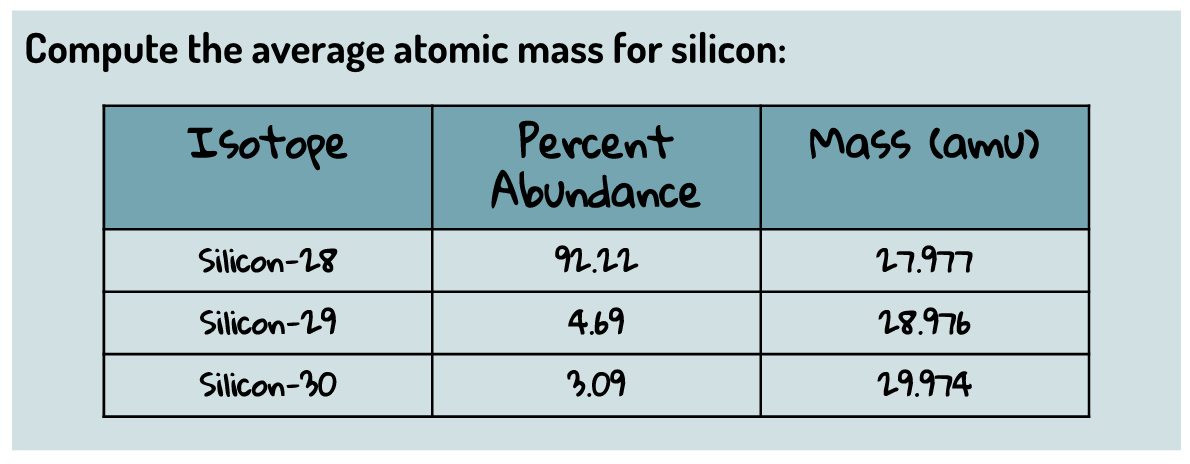
Compute the average atomic mass for silicon:
a)
27.977
b)
28.09
c)
28.976
d)
The average mass cannot be determined from provided information.
63.
The  mass of an atom is located  in the ___________ and the volume of an atom is made of the ____________
a)
electron cloud, nucleus
b)
electron cloud, energy levels
c)
nucleus, electron cloud
d)
nucleus, neutrons
64.
What is an ion?
a)
A Charged Atom
b)
A Large Atom
c)
A Small Atom
d)
A Cute Atom
65.
Four isotopes of lead include lead-204, lead-206, lead-207, and lead-208.  The average atomic mass of lead is 207.2.  Which isotope of lead is likely to be the most abundant.
a)
204
b)
206
c)
207
d)
208
66.
4.35% of all X atoms have a mass of 39.946 amu. 83.79% have a mass of 41.941 amu, 9.50% have a mass of 42.941 amu, and 2.36% have a mass of 43.939 amu. What is the average atomic mass of atom X?
a)
41.97 amu
b)
42.19 amu
c)
10.43 amu
d)
40.04 amu
67.
24.1% of all the isotopes of a an element have a mass of 75.23 amu, 48.7% have a mass of 74.61 amu, and 27.2% have a mass of 75.20 amu.
What is the average mass of this element?
a)
74.92 amu
b)
24.97 amu
c)
75.01 amu
d)
74.51 amu
68.

Chlorine has two naturally occurring isotopes, Cl-35 and Cl-37, The atomic mass of chlorine is 35.45. Which of these two isotopes of chlorine is more abundant?

a)

Cl-35

b)

Cl-37

c)

Cannot be determined from the information provided.

69.
24.1% of all the isotopes of a an element have a mass of 75.23 amu, 48.7% have a mass of 74.61 amu, and 27.2% have a mass of 75.20 amu.
How many protons does this element have?

a)
32
b)
33
c)
34
d)
no way to know
70.
An element has three different isotopes. One has a mass of 35.00 amu; another has a mass of 36.00  amu; and another has a mass of 38.00  amu. What is the average atomic mass of this element?
a)
36.33 amu
b)
37.00 amu
c)
12.11 amu
d)
impossible to tell