wayground logo

Free Printable Worksheets

NEW

Font size

S
M
L
XL
Worksheets

Adaptation

Total questions: 40

Worksheet time: 2hrs 34mins

Name
Class
Date
1.

An inherited trait that helps those organisms that have it to survive

a)

niche

b)

structure

c)

characteristic

d)

adaptation

2.

What is the advantage of having different shaped beaks?

a)

To look different from other species.

b)

To be able to eat the food readily available in the environment.

c)

To protect itself against predators.

d)

To protect itself against prey.

3.

Beak shape depends on...

a)

where birds live

b)

who they hang out with

c)

diet (fish or seeds)

d)

exercise

4.

This is the organisms with traits best suited to their environment are more likely to survive and reproduce.

a)

Variation

b)

Mutation

c)

Natural Selection

d)

Gradualism

5.

This is any variation that makes an organism better suited to its environment.

a)

Evolution

b)

Graduation

c)

Species

d)

Adaptation

6.
Which feature helps an animal hide from other animals?
a)
looking like a dangerous animal
b)
being the same color as the place it lives (camoflauge)
c)
having sharp claws or a strong shel
d)
having only a few young and caring for them
7.

A giraffe has a long neck in order to better reach leaves to eat. This is an example of _____.

a)

an adaptation

b)

environment

c)

response

d)

stimulus

8.

How do adaptations help animals?

a)

To escape animals

b)

to hunt for food

c)

to survive in their habitats

d)

All of these are correct

9.

Adaptation that refers to how an organism behaves and how interacts with other.

a)

adaptations

b)

mimicry

c)

behavioral

d)

camouflage

10.

An organism that hunts and feeds on another organism is a ______________________.

a)

prey

b)

producer

c)

predator

d)

decomposer

11.

An animal that is hunted as food

a)

prey

b)

predator

c)

decomposer

d)

producer

12.

A natural process in which new organisms are created and the species continues

a)

population

b)

niche

c)

reproduction

d)

behavior

13.
When an organism copies a characteristic of something else in order to better its chances for survival and reproduction
a)
hibernation
b)
camouflage
c)
mimicry
d)
migration
14.
The seasonal movement of an organism from one place to another
a)
camouflage
b)
migration
c)
hibernation
d)
function
15.
What was the name of the scientist who had the theory of evolution?
a)
Lamarck
b)
Einstein
c)
Washington
d)
Darwin
16.
Which of the following is a physical adaptation for the underlined animal?
a)
A snake unhinges its jaw to eat a rabbit it just caught.
b)
A hognose snake rolls over, slows its breathing, and hangs its tongue out to pretend to be dead.
c)
A herd of buffalo encircle their young to protect them from a pack of wolves.
d)
A dung beetle rolls a piece of dung across the desert.
17.
Which of the following is NOT a behaviour?
a)
Migration
b)
Hibernation
c)
Extinction
18.
Polar bears have compact ears, a small tail, and thick fur to keep themselves warm. Are these examples of physical (structural) or behavioural adaptations?
a)
Physical
b)
Behavioural
19.
The goal of every species on earth is...
a)
to survive and reproduce 
b)
divide and conquer 
c)
survive and conquer 
d)
reproduce and die 
20.
A trait or behavior that helps organisms survive and reproduce 
a)
multiplication 
b)
revolt
c)
adaptation 
d)
populate 
21.
What is the scientific term for an animal that is eaten by another animal?
a)
predator
b)
dinner
c)
prey
d)
stupid
22.
Lions often hide in the tall grass while stalking their prey.  This is an example of...
a)
camouflage
b)
warning coloration
c)
mimicry
d)
hibernation
23.
A pine snake moves it tail quickly in pine needles so it sounds like a rattle snake. This is an example of which type of behavior?
a)
camouflage
b)
mimicry
c)
estivation
d)
migration
24.
Michael went to the circus and saw a seal balance a beach ball on its nose.  This is an example of a...
a)
instinct
b)
mimicry
c)
camouflage
d)
learned behavior
25.
Which of these choices is an example of something that is needed for survival?
a)
Adaptation
b)
Food 
c)
Water
d)
All of the above
26.
Jessica’s dog Spike likes to dig holes and chase other dogs. He barks when a stranger approaches. Spike comes to Jessica whenever she calls him.Which is a learned behavior of Spike’s?
a)
barking at strangers
b)
digging holes
c)
chasing other dogs
d)
coming when called
27.
What is the scientific term for the ability to blend in with the surroundings?
a)
invisibility
b)
conservation
c)
ninja skills
d)
camouflage
28.
What is an adaptation?
a)
A feature or behavior that helps an animal survive.
b)
The food that an animal eats.
c)
How energy moves in a food web.
d)
How animals evolve throughout time.
29.
The ears of this fox are an example of...
a)
A behavioral adaptation
b)
Poor breeding
c)
A physical adaptation
d)
Plastic surgery gone horribly wrong
30.
A scientist puts 100 houseflies in a sealed container; then sprays an insecticide into the container.  Ninety-six of the flies die.  Four survive.  The scientist lets the survivors mate and produce offspring, then repeats the experiment with 100 offspring.  Fifty-six of them survive the spray.  This experimental result is evidence of – 
a)
adaptive radiation 
b)
speciation
c)
natural selection
d)
extinction
31.

which is the learned behavior?

a)

shape of beak

b)

monkey riding bicycle

c)

horse eating hay

d)

snake eating mice

32.

What is the difference between learned behavior and inherited trait?

a)

Learned behaviors are taught, and inherited traits are passed down from parent to child.

b)

Learned behaviors take years to acquire, and inherited traits take only a short time.

c)

Learned behavior are difficult to accomplish, and inherited traits are easy to accomplish.

d)

Learned behaviors are passed down from parent to child, and inherited traits are taught to children.

33.
The purpose of selective breeding is to 
a)
Get bigger animals
b)
get smaller animals
c)
create animals with desirable traits
d)
create animals with bad traits
34.
A farmer has bred his pineapple plants from the sweetest pineapples from his last harvest to get even sweeter pineapple plants. What is this an example of?
a)
Selective breeding
b)
Natural selection
c)
Extinction
d)
Mutagenesis
35.

The figure below shows four different species of finches found on the Galapagos Islands. Each of these finches evolved from a common ancestor through natural selection. Which of these finches is best suited to pick small insects off a cactus?

a)
b)
c)
d)
36.

The purpose of selective breeding is to

a)

Create animals and plants with desirable traits

b)

Get smaller animals and plants

37.
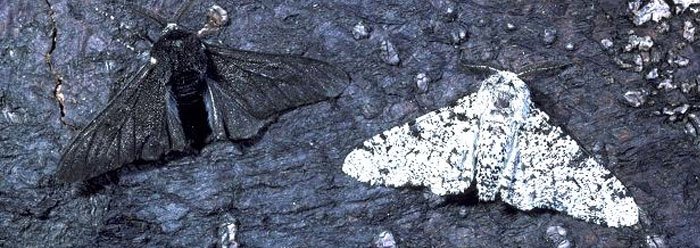
The trees these moths used to live on were white, but have been covered in soot from coal factories. Which moth will be more successful in this environment?
a)
Dark moth
b)
Light moth
c)
Both will be equally successful
d)
Neither will be successful
38.

For which trait is the breeder most likely selectively breeding chickens?

a)

Heavier bodies

b)

Longer beaks

c)

More white feathers

d)

More abundant tail feathers

39.

Which traits would be useful for farmers reproducing wheat in areas of short summers?

a)

long stem length

b)

large seed size

c)

fast growth rate

d)

shallow root system

40.

the process where humans SELECT specific favorable traits to be passed to the next generation

a)

Natural Selection

b)

Selective Breeding