
 Worksheets
Periodic Table & Trends Quiz Review
Total questions: 97
Worksheet time: 2hrs 37mins
The ability to attract an electron in a chemical bond
electronegativity
electron affinity
metallic character
ionization energy
The energy it takes to remove an electron from an atom in the gas phase
electron affinity
electronegativity
metallic character
ionization energy
Ionization energy increases
from L to R and from bottom to top
from L to R and from top to bottom
from R to L and from bottom to top
from R to L and from top to bottom
metallic character is greatest
in the top right corner
in the bottom right corner
in the top left corner
in the bottom left corner
Atomic radius decreases from left to right across a period because from left to right there is
increasing number of valence electrons
increasing shielding
increasing effective nuclear charge
increasing number of protons in the nucleus
The element with the highest electronegativity is -
At
F
Cl
Br
Which atom has the smallest metallic character?
O
Ba
Co
K
The ionization energy of Na is larger than Cs because...
Na has a greater effective nuclear charge
Na has fewer energy levels and less shielding
Cs has a greater effective nuclear charge than Na
Cs has more valence electrons than Na
As you move from top to bottom down a group on the periodic table, the number of valence electrons ___ .
Decreases
Increases
Stays the same
As you move from left to right across a period of the periodic table, the number of valence electrons ___.
Decreases
Increases
Stays the same
As you move from top to bottom down a group on the periodic table, the number of energy levels ___.
Decreases
Increases
Stays the same
As you move from left to right across a period of the periodic table, the number of energy levels ___.
Decreases
Increases
Stays the same
Which of the following elements has the greatest amount of energy levels?
Boron
Gallium
Thallium
They have the same number of energy levels.
As we travel from RIGHT to LEFT on the periodic table, ionization energy ________.
Increases
Decreases
Stays the same
Which of the group 13 elements is the smallest?
B
Ti
Fr
Ga
If an electron is closer to the nucleus, it will be (harder, easier) to remove that electron and its ionization energy will be (high, low )
Easier, High
Easier, Low
Harder, High
Harder, Low

Of the following pictured ions and atom, which would have the largest atomic radius


You can't tell from the pictures

Cl or Al?
H or F?
Which statement correctly and completely identifies a trend?
Atomic radius is highest in the lower left part of the periodic table and smallest in the upper right part of the periodic table
Electronegativity lowest in the upper right part of the periodic table and highest in the lower left part of the periodic table
Ionization energy lowest in the upper right part of the periodic table and highest in the lower left part of the periodic table.
Metallic character is lowest in the lower left part of the periodic table and highest in the upper right part of the periodic table
The element with the lowest electronegativity in Period 3 is -
Na
Cl
Ar
Mg
Electronegativity is...
the ability of an atom to attract/ accept electrons in a compound
the ability of an atom to lose electrons
the energy required to remove an electron from a specific atom
how easy it is to make friends.
A measure of the size of an atom, and is generally defined as the distance from the nucleus to the outermost electron orbit
chemical reactivity
atomic radius
energy levels
orbit
(select 2) Ionization energy increases as you move
Down a Group
Up a Group
Left to Right across a Period
Right to Left across a Period
(select 2) Electronegativity energy increases as you move
Down a Group
Up a Group
Left to Right across a Period
Right to Left across a Period
(select 2) Atomic Radius energy increases as you move
Down a Group
Up a Group
Left to Right across a Period
Right to Left across a Period
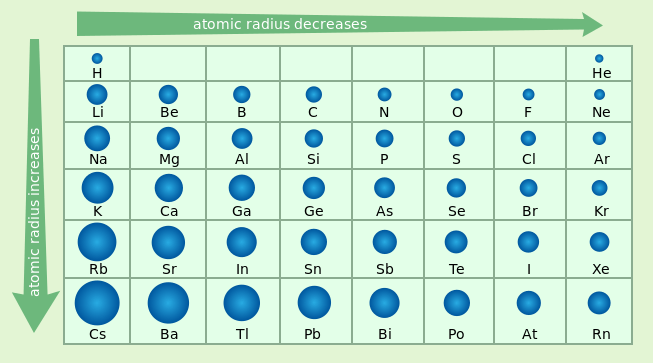


which of the following families is the least electronegative?
noble gases
Halogens
transition metals
alkali metals

The name given to vertical (up and down) columns of the periodic table
Group or Famly
Period
The charge of an atom that has an equal number of protons and electrons
Protons
Neutral
Electrons
This tells you the total number of protons plus the neutrons in an atom
Atomic Number
Valence
Atomic Mass
The name given to the horizontal (side to side) rows of the period table
Group or Family
Period
This tells you the number of protons in an atom
Atomic Number
Atomic Mass
AMU
The name of the particles in the furthest shell
Electrons
Neutrons
Protons
Valence Electrons

How many protons does this element have?
7
8
9
How many electrons does this element have?
7
8
9
You have an that has an atomic mass of 23 and an atomic number of 11. How many neutrons does it have?
12
13
14
11
Elements between metals and nonmetals are called
Gasses
Metalloids
Radioactive
What is the name of group number 1?
halogens
noble gases
alkali metals
alkaline earth metals

Which element is found in group 2, period 6?
Oxygen (O)
Barium (Ba)
Selenium (Se)
Carbon (C)
Which halogen is found in period 4?
Krypton (Kr)
Xenon (Xe)
Bromine (Br)
Iodine (I)
Using your periodic table, locate the element with the average atomic mass of 101.07 What is the element symbol for this element?
Me (mendelevium)
Os (osium)
Ru (ruthenium)
No (nobelium)
All atoms of a given element contain:
the same number of protons
the same number of neutrons
the same number of electrons
the same number of protons, neutrons, and electrons
none of the subatomic particles will be the same - every atom is different
Using your periodic table, locate the element with the atomic number of 35. What is the element name for this element?
B (boron)
He (helium)
Cl (chlorine)
Br (bromine)
What do elements in the same group on the periodic table have in common?
They have the same number of protons.
They have the same atomic number.
They have similar chemical symbols.
They have the same number of valence electrons.
They have the same average atomic mass.
Elements on the periodic table are classified into which three major categories (classes)?
atomic number, chemical symbol, element name
solid, liquid, gas
metals, nonmetals, metalloids
period, row, columns
. The periodic table has a lot of information in the form of letters and number. The information is organized into boxes, which are placed into rows and columns. Which of the following does each box represent?
a group
a period
an element
an atom
What is true about the position of all metals in the periodic table?
They are in the group 3.
They are in period 1.
They are to the right of the zigzag line created by the metalloids.
They are to the left of the zigzag line created by the metalloids.
They are the touching the zigzag line created by the metalloids.
What is true about the position of all nonmetals in the periodic table?
They are in group 13.
They are in period 3.
They are to the right of the zigzag line created by the metalloids.
They are to the left of the zigzag line created by the metalloids.
They are the touching the zigzag line created by the metalloids.
Which describe how elements are arranged in the periodic table?
by decreasing atomic number
alphabetical order by element symbol
by increasing atomic mass
by increasing atomic number
by decreasing atomic mass
. ______________ are elements that have some properties of metals and some properties of nonmetals.
metals
nonmetals
metalloids
gasses
______________ are elements that are good conductors of heat and electricity. They are usually shiny and malleable.
metals
nonmetals
metalloids
gasses
______________ are elements that are poor conductors of heat and electricity. They are usually dull and brittle.
metals
nonmetals
metalloids
gasses
______________ is credited with creating the periodic table.
Sir Isaac Newton
Albert Einstein
Marie Curie
Dmitri Mendeleev
The periodic table ______________.
has never changed since the time of Aristotle.
changes whenever someone makes a claim that it should whether or not there is evidence.
always has been the same and will never change.
changes as scientist have new data about new elements.
If scientists discover a new element, what would happen to the current periodic table?
It has never changed since the time of Aristotle so the element wouldn’t be added.
Nothing would happen.
It would change to include the new element as long there was enough evidence to prove that it really existed.
It would be added to the new periodic table in 2100 as new elements can only be added every 100 years.
Elements in the same column have the same number of
valence electrons which results in them having similar
___________.
atomic mass
color
physical properties
chemical properties
_________ is an element with an atomic number of 19 that can
be found in the periodic table.
calcium
potassium
chlorine
flourine
______ is the element with the fewest protons that can
be found in the periodic table.
hydrogen
helium
oganesson
lawrencium

The first orbital can hold ______ electrons.
2
8
18
0
the positively charged subatomic particle contained in the nucleus of an atom
proton
neutron
electron
matter
a subatomic particle, contained in the nucleus of an atom, having the same mass as a proton but no electrical charge
proton
neutron
electron
matter
a negatively charged subatomic particle that orbits the nucleus of an atom
proton
neutron
electron
matter

