wayground logo

Free Printable Worksheets

Font size

S
M
L
XL
Worksheets

SE Review - All Topics APA

Total questions: 100

Worksheet time: 25hrs 0mins

Name
Class
Date
1.

The correct name of Cu₃N₂ is

a)

copper (III) nitride

b)

copper (II) nitride

c)

copper nitride

d)

tricopper dinitride

2.

What is the correct name for MgI₂?

a)

Manganese IV iodide

b)

Manganese diiodide

c)

Magnesium iodide

d)

Magnesium diiodide

3.
What is the correct name for P₃Cl₆?
a)
Potassium chloride
b)
Phosphorous chloride
c)
Triphosphorous hexachloride
d)
Tetraphosphorous heptachloride
4.
What is the correct name for SO₂?
a)
Sulfur oxide
b)
Sulfite
c)
Sulfur dioxide
d)
Sulfur II Oxide
5.
The chemical formula for an ionic compound of aluminum and chlorine is
a)
AlCl.
b)
ClAl.
c)
AlCl3.
d)
Al3Cl.
6.
Which of the following is the correct Lewis dot structure for the molecule fluorine (F2)?
a)
A
b)
B
c)
C
d)
D
7.

Which is the correct molecular structure for carbon dioxide CO2?

a)
b)
c)
d)
8.

Which of the following is the correct Lewis dot between Rb and O?

a)
b)
c)
d)
9.

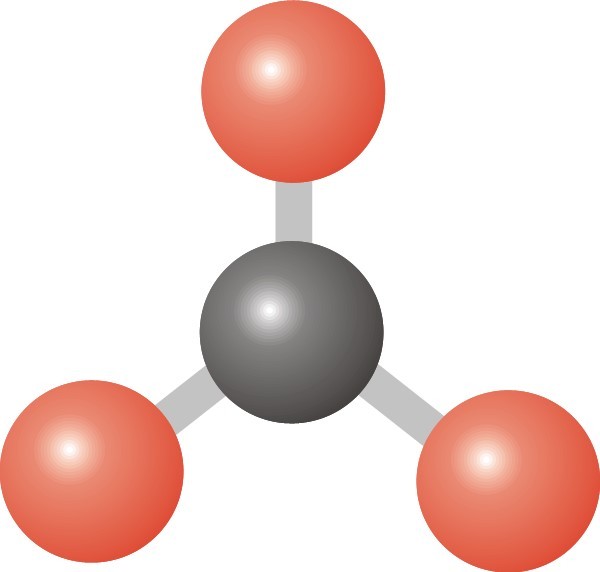
What molecular shape could this be?

a)

trigonal planar

b)

trigonal pyramid

c)

bent

d)

tetrahedral

10.

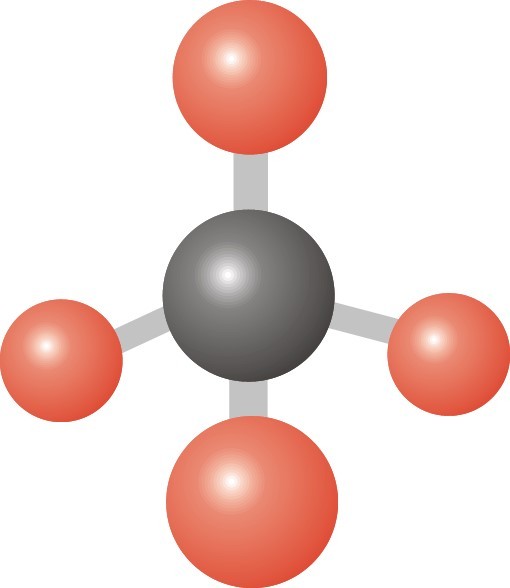
What shape would CCl4 have?

a)

tetrahedral

b)

trigonal pyramid

c)

bent

d)

trigonal planar

11.
What does malleable mean?
a)
able to be shaped
b)
will break easily
c)
can be used for wire
d)
is shiny
12.
What is the ability of a substance to be pulled into a thin strand?
a)
Malleability
b)
Ductility 
c)
Conductivity
d)
Solubility
13.
Why do metals conduct
a)
They are shiny
b)
The electrons are held tightly within the lattice
c)
The electrons are delocalised and able to move
d)
The electrons are shared between two metal ions
14.
What type of bond forms when electrons are transferred from one atom to another?
a)
ionic bond
b)
atomic bond
c)
covalent bond
d)
metallic bond
15.
Which of the following gives the correct chemical formula for the compound Dinitrogen Monoxide?
a)
NO
b)
N2O
c)
N2O2
d)
O2N2
16.
Which of the following gives the correct chemical formula for the compound Magnesium Phosphide?
a)
Mg2P3
b)
MgP
c)
Mg3P2
d)
MgP2
17.
What is the correct chemical name for the ionic compound: Fe3N2
a)
Iron nitride
b)
Iron (III) nitride
c)
Iron (II) nitride
d)
TriIron dinitride
18.
What is the correct formula for the compound, lithium oxide?
a)
LiO
b)
Li2O
c)
LiO2
d)
Li2O2
19.
The name for CrN:
a)
Chromium nitride
b)
Chromium (I) nitride
c)
Chromium (III) nitride
d)
Chromium nitride (III)
20.

Name this compound: NH4F

a)

Ammonia fluoride

b)

Ammonium fluorite

c)

Ammonia fluorate

d)

Ammonium fluoride

21.

Which of the following is a physical property?

a)

color

b)

burning

c)

neutralizing

d)

releasing a gas

22.
What are intensive physical properties?
a)
A property that depends on how much substance you have.
b)
A property that depends on what the substance is.
c)
A chemical property.
d)
An indicator of a chemical change.
23.
Which of the following IS a physical change?
a)
Getting a haircut
b)
Rusty metal
c)
sour milk
d)
A compound
24.

What can only be separated by chemical means?

a)

element

b)

heterogeneous mixture

c)

compound

d)

solution

25.

Freezing point is what kind of property?

a)

Extensive Physical

b)

Intensive Physical

c)

Extensive Chemical

d)

Intensive Chemical

26.
What is black ink an example of?
a)
heterogeneous mixture
b)
homogeneous mixture
c)
compound
d)
element
27.
What is burning an example of?
a)
physical change
b)
physical property
c)
chemical change
d)
chemical property
28.
___________ is a combination of substances that can be physically separated. 
a)
Element
b)
Mixture 
c)
Suspension 
d)
Compound 
29.

What environmental element assists rusting?

a)

nitrogen

b)

oxygen

c)

carbon

d)

hydrogen

30.

Which metals rusts?

a)

Copper

b)

manganese

c)

iron

d)

potassium

31.

All of the following are indicators of a chemical reaction except one. Which one is NOT an indicator that a chemical reaction has taken place?

a)

the production of heat or light

b)

a color change

c)

the production of gas bubbles

d)

the dissolving of one substance in another

32.
Four students performed four different investigations by combining different substances. Which of the observations is most indicative of a chemical reaction?
a)
investigation 1
b)
investigation 2
c)
investigation 3
d)
investigation 4
33.

Hydrogen peroxide breaks down to form water and oxygen gas. A thermometer indicates an increase in temperature. Which observation is evidence that a chemical reaction has occurred?

a)

The mass of the solution remains the same.

b)

Phase changes are observed.

c)

The color of the solution remains clear.

d)

The temperature of the solution increases.

34.

Which properties do solids have?

a)

definite shape and volume

b)

no definite shape and a definite volume

c)

no definite shape and no definite volume

35.

What properties do liquids have?

a)

definite shape and volume

b)

no definite shape and a definite volume

c)

no definite shape and no definite volume

36.

Easily compressed

a)

Solid

b)

Liquid

c)

Gas

37.

The particle diagram shown is a:

a)

pure substance

b)

mixture

38.

The particle diagram shown is a:

a)

pure substance

b)

mixture

39.

Which picture(s) represents a mixture between two elements?

a)

A

b)

B

c)

C

d)

A and C

40.

Which picture(s) represents a mixture between an element and a compound?

a)

A

b)

B

c)

D

d)

B and D

41.

The idea of arranging the elements in the periodic table according to their chemical and physical properties is attributed to

a)

Moseley

b)

Mendeleev

c)

Dalton

d)

Democritus

42.

The person whose work led to a periodic table based on increasing atomic number was

a)

Dmitri Mendeleev

b)

Henry Moseley

c)

John Dalton

d)

J.J. Thomson

43.
Put the following in order of increasing ionization energy:Neon, Lithium, Carbon
a)
Lithium, Carbon, Neon
b)
Carbon, Lithium, Neon
c)
Neon, Carbon, Lithium
d)
Lithium, Neon, Carbon
44.
As you move down the periodic table atoms get bigger.  This is because ____________.
a)
The atoms have more mass.
b)
The atoms have more protons.
c)
The atoms have more energy levels
d)
The atoms have more nuetrons
45.
As you move across the periodic table atoms tend to get smaller because, ______________.
a)
the atoms have more mass.
b)
the atoms have less mass
c)
the atoms have more protons.
d)
the atoms have less electrons.
46.

Which statement correctly and completely identifies a trend?

a)

Atomic radius decreases across a period and increases down a group.

b)

Electronegativity decreases across a period and decreases down a group.

c)

Ionization energy increases across a period and increases down a group.

d)

Ionic radius increases across a period and increases down a group.

47.

The reason that Noble Gases do not react is because

a)

Their outer electron shell is filled

b)

Their inner electron shell is filled

c)

They are able to bond to fill their outer shell

d)

None of the above, Noble Gases are highly reactive

48.
Which of these is not a property of noble gases?
a)
Colourless
b)
Unreactive
c)
Flammable
d)
Gas at room temperature
49.
 Which of the following generally applies to the noble gases? 
a)
high ionization energy, low electronegativity, high reactivity
b)
high ionization energy, high electronegativity, high reactivity
c)
low ionization energy, low electronegativity, low reactivity
d)
high ionization energy, low electronegativity, low reactivity 
50.
Choose the set that goes from lowest to highest electronegativity?
a)
Cu, Mg, Sr, Ca
b)
F, Cl, Br, Si
c)
Cs, Rb, Ca, Mg
d)
Zn, Cd, Ag, Cu
51.

Highly reactive

a)

Alkali metal

b)

Noble gases

c)

Rare earth metals

d)

Neon

52.

Which family(group) of metals have two electrons in the outer most energy level?

a)

Lanthanides

b)

Halogens

c)

Oxygen family

d)

Alkaline earth metals

53.

------ are good conductors of heat and electricity (pick all that apply)

a)

Transition metals

b)

alkali metals

c)

Non metals

d)

alkaline earth metals

54.

Which alkali metal is most reactive out of the following

a)

rubidium

b)

potassium

c)

sodium

d)

lithium

55.
Elements in the same ________ are more chemically similar.
a)
group
b)
period
c)
club
d)
table
56.
Which elements have the most similar chemical properties?
a)
K and Na
b)
K and Ca
c)
K and Cl
d)
K and S
57.
What is ionization energy?
a)
Energy needed to destroy an atom
b)
Energy required to remove an electron
c)
Energy needed to split an electron
d)
Energy required to add an electron
58.

Which element has the greater ionization energy?

a)

Magnesium (Mg)

b)

Phosphorus (P)

59.

Who arranged the known elements into horizontal rows of increasing atomic mass leaving gaps for as yet undiscovered elements?

a)

Mendeleev

b)

Meyer

c)

Newlands

d)

Moseley

60.

Who suggested that the physical and chemical properties were related to the atomic number, rather than atomic mass?

a)

Meyer

b)

Mendeleev

c)

Moseley

d)

Newlands

61.
What is the mole used for? 
a)
To measure the amount of grams in a substance
b)
To measure the amount of atoms or molecules in a substance
c)
To measure the amount of energy in a substance
d)
To measure the amount of bonding in a substance 
62.
What is Avogadro's Number? 
a)
6.02 x 10²³
b)
- 6.02 1023
c)
6.02 x 10²²
d)
6,020,000,000,000
63.
What is the Molar mass of one mole of Iron (Fe)?
a)

55.93 amu

b)

55.85 g

c)
111.86 amu
d)
111.86 g
64.
What is the molar mass of one molecule of Nitrogen N2?
a)
14.01 amu
b)
14.01 g
c)
28.02 g
d)
28.02 amu
65.
What is the molar mass of Carbon Dioxide (CO2)?
a)
12 amu
b)
12 g
c)
44 g
d)
44 amu
66.
0.50 moles of carbon is equal to how many grams?
a)
6.0
b)
12.0
c)
8.0
d)
14.0
67.
How many moles are present in 36 g of H2O?
a)
1 mole
b)
0.24 moles
c)
2 moles
d)
6.01 x 10²³molecules
68.
What is the molar mass of Mg3N2?
a)
191.6 g/mol
b)
76.64 g/mol
c)
38.32 g/mol
d)
100.95 g/mol
69.
Which of the following dimensional analysis setups will correctly convert 27.76g of Li to atoms of Li?
a)
A
b)
B
c)
C
d)
D
70.

25 g of iron = _________atoms of iron Fe

a)

0.70 x 10²³ atoms

b)

1.70 x 10²³ atoms

c)

2.70 x 10²³ atoms

d)

5.70 x 10²³ atoms

71.

How many molecules are present in 135 g of Teflon C2F4

a)

6.13 x 10²³ molecules

b)

5.13 x 10²³ molecules

c)

8.13 x 10 23 molecules

d)

9.13 x 10²³ molecules

72.

How many moles does 17.3 grams of silver (Ag) represent?

a)

0.100 mole

b)

0.020 mole

c)

0.160 mole

d)

0.320 mole

73.

8.50 g of Cu = _________atoms of Cu?

a)

6.05 x 10 23 atoms of Cu

b)

7.05 x 10²³ atoms of Cu

c)

8.05 x 10²³ atoms of Cu

d)

9.05 x 10²³ atoms of Cu

74.
How many molecules are in 2.5 mol of NaCl?
a)
1.51x10²³
b)
146
c)
4.15
d)
1.51x1024
75.
How many moles are in 16.94g of water?
a)
16.94 mol H2O
b)
0.9401 mol H2O
c)
305.3 mol H2O
d)
1.063 mol H2O
76.

What is the percent by mass of oxygen in carbon dioxide? (CO2)

a)

27.3%

b)

72.7%

c)

30%

d)

70%

77.

What is the percent by mass of chlorine in sodium chloride? (NaCl)

a)

60.7%

b)

39.3%

c)

60%

d)

40%

78.
What is the percent by mass of magnesium in MgO?
a)
20%
b)
40%
c)
50%
d)
60%
79.
Which conversion factor should be used for the following question " How many molecules are there in 4.00 moles of glucose, C6H12O6
a)
1 mole = 78.12 g
b)
1 mole = 22.4 L 
c)
1 mol = 6.02x 10²³ particles 
d)
more than one
80.

Find the percent composition of Cu2S?

a)

Cu= 67.987%; S= 32.013%

b)

Cu= 79.854%: S= 20.145%

c)

Cu= 35.946%; S= 64.054%

d)

Cu= 39.925%; S= 20.151%

81.

How many electrons can a d sublevel hold?

a)

14

b)

10

c)

2

d)

6

82.

How many orbitals does an s sublevel have?

a)

1

b)

3

c)

5

d)

7

83.

How many orbitals does an f sublevel have?

a)

1

b)

3

c)

5

d)

7

84.

How many electrons can an p sublevel hold?

a)

5

b)

10

c)

6

d)

2

85.

This could be the dot diagram of

a)

Mg

b)

Cl

c)

C

d)

O

86.

How many valence electrons should Lithium have in its Lewis dot model?

a)

1

b)

2

c)

3

d)

4

87.

The mass # tells us the mass of the atom. Which two subatomic particles make up the mass of the atom?

a)

protons and electrons

b)

neutrons and electrons

c)

Kyrontrons and Kytrons

d)

protons and neutrons

88.

What can you do to find the number of neutrons in an atom?

a)

It's the same as the atomic #.

b)

Ask Sierra!

c)

Subtract the atomic # (protons) from the mass # (protons and neutrons)

d)

Multiply the mass # (protons and neutrons) and the atomic # (protons)

89.
What is the atomic number?
a)
the number of protons
b)
the number of protons and neutrons
c)
the number of neutrons
d)
the number of protons and electrons
90.
24.1% of all the isotopes of a an element have a mass of 75.23 amu, 48.7% have a mass of 74.61 amu, and 27.2% have a mass of 75.20 amu.
What is the average mass of this element?
a)
74.92 amu
b)
24.97 amu
c)
75.01 amu
d)
74.51 amu
91.
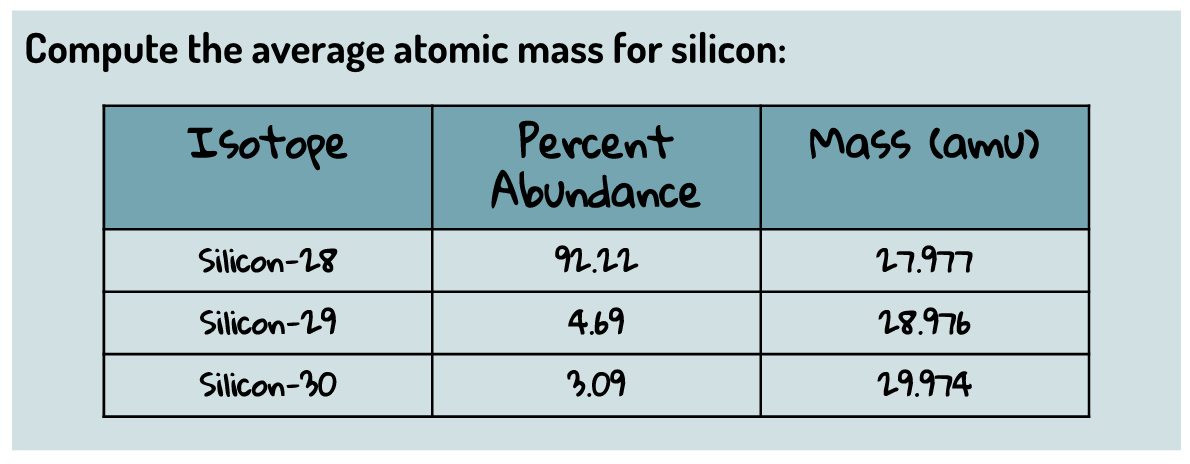
Compute the average atomic mass for silicon:
a)
27.977
b)
28.09
c)
28.976
d)
The average mass cannot be determined from provided information.
92.
The scientist responsible for "discovering" the nucleus is:
a)
Bohr
b)
Rutherford
c)
Schroedinger
d)
Einstein
93.
The nucleus of an atom can be described as:
a)
spacious and negatively charged
b)
dense and positively charged
c)
spacious and positively charged
d)
dense and negatively charged
94.
True or False: The majority of an atom is made up of empty space
a)
True
b)
False
95.

A wave with a large wavelength will have a ______ frequency and _____ energy

a)

high, low

b)

high, high

c)

low, high

d)

low, low

96.
High frequency waves have _________ wavelength.
a)
varying
b)
high
c)
the same
d)
low
97.

What is this element?

1s22s22p63s23p64s23d104p6

a)

Argon

b)

Krypton

c)

Selenium

d)

Bromide

98.
What is the electronic configuration of iron?
a)
1s22s22p63s23p64s23d6
b)
1s22s22p63s23p63d8
c)
1s22p63s23p64s23d6
d)
1s22s22p63s23p64s13d6
99.
High frequency waves have _________ wavelength.
a)
varying
b)
high
c)
the same
d)
low
100.

What is the electron configuration of this atom?

a)

1s22s83s84s1

b)

1s22s22p63d84s1

c)

1s22s22p62d83s1

d)

1s22s22p63s23p64s1