wayground logo

Free Printable Worksheets

Font size

S
M
L
XL
Worksheets

pAP 2019 fall SER

Total questions: 100

Worksheet time: 2hrs 4mins

Name
Class
Date
1.

When instructed, you should wear ____ to protect your eyes.

a)

Gloves

b)

Goggles

c)

Googles

d)

Sun glasses

2.

When you do not know what a substance smells like, you should...

a)

stick your nose in the bottle

b)

directly smell and taste it

c)

use the wafting technique

d)

ask Brooke to smell it for you

3.
a)

beaker

b)

graduated cylinder

c)

Erlenmeyer flask

d)

test tube

4.
a)

scoopula

b)

dropper

c)

crucible tongs

d)

glassware tongs

5.
A crucible and lid are used 
a)
to hold small amounts of dry chemicals for observation
b)
 to heat wet solids at high temperature in order to dry them out 
c)
to evaporate liquids at low temperature  in order to recover  dissolved solids
d)
to grind solids into powder in order to increase surface area
6.
What would you use to hold a small piece of metal in a flame for heating?
a)
Forceps
b)
Test tube holder
c)
Gauze
d)
Tongs
7.
Jack has a rock. The rock has a mass of 14g and a volume of 2cm3. What is the density of the rock?
a)
7 mL
b)
7 g/cm3
c)
28 g/cm3
d)
1/7 g/cm3
8.
Here are 5 cubic centimeters (cm3).    All together they  have a mass of 20 g what is the density?
a)
20 g/cm3
b)
80 grams
c)
 4 g/cm3
d)
80 g/cm3
9.
Archimedes used density to discover if the crown of gold was real because
a)
Substances have their own unique densities
b)
Substances can change densities depending on their size
c)
Substances can change densities depending on their mass
d)
Substances can change densities depending on their volume
10.
How many significant figures does the following number have: 100.00210
a)
7
b)
5
c)
10
d)
8
11.
Determine the number of Significant Figures in 10.0-g
a)
5
b)
4
c)
3
d)
2
12.
How many Significant Figures in the number below?
4.56 x 10³
a)
5
b)
4
c)
6
d)
3
13.
What atom matches this electron configuration?
1s22s22p63s23p64s23d10
a)
Zinc
b)
Copper
c)
Nickel
d)
Germanium
14.
What atom matches this electron configuration?
1s22s22p63s2
a)
Neon
b)
Magnesium
c)
Aluminum
d)
Potassium
15.
How many electrons does Si contain? (click to see image)
a)
14
b)
28
c)
2
d)
4
16.
Electron arrangement that uses arrows
a)
Electron configuration
b)
Shorthand configuration
c)
Lewis dot structure
d)
Orbital diagram
17.
Electrons occupy orbitals of lowest energy first is part of what electron configuration rule?
a)
Hund’s Rule
b)
Aufbau Principle
c)
Pauli Exclusion Principle
18.
An orbital can at most hold how many electrons?
a)
1 electron
b)
2 electrons
c)
3 electrons
d)
4 electrons
19.
Identify the Electron Configuration for Aluminum (Al)
a)
1s2s2p3s3p1
b)
1s2s2p3s3p3
c)
1s2s2p3s4p1
20.
What does Hund's rule states ?
a)
states that single electrons electrons with the same spin must occupy each-energy orbital before additional electrons with opposite spins can occupy the same orbitals
b)
states that each electron occupies the lowest energy orbital available
c)
states that a maximum of two electrons can occupy a single atomic orbital, but if only if the electros have opposite spins
21.
What does an atom's electron-dot structure consist of ? 
a)
the elements atomic number and mass number which represents the number of protons and neutrons
b)
the element's symbol, which represents the atomic nuclues and inner-level electrons,surrounded by dots representing all of the atom's valence electrons
22.
There are 4 different types of subshells (orbitals) s,p,d,f.
a)
true
b)
false
23.
Which periodic table family could have electrons filling orbitals in the s-block?
a)
Alkaine Earth 
b)
Halogens
c)
Noble Gases
d)
Transition Metals
24.
As you move down a group, atomic radius increases because - 
a)
you add more and more neutrons
b)
you add more and more protons
c)
you add more and more shells (energy levels)
d)
you add more atomic mass
25.
As you move across the periodic table from left to right, the atomic radius decreases.  This is because - 
a)
the number of protons increases, so attraction to electrons increases
b)
the number of energy levels increases
c)
the number of electrons increases
d)
the atomic mass increases
26.
The element with the smallest ionization energy in Period 6 is - 
a)
Rn
b)
Cs
c)
Os
d)
Tm
27.
Electronegativity __________ from left to right within a period and __________ from top to bottom within a group.
a)
decreases, increases 
b)
increases, increases
c)
increases, decreases 
d)
stays the same, increases
28.

What is the name of the family that is highlighted?

a)

Alkali Metal Family

b)

Halogen Family

c)

Noble Gas Family

d)

Transition Metal Family

29.
Which elements are in the same period?
a)
A & F
b)
F, B & D
c)
E & D
d)
F & B
30.

Nickel

a)

H

b)

Na

c)

K

d)

Ni

31.

Iron

a)

Fe

b)

K

c)

C

d)

O

32.

Calcium

a)

C

b)

Cl

c)

Ca

d)

K

33.

Potassium

a)

Na

b)

K

c)

Fe

d)

S

34.

Fe

a)

Oxygen

b)

Hydrogen

c)

Iron

d)

Potassium

35.

He

a)

Calcium

b)

Helium

c)

Iron

d)

Hydrogen

36.

H

a)

Iron

b)

Helium

c)

Hydrogen

d)

Oxygen

37.
Cl
a)
chlorine
b)
calcium
c)
carbon
d)
cobalt
38.
Ar
a)
argon
b)
aluminum
c)
arsenic
d)
astatine
39.
H
a)
hydrogen
b)
helium
c)
holmium
d)
mercury
40.
He
a)
helium
b)
hydrogen
c)
holmium
d)
mercury
41.
Adding or subtracting neutrons (charge = 0, mass = 1) makes the element change into an...
a)
ion
b)
mixture
c)
isotope
d)
neutral atom
42.

The atomic number is equal to _.

a)

the number of protons and electrons only in an atom

b)

the number of neutrons only in an atom

c)

the total number of protons and neutrons only in an atom

d)

the number of protons neutrons and electrons in an atom

43.
What is the charge on a lithium atom that looses 1 electron?
a)
+1
b)
0
c)
-1
d)
-2
44.

Is the element shown in this image an ion, isotope or normal atom?

a)

atom

b)

isotope

c)

cation (+ ion)

d)

anion (- ion)

45.
Helium (He atomic number 2) has 2 protons, 2 neutrons, and 2 electrons) is the He element shown above an atom, an element, or an isotope?
a)
atom
b)
cation  (+ ion)
c)
isotope
d)
anion (-)
46.
The atomic mass is equal to _.
a)
the number of protons only
b)
the number of neutrons only
c)
the total number of protons and neutrons
d)
the number of protons, neutrons, and electrons.
47.
What is the net charge on the element shown above? 
(Calcium - atomic number 20)
a)
cation +1 charge
b)
cation +2 charge
c)
anion -1 charge
d)
anion -2 charge
48.
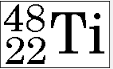
How many protons does this isotope of titanium have? Hint titanium has an atomic number of 22.
a)
48
b)
22
c)
26
d)
70
49.
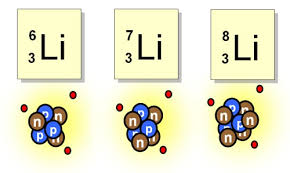
Which atom has  4 neutrons?
a)
Li-6
b)
Li-7
c)
Li-8
d)
they have the same # of neutrons
50.
What is the atomic number of Fe? (click to see image)
a)
26
b)
55.845
c)
56
d)
None of these
51.
Carbon has an atomic number of 6 and an atomic mass of 12. Which elements are considered isotopes of carbon?
a)
Carbon-12
b)
Carbon-13
c)
Carbon-14
d)
Both Carbon-13 and Carbon-14
52.

The image shows that Hydrogen can become an isotope by adding a(n)..

a)

electron

b)

proton

c)

nuetron

d)

any of the above answers

53.

What is the mass number of this element?

a)

12

b)

24

c)

23

d)

11

54.

What type of atom is element C?

a)

Normal atom

b)

Ion

c)

Isotope

55.

What does it happen to this atom?

a)

It LOSES electrons

b)

It GAINS electrons

c)

It GAINS protons

d)

It LOSES protons

56.

How many neutrons does this Neon atom have?

a)

21

b)

11

c)

10

d)

12

57.

What is the representation of an isotope?

a)

N-3

b)

Al+3

c)

Si

d)

P-33

58.
This image is an illustration of
a)
photoelectric effect
b)
Dalton's atomic theory
c)
Bohr model
d)
Quantum mechanical model
59.
Which element is pictured?
a)
neon
b)
fluorine
c)
magnesium
d)
argon
60.
Which element is depicted from this orbital diagram
a)
Fluorine
b)
Neon
c)
Chlorine
d)
Argon
61.
This orbital diagram represents:  
a)
C
b)
B
c)
N
d)
O
62.
What is incorrect about this orbital diagram?
a)
Both arrows in the 2p box should be pointing up
b)
There is nothing incorrect with this diagram
c)
In the 2p box there should only be 1 electron in the first 2p box and one in the 2nd 2p box
d)
All the arrows should be pointing up.
63.
Which orbital shows a violation of the Pauli Exclusion Principle?
a)
A
b)
B
c)
C
d)
D
64.
What is the correct chemical formula for a compound that is made up of Nitrogen and Calcium?
a)
N3Ca2
b)
Ca3N2
c)
N2Ca3
d)
Ca2N3
65.
Which of the following orbital block does not exist?
a)
4d
b)
3s
c)
2d
d)
6p
66.
What would be the proper chemical formula for combining Al3+ and Cl- :
a)
AlCl3
b)
Al3Cl
c)
AlCl
d)
Al3Cl3
67.
Name the following ionic compound: BeCl2
a)
beryllium chlorine
b)
beryllium II chloride
c)
beryllium chloride
d)
beryllium dichloride
68.
Name the following ionic compound: Cr(NO2)3
a)
chromium nitrite
b)
chromium nitride
c)
chromium III nitride
d)
chromium III nitrite
69.
magnesium carbonate
a)
Mg2C
b)
Mg2CO4
c)
Mg2(CO3)2
d)
MgCO3
70.
When naming an ion containing a transition metal what would be included in the name?
a)
roman numeral
b)
prefix
c)
suffix
d)
superscript
71.
Carbon dioxide
a)
C2O2
b)
C20
c)
CO
d)
CO2
72.
Phosphorous trichloride
a)
PCl3
b)
P3Cl
c)
P3Cl3
d)
PCL
73.
Bromine monoflouride
a)
Br1F1
b)
BrF
c)
Br2F
d)
BrF2
74.
Disulfur trioxide
a)
S3O2
b)
SO
c)
S2O3
d)
S2O
75.
P2O5
a)
Phosphorus Oxide
b)
Pentaphosphorus Dioxide
c)
Diphosphorous pentoxide
d)
Phosphoric Oxygen
76.
Which of these is covalent?
a)
NaCl
b)
Pb(NO3)2
c)
CO2
d)
AlCl3
77.
Covalent compounds
a)
Share electrons
b)
transfer electrons
c)
contain a sea of electrons
d)
conduct electricity
78.

What is the correct Lewis Dot Structure for ammonia NH3

a)
b)
c)
d)
79.

Which is the correct molecular structure for carbon dioxide?

a)
b)
c)
d)
80.

How many total valence electrons are participating in bonding in the molecule above?

a)

8

b)

4

c)

2

d)

3

81.
Which of the following is the correct Lewis dot structure for the molecule fluorine (F2)?
a)
A
b)
B
c)
C
d)
D
82.

Carbonate (CO32-) has how many double bonds?

a)

0

b)

1

c)

2

d)

3

83.

CCl4 has how many double bonds?

a)

0

b)

1

c)

2

d)

3

84.

Which of the following elements are an exception to the octet rule and require less than 8 valence electrons?

a)

H

b)

Li

c)

Be

d)

B

e)

C

85.

In HCN (Carbon is usually the central atom) what kind of bond is between the C and N

a)

Single

b)

Double

c)

Triple

86.

How many valence electrons does Argon Have?

a)

4 Valence electron

b)

5 Valence electron

c)

6 Valence electron

d)

7 Valence electron

e)

8 Valence electron

87.

How many valence electrons does Sulfur Have?

a)

4 Valence electron

b)

5 Valence electron

c)

6 Valence electron

d)

7 Valence electron

e)

8 Valence electron

88.
This is the correct dot diagram for nitrogen (N)
a)
true
b)
false
89.
This is a correct dot diagram for fluorine (F)
a)
true
b)
false
90.
This could be the dot diagram of
a)
Mg
b)
Cl
c)
C
d)
O
91.
?
a)
Helium
b)
Oxygen
c)
Sodium
d)
Phosphorous
92.
Which object has greater density?
a)
Blue
b)
Green
c)
They are the same
93.
What is the density of a Christmas present with a mass of 8.1 g and a volume of 1200 mL
a)
0.122 g/mL
b)
0.00675 g/mL
c)
148 g/mL
d)
297 g/mL
94.
What is the shorthand configuration of Tungsten?
a)
[Xe] 6s²4f¹⁴5d⁴
b)
[Rn] 6s²4f¹⁴5d⁴
c)
[Rn] 6s²5d⁴
d)
[Xe] 6s²5d⁴
95.

What is Mrs. Starnes first name?

a)

Shiloh

b)

Sarah

c)

Shianne

d)

Silo

96.

What is Mrs. Starnes middle name?

a)

Free

b)

Kenidie

c)

Adaleigh

d)

Sophie

97.

Where is Mrs. Starnes from?

a)

Alaska

b)

Texas

c)

Nebraska

d)

Canada

98.

How many children does Mrs. Starnes have?

a)

4

b)

2

c)

3

d)

1

99.

What is Mrs. Starnes favorite color?

a)

grey

b)

blue

c)

teal

d)

coral

100.

What do you do with a dead chemist?

a)

Barium

b)

Helium

c)

Curium

d)

Sodium