wayground logo

Free Printable Worksheets

Font size

S
M
L
XL
Worksheets

Unit 4 - Bonding Review

Total questions: 99

Worksheet time: 2hrs 37mins

Name
Class
Date
1.
Which type of bond shares electrons?
a)
ionic
b)
covalent
2.
Which type of bond TRANSFERS electrons?
a)
ionic
b)
covalent
3.
When an ionic compound forms, one part loses electrons while the other gains.  Which substance loses electrons?
a)
metal
b)
non-metal
4.
When a negative ion is formed, does the particle gain, lose or share electrons?
a)
gain
b)
lose
c)
share
5.
Ionic or covalent?
Low melting point
a)
ionic
b)
covalent
6.
ionic or covalent?
Conducts electricity when dissolved in solution
a)
ionic
b)
covalent
7.
ionic or covalent?
Does not conduct electricity at all
a)
ionic
b)
covalent
8.
ionic or covalent?
Forms a very strong crystal lattice when solid.
a)
ionic
b)
covalent
9.

________________________ have the strongest intermolecular forces of attraction.

a)

Dipole- Dipole

b)

Dispersion

c)

Hydrogen Bonds

10.

Intermolecular forces for: NH3

a)

Dispersion Force

b)

Dipole dipole

c)

Hydrogen bonding

11.

Intermolecular forces for: CO2

a)

Dispersion Force

b)

Dipole dipole

c)

Hydrogen bonding

12.
Intermolecular force present in HCl?
a)
dipole dipole
b)
dispersion
c)
H-bond
d)
ionic
13.
Polarity of a molecule is determined by
a)
shape and charge
b)
shape and difference in EN value
c)
difference in EN value and size
d)
difference in EN value and charges
14.

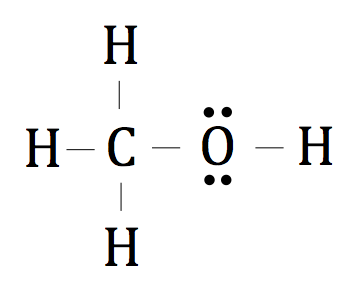
Is the following molecule polar or nonpolar?

a)

polar

b)

nonpolar

15.

Is the following molecule polar or nonpolar?

a)

polar

b)

nonpolar

16.

Is the following molecule polar or nonpolar?

a)

polar

b)

nonpolar

17.

Is the following molecule polar or nonpolar?

a)

polar

b)

nonpolar

18.

Why is the molecule polar?

a)

There are nonbonding pairs on the central atom.

b)

There are different types of elements bonded to the central atom.

c)

There are no nonbonding pairs on the central atom and all of the atoms bonded to the central atom are the same.
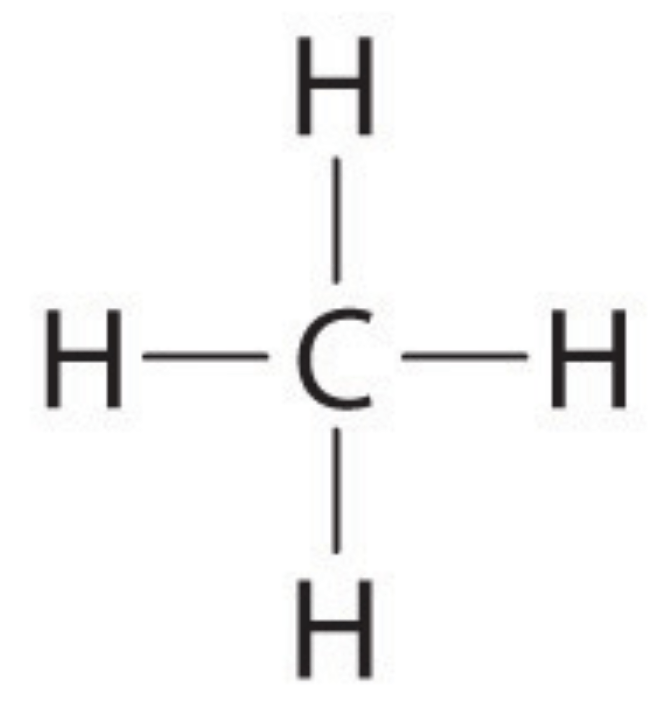
19.

Why is the molecule nonpolar?

a)

There are nonbonding pairs on the central atom.

b)

There are different types of elements bonded to the central atom.

c)

There are no nonbonding pairs on the central atom and all of the atoms bonded to the central atom are the same.

20.

Why is the molecule polar?

a)

There are nonbonding pairs on the central atom.

b)

There are different types of elements bonded to the central atom.

c)

There are no nonbonding pairs on the central atom and all of the atoms bonded to the central atom are the same.
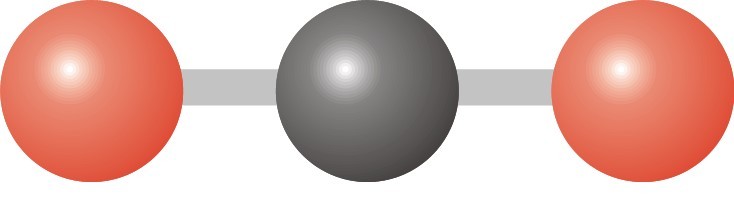
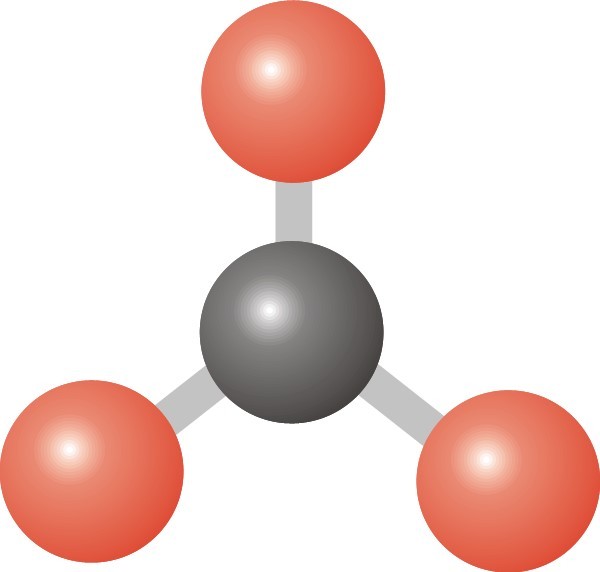
21.
What is the VSEPR theory used to predict?
a)
Bond Strength
b)
Polarity
c)
Molecular Shape
d)
Electronegativity
22.
According to VSEPR, molecules adjust their shapes to keep which of the following as far away as possible?
a)
Pairs of valence electrons
b)
Inner shell electrons
c)
Mobile Electrons
d)
Electrons closest to the nucleus
23.
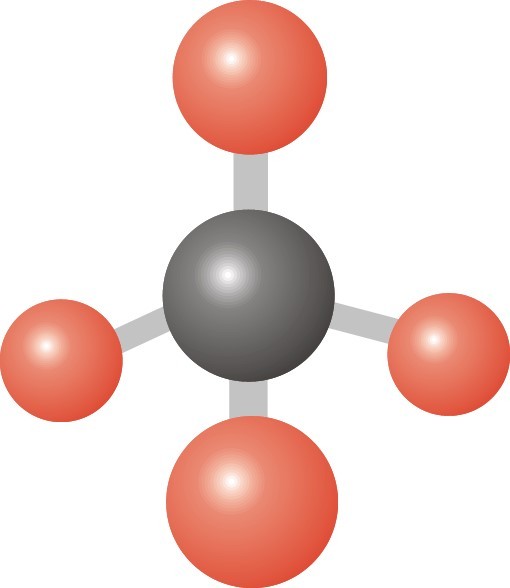
Which molecule would have this shape?
a)
BF3
b)
CH4
c)
PCl5
d)
CO2
24.
Which of the following shapes has unshared pairs of electrons on the central atom? 
a)
Bipyramidal
b)
Bent
c)
Trigonal Planar
d)
Tetrahedral
25.
Which of the following molecular shapes would have a bond angle of 180 Degrees?
a)
Bent
b)
Trigonal Planar
c)
Tetrahedral
d)
Linear
26.
What molecule could this be? 
a)
BF3
b)
CH4
c)
H2O
d)
CO2
27.
Which shapes are altered by unshared pairs of electrons? 
a)
Bent and Pyramidal
b)
Trigonal Planar and Bent
c)
Tetrahedram and Bipyramidal
d)
Pyramidal and Linear
28.

How many unshared pairs of electrons will a bent molecule have?

a)

0

b)

2

c)

3

d)

4

29.
How many unshared pairs of electrons will a pyramidal molecule have? 
a)
1
b)
2
c)
3
d)
4
30.
Who could this molecule be?
a)
CH4
b)
CO2
c)
PCl5
d)
BF3
31.

What shape would PH3 have?

a)

Trigonal Planar

b)

Trigonal pyramidal

c)

Bent

d)

Linear

32.

Ammonia, NH3, adopts a tetrahedral geometry. However, the non-bonding pair on the central nitrogen atom distorts the bond angle away from the expected 109.5°. Which of the following statements correctly describes how the bond angle is distorted?

a)

The actual bond angle is reduced: it is less than 109.5°

b)

The actual bond angle is increased: it is more than 109.5°

33.
VSEPR theory is to
a)
determine the number of bonding and lone pairs electrons
b)
determine the number of ECC
c)
determine the shape and geometry of molecule
d)
determine the lewis structure of molecule
34.
What molecular shape is the structure shown here? (BCl3)
a)
linear
b)
trigonal planar
c)
tetrahedral
d)
trigonal pyramidal
35.
What is the molecular shape of a silicon dioxide molecule?
a)
linear
b)
trigonal planar
c)
bent
d)
tetrahedral
36.
Determine the molecular shape of carbon tetrafluoride.
a)
linear
b)
trigonal planar
c)
bent
d)
tetrahedral
37.
VSEPR stands for ________ theory.
a)
Valence Structure of Electron Pyramids and Regression
b)
Varied Structures of Electrons Paired and Replaced
c)
Varied Shell Energy of Protons and Radiation
d)
Valence Shell Electron Pair Repulsion
38.
According to the octet rule most elements need _______ valence electrons.
a)
2
b)
8
c)
6
d)
18
39.
If electrons are shared unequally then the bond is....
a)
Non-polar covalent
b)
Ionic
c)
Non-polar ionic
d)
Polar covalent
40.
After drawing in your bonds, what do you do if you don't have enough electrons to get each atom to its octet?
a)
Place dots until everything has eight
b)
Place dots only around the terminal atoms
c)
Add a multiple bond
d)
Have eight only around the central atom
41.
Which of the following is the correct Lewis dot structure for the molecule fluorine (F2)?
a)
A
b)
B
c)
C
d)
D
42.
What is the name of this compound?  Na2CO3
a)
Disodium carbonate
b)
Sodium carbon oxide
c)
Sodium II carbonate
d)
Sodium carbonate
43.
Name this formula: 
Al2O3
a)
Aluminum Oxide
b)
Aluminum Oxygen
c)
Antimony Oxide
d)
Aluminum (VII) Oxide
44.
Name this compound. 
N2O
a)
Dinitrogen monoxide
b)
Dinitrogen oxide
c)
Nitrogen oxide
d)
Nitrogen dioxide
45.
Name this compound
PH3
a)
triphosphorus trihydride
b)
Phosphorus hydride
c)
Trihydrogen monophosphide
d)
Phosphorus trihydride
46.
Name this compound.
K2S
a)
dipotassium sulfide
b)
potassium sulfide
c)
potassium sulfate
d)
potassium sulfite
47.
Prefixes are used only for _______________ compounds
a)
Ionic
b)
covalent
48.
What is the chemical formula for Aluminum hydroxide
a)
AlOH
b)
AlOH3
c)
Al(OH)3 
d)
AlHO
49.
What is the formula for  Barium nitrate
a)
BaNO3
b)
Ba(NO3)2
c)
Be(NO3)2
d)
Be2NO3
50.
potassium iodide
a)
KI
b)
KI2
c)
K2I
d)
KI3
51.
Ca3N2
a)
calcium nitrogen
b)
carbon nitrogen
c)
calcium nitride
d)
carbon nitrate
52.
CO
a)
Carbon oxide
b)
Cobalt
c)
Carbon monoxide
d)
Carbonate
53.

What is the prefix for 10:

a)

deca-

b)

nona-

c)

septa-

d)

hexa-

e)

hepta-

54.

What is the prefix for 8:

a)

octa-

b)

nona-

c)

septa-

d)

hexa-

e)

hepta-

55.

What is the prefix for 7:

a)

penta-

b)

nona-

c)

septa-

d)

hexa-

e)

hepta-

56.

Which of the following is NOT a property of ionic compounds?

a)

They conduct electricity when molten

b)

They conduct electricity when in solution

c)

They have high boiling points

d)

They are insoluble in water

57.
What is the charge on an Aluminium ion?
a)
3
b)
+3
c)
+2
d)
+1
58.
What is the charge on a Hydrogen ion?
a)
+1
b)
1
c)
2
59.
What is the charge on a chloride ion?
a)
-1
b)
1
c)
+2
d)
+1
60.
Magnesium bromide is an ionic compound with the chemical formula MgBr₂.  What does the "2" tell you?
a)
There are 2 bromide ions for every magnesium ion
b)
Bromide has a 2- charge
c)
Bromide has a 2+ charge
d)
There are 2 magnesium ions to every bromide ion
61.
In the chemical formula for an ionic compound, which item is written first?
a)
positive ion
b)
negative ion
c)
subscript
d)
the female
62.
Elements in Group 1 lose one electron to form ions with a _________________ charge.
a)
1+
b)
2+
c)
0
d)
1-
63.
What is the formula for copper(I) sulfate?
a)
CuSO3
b)
CuSO4
c)
Cu2SO3
d)
Cu2SO4
64.
What is the formula for iron(II) carbonate?
a)
Fe2CO3
b)
FeCO3
c)
Fe2CO2
d)
FeCO4
65.
Name this compound:
NiPO4
a)
Nickel (I) phosphate
b)
Nickel (II) phosphate
c)
Nickel (IV) phosphate
d)
Nickel (III) phosphate
66.
What is the formula for copper (II) hydroxide?
a)
CuOH
b)
Cu(OH)2
c)
Cu2OH
d)
Cu2O
67.
Which of the following is NOT an ionic compound:
a)
CaO
b)
NaOH
c)
BaCl2
d)
Br2
68.
What is the basis of a metallic bond?
a)
the attraction of neutral metal atoms.
b)
the attraction between protons and neutrons.
c)
the attraction between positive metal ions and interlocking electrons.
d)
the attraction between positive metal ions and free floating electrons.
69.
At room temperature, most metals are
a)
liquid
b)
solid
c)
gas
d)
an alloy
70.

How are compounds with metallic bonds similar to ionic compounds?

a)

Both tend to have double and triple bonds.

b)

Both tend to have low boiling point

c)

Both tend to have poor conductivity.

d)

Both tend to have high melting points.

71.

What are the valence electrons in metallic bonds attracted to?

a)

Positively charged ions inside of the metal

b)

Positively charged ions outside of the metal

c)

Negatively charged ions inside of the metal

d)

Negatively charged ions outside of the metal.

72.
What is the ability of a substance to be pulled into a thin strand?
a)
Malleability
b)
Ductility 
c)
Conductivity
d)
Solubility
73.
Which of these is NOT an alloy?
a)
bronze
b)
copper
c)
brass
d)
stainless steel
74.
What does malleable mean?
a)
able to be shaped
b)
will break easily
c)
can be used for wire
d)
is shiny
75.
What type of bond is illustrated above?
a)
Metallic
b)
Ionic
c)
Covalent
d)
Wiggly
76.

Why do metals have high melting points?

a)

Metallic bonds are weak and metals have a simple structure

b)

Metallic bonds are strong and metals have a lattice structure

c)

Metallic bonds are strong and metals have a simple structure

d)

Metallic bonds are weak and metals have a lattice structure

77.

The correct name for Cu(CN)2 is __.

a)

copper (I) cyanide

b)

carbon cyanide

c)

carbon carbonate

d)

copper (II) cyanide

e)

copper (I) nitride

78.

Which formula/name pair is incorrect?

a)

FeSO4 iron (II) sulfate

b)

Fe2(SO3)3 iron (III) sulfite

c)

FeS iron (II) sulfide

d)

FeSO3 iron (II) sulfite

e)

Fe2(SO4)3 iron (III) sulfide

79.

In the compound CoSO4, what is the charge on cobalt?

a)

+4

b)

+1

c)

+2

d)

-2

e)

-1

80.

What is the correct formula for ammonium phosphide?

a)

(NH4)3P

b)

(NH4)3PO4

c)

NH4PO4

d)

(NH4)2(PO4)3

81.

What is the correct name for KMnO4?

a)

potassium (I) permanganate

b)

potassium manganese tetraoxide

c)

potassium manganese (I) oxide

d)

potassium permanganate

82.

What is the correct name for Fe2CO3?

a)

iron (I) carbide

b)

iron (I) carbonate

c)

iron (II) carbonate

d)

iron (III) carbonate

83.
Be careful with this question.....
SO-2  and  Al +3
a)
(SO4)3Al2
b)
(SO4)2Al3
c)
Al3SO4
d)
Al2(SO4)3
84.
Cu +2  and  OH -
a)
CuOH2
b)
Cu2OH
c)
Cu(OH)2
d)
correct answer is not given
85.

The name of the compound (NH4)3PO4 is:

a)

tetrammonium phosphate

b)

ammonium phosphate

c)

nitrogen hydrogen phosphate

d)

ammonia phosphide

e)

triammonium phosphate

86.

What is the correct formula for ammonium phosphide?

a)

(NH4)3P

b)

(NH4)3PO4

c)

NH4PO4

d)

(NH4)2(PO4)3

87.
The formula of this atom when it becomes an ion would be
a)
N-2
b)
N+3
c)
N-3
d)
N+2
88.
+  and  N-3
a)
KN
b)
KN3
c)
K3N3
d)
K3N
89.
How do the following two elements bond together?
Al3+  O2-         
a)
AlO
b)
Al2O3
c)
Al3O6
d)
Al3O2
90.
If an element has 3 valence electrons, what charge will likely form on its ion ?
a)
+3
b)
+5
c)
-3
d)
-5
91.

Which is a binary compound?

a)

silver nitrate

b)

sodium chlorite

c)

potassium sulfide

d)

ammonium sulfate

92.

Copper (II) sulfide is

a)

Cu2S2.

b)

CuS2.

c)

CuS.

d)

Cu2S.

93.

Name YI3

a)

yttrium iodineide

b)

lanthanum iodide

c)

lanthanum iodineide

d)

yttrium iodide

94.
When calcium binds with iodine, the compound formed is
a)
CaI
b)
Ca₂I
c)
CaI₂
d)
Ca₂I₂
95.
If magnesium binds with oxygen, what compound forms? (use your periodic table)
a)
MgO
b)
Mg₂O
c)
Mg₂O₂
d)
MgO₂
96.
A phosphorus atom needs to gain ___ electrons to achieve a full octet.
a)
3
b)
4
c)
6
d)
5
97.

How many bonding domains?

a)

2

b)

3

c)

4

d)

5

98.

How many bonding domains? 

a)

3

b)

4

c)

5

d)

6

99.

How many bonding domains?

a)

1

b)

2

c)

3

d)

4