wayground logo

Free Printable Worksheets

Font size

S
M
L
XL
Worksheets

Chemistry Quizizz Review

Total questions: 99

Worksheet time: 3hrs 31mins

Name
Class
Date
1.
The SI unit of heat and energy is the __________.
a)
calorie
b)
heat
c)
joule
d)
watt
2.
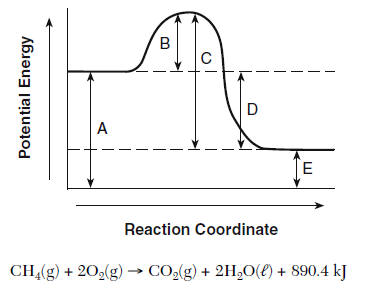
What type of reaction is shown in the reaction pathway?
a)
endothermic reaction
b)
exothermic reaction
3.
N2 +  3H2 −->  2NH3 
How many moles of ammonium are produced when 3 moles of nitrogen react with hydrogen?
a)
6 moles Ammonium
b)
1.5 moles ammonium
c)
9 moles ammonium
d)
9 moles hydrogen
4.
 _?_  is the amount of energy required to raise the temperature of 1 gram of any substance 1oC.
a)
Specific heat
b)
A calorie
c)
Thermal energy
d)
Conduction
5.
As 120 g of hot milk cools in a mug, it transfers 20, 000 J of heat to the environment. What is the temperature change of the milk? The specific heat of milk is 2.6 J/g·°C. (Q=mcΔT)
a)
64 °C
b)
1.56 °C
c)
640 °C
d)
cannot be determined
6.
If 100 g of aluminum at 145ºC gains 6,800 J of heat, what is the final temperature (Tfinal) of the aluminum? Aluminum has a specific heat of 0.897 J/gºC. (Q=mcΔT)
a)
-69°C
b)
0.52°C
c)
221°C
7.
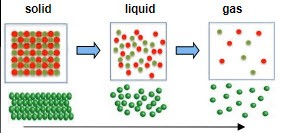
Entropy increases from solid, liquid to gas. Why?
a)
Molecular disorder increases
b)
Molecular randomness decreases
c)
Molecules are more energetic
d)
Molecules are more reactive
8.
Which interval represents the heat of reaction for the reaction?
a)
A
b)
B
c)
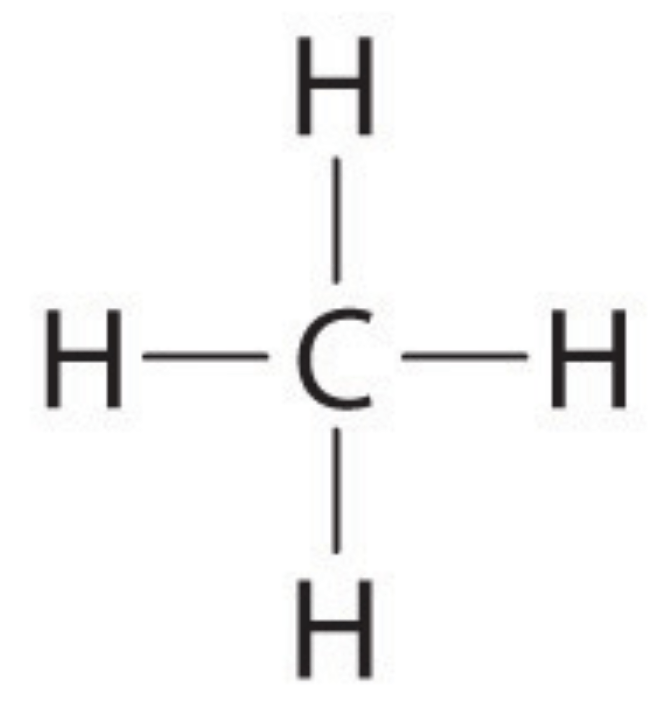
D
d)
E
9.
Entropy is a measure of:
a)
order
b)
disorder
10.
Enthalpy is energy absorbed or relased during a chemical reaction as
a)
light.
b)
heat.
c)
sound.
d)
pressure.
11.
When ammonium nitrate dissolves in water, the solution gets cold. Which is true?
a)
Reaction is ENDOTHERMIC with positive ΔH
b)
Reaction is ENDOTHERMIC with -ΔH
c)
Reaction is EXOTHERMIC with a -ΔH
d)
Reaction is EXOTHERMIC with +ΔH
12.
Which one of these would result in a decrease in entropy?
a)
A solid solute dissolves in water.
b)
A gas is released.
c)
A liquid freezes.
d)
A liquid boils.
13.
Entropy always increases when
a)
enthalpy decreases.
b)
temperature decreases.
c)
temperature increases.
d)
volume increases.
14.
The molecules of a gas are in constant and random motion.
a)
TRUE
b)
FALSE
c)
DEPENDS UPON THE KIND OF MOLECULE
15.
Pressure is caused by ______.
a)
gravity.
b)
gas molecules colliding with each other.
c)
gas molecules colliding with surfaces of the container.
d)
gas molecules reacting with each other.
16.
What will happen to the size of the balloon when it is placed inside the refrigerator? 
a)
Its size decreases.
b)
Its size increases.
17.
The movement of gas molecules is greatly affected by _________.
a)
the shape of the container
b)
size of the container
c)
temperature of the container
18.
Among the following gases, which one is the heaviest?
a)
hydrogen gas
b)
nitrogen gas
c)
oxygen gas
d)
chlorine gas
19.
At what temperature do nitrogen molecules move fastest?
a)
350 K
b)
300 K
c)
250 K
d)
200 K
20.
Gas molecules can easily be compressed  because ___________. 
a)
gas molecules are soft
b)
gas molecules are far apart
c)
gas molecules follow the shape of the container
21.
Segment A? (Notice it is the coldest!)
a)
solid
b)
liquid
c)
freezing
d)
melting
22.
Segment C?
a)
gas
b)
liquid
c)
boiling
d)
melting
23.
Segment E? (Notice it is the hottest!)
a)
gas
b)
liquid
c)
boiling
d)
melting
24.
Segment B? 
a)
gas
b)
liquid
c)
boiling
d)
melting/freezing
25.
Segment D? 
a)
gas
b)
liquid
c)
boiling/condensation
d)
melting/freezing
26.
What phase of matter is shown in the diagram? (It is a regular pattern and the particles are locked in place.)
a)
solid
b)
liquid
c)
gas
d)
physical changes
27.
What phase of matter is shown in the diagram? (The particles are close to each other but move around freely.)
a)
solid
b)
liquid
c)
gas
d)
physical change
28.
What phase of matter is shown in the diagram? (The particles are far apart and have lots of energy.)
a)
solid
b)
liquid
c)
gas
d)
phase change
29.
What phase change can happen if enough heat energy is added to a liquid?
a)
it melts
b)
it freezes
c)
it condenses
d)
evaporation
30.
a change of state when a gas becomes a liquid
a)
melting
b)
freezing
c)
condensation
d)
boiling
31.

1) Which isotope has the greatest number of protons?

a)

Pa-238

b)

U-240

c)

Np-238

d)

Pu-239

32.

2) A neutral atom of a certain element has the electron configuration 1s22s22p63s23p4. How many valence electrons does the atom have?

a)

4

b)

6

c)

11

d)

16

33.

3) What color of light does a hydrogen atom emit when an electron transitions from the n=6 energy level to the n=2 energy level?

a)

orange

b)

yellow

c)

blue

d)

violet

34.

4) The equation below represents the radioactive decay of a gold isotope.

174 79 Au →17077 Ir + ?

Which choice correctly completes this equation?

a)

alpha particle

b)

beta particle

c)

photon

d)

neutron

35.

5) A neutral atom has a ground state electron configuration of 1s22s22p63s2. The neutral atom becomes an ion during a chemical reaction. Which is the most likely charge of the ion?

a)

2+

b)

1+

c)

2-

d)

6-

36.

6) How many electrons are in the outermost energy level of a neutral carbon atom?

a)

2

b)

4

c)

6

d)

8

37.

7) The compound sodium chloride is placed in water and separates into ions. What are the correct names for these ions?

a)

The chloride and sodium ions are cations.

b)

The chloride and sodium ions are anions.

c)

The sodium ion is the anion, and the chloride ion is the cation.

d)

The sodium ion is the cation, and the chloride ion is the anion.

38.

9) Which type of bonding or intermolecular forces is/are weakest?

a)

London dispersion forces

b)

hydrogen bonding

c)

dipole-dipole forces

d)

covalent bonding

39.

11) Based on the information in the table, what can be concluded?

a)

Both solids contain only ionic bonds.

b)

Both solids contain only covalent bonds.

c)

Solid X contains only covalent bonds, and Solid Y contains only ionic bonds.

d)

Solid X contains only ionic bonds, and Solid Y contains only covalent bonds.

40.

12) What is the name of the compound with the chemical formula CoF3?

a)

fluorocobalt

b)

cobalt trifluoride

c)

cobalt(III) fluoride

d)

fluorine(III) cobalt

41.

14) How is copper (Cu) classified based on its location on the periodic table?

a)

a nonmetal

b)

an alkaline earth metal

c)

a transition metal

d)

an alkali metal

42.
A horizontal row of elements in the periodic table.
a)
atomic radius
b)
group
c)
period
d)
electron configuration
43.
A column on the periodic table.
a)
electron configuration
b)
group
c)
period
d)
atomic radius
44.
a positively charged ion
a)
cation
b)
anion
c)
catalyst
d)
chemical bond
45.

What is the number of protons that the element in this image contain?

a)

14

b)

7

c)

15

d)

18

46.
An isotope of an element has the same number of _________, but a different number of _________.
a)
Protons, electrons
b)
Protons, neutrons
c)
Electrons, neutrons
47.
How many elements are in C6H12O6?
a)
1
b)
2
c)
3
d)
4
48.
What is the percent by mass of oxygen in MgO?
a)
20%
b)
40%
c)
50%
d)
60%
49.
What is the percent by mass of magnesium in MgO?
a)
20%
b)
40%
c)
50%
d)
60%
50.
What is the percent by mass of sodium in NaCl?
a)
39%
b)
61%
c)
35%
d)
65%
51.
In which compound is the percent composition by mass of Cl equal to 42%?
a)
HClO (gram formula mass = 52 g/mol)
b)
HClO2 (gram formula mass = 68 g/mol)
c)
HClO3 (gram formula mass = 84 g/mol)
d)
HClO4 (gram formula mass = 100 g/mol)
52.

The mass % of aluminum in aluminum sulfate Al2(SO4)3 is:

a)

12.93%

b)

45.70%

c)

7.89%

d)

35.94%

e)

15.77%

53.

What is the name of the compound SO2

a)

Monosulfate oxide

b)

Sulfur Dioxide

c)

Monosulfur dioxide

54.

what is the name of CCl4?

a)

carbon tetrachloride

b)

monocarbon tetrachloride

c)

tetracarbon monochloride

d)

carbon chloride

55.
What is the charge on the calcium ion?
a)
1+
b)
2+
c)
2-
d)
1-
56.
Which is a transition metal?
a)
cesium
b)
iron
c)
helium
d)
tellurium
57.

NaBr

a)

Bromide sodide

b)

Sodium bromide

c)

Sodium bromate

d)

Sodium bromite

58.
What kind of bond forms between a cation and an anion?
a)
Chemical bond
b)
Ionic bond
c)
Covalent bond
d)
Electron bond
59.
Name the following compound: SnO2
a)
tin(II) oxide
b)
tin(IV)oxide
c)
tin(II)oxygen 
d)
tin oxide
60.
Name the following ionic compound: Cr(NO2)3
a)
chromium nitrite
b)
chromium nitride
c)
chromium (III) nitride
d)
chromium (III) nitrite
61.
Name the following ionic compound: FeCl3
a)
iron chloride
b)
iron (III) chloride
c)
iron chlorate
d)
iron (III) chlorate
62.

Which of the following is a binary

compound?

a)

O2

b)

HCN

c)

H2SO4

d)

H2S

e)

NaOH

63.

The correct name for LiCl is _______.

a)

lithium monochloride

b)

lithium(I) chloride

c)

monolithium chloride

d)

lithium chloride

e)

monolithium monochloride

64.
How many electrons should Helium have around its Lewis dot model?
a)
1
b)
2
c)
7
d)
8
65.
How many valence electrons does Argon have
a)
5
b)
11
c)
8
d)
6
66.

What do atoms that form positive ions tend to do?

a)

lose electrons

b)

gain electrons

c)

lose protons

d)

gain protons

67.

What usually forms a positive ion?

a)

metal

b)

nonmetal

c)

metalloid

d)

there is no way to tell

68.

By replacing the element symbol, this could be a diagram of which element?

a)

Li

b)

Al

c)

C

d)

Be

69.
Why do elements bond?
a)
To be friends
b)
To create a new element
c)
To become stable
70.

Classify the following molecule.

a)

polar

b)

nonpolar

71.

Classify the following molecule.

a)

polar

b)

nonpolar

72.

Classify the following molecule.

a)

polar

b)

nonpolar

73.

Is the following molecule polar or nonpolar?

a)

polar

b)

nonpolar

74.

Is the following molecule polar or nonpolar?

a)

polar

b)

nonpolar

75.

Is the following molecule polar or nonpolar?

a)

polar

b)

nonpolar

76.

How many valence electrons?

a)

2

b)

3

c)

4

d)

5

77.

Orbitals are associated with a certain amount of _____________.

a)

space

b)

light

c)

speed

d)

energy

78.

When an electron moves from n=4 to n=1, what wavelength of energy is emitted?

a)

97 nm

b)

410 nm

c)

434 nm

d)

1282 nm

79.

The line with the shortest wavelength is produced in the hydrogen spectrum when electron moves

a)

from n=2 to n=1

b)

rom n=4 to n=1

c)

from n=3 to n=1

d)

from n=4 to n=3

80.
The parallel lines represents...
a)
energy levels of the atom
b)
energy levels of the electrons
c)
energy levels of the photons
d)
energy levels of the nucleus
81.

The color of emitted light with the LONGEST wavelength is

a)

violet

b)

green

c)

red

d)

indigo

82.

Each element produces its own pattern of emission spectra lines because each element has its own distinct

a)

Speed of light

b)

Electron configuration

c)

Number of neutrons

d)

None of these

83.
What atom matches this electron configuration?
1s22s22p63s23p64s23d10
a)
Zinc
b)
Copper
c)
Nickel
d)
Germanium
84.
Which element is pictured?
a)
neon
b)
fluorine
c)
magnesium
d)
argon
85.
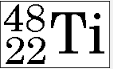
How many protons does this isotope of titanium have?
a)
48
b)
22
c)
26
d)
70
86.

What is a hydrocarbon?

a)

A compound that contains Hydrogen and carbon

b)

A compound that contains Hydrogen and carbon only

c)

A fuel that contains hydrogen and carbon

d)

A misture of Carbon and water

87.

16) Which three elements are arranged according to increasing electronegativity values?

a)

N, C, B

b)

N, P, As

c)

N, O, F

d)

F, O, N

88.

17) Which group of elements is arranged in order of increasing atomic radii?

a)

O, S, Se, Te

b)

Fe, Ni, Ag, Au

c)

Rb, K, Na, Li

d)

Y, Zr, Nb, Mo

89.

18) Which statement describes equilibrium between liquid water and water vapor?

a)

The rate of vaporization equals the rate of condensation.

b)

The rate of vaporization is greater than the rate of condensation.

c)

The rate of vaporization equals the rate of sublimation.

d)

The rate of vaporization is greater than the rate of sublimation.

90.

19) Which choice describes the state of the substance at X?

a)

A boiling liquid is in equilibrium with its vapor.

b)

A subliming solid is in equilibrium with its vapor.

c)

A freezing liquid is in equilibrium with its solid.

d)

A melting solid is in equilibrium with its liquid.

91.

20) A sample of metal has a mass of 5.2 g and absorbs 20.0 J of energy as it is heated from 30.0°C to 40.0°C. What is the identity of the metal?

a)

iron

b)

gold

c)

copper

d)

magnesium

92.

21) A 2.0-liter closed container holds 1.0 mole of an ideal gas at a certain temperature and pressure. Which closed container will hold 3.0 moles of this ideal gas at the same temperature and pressure?

a)

a 3.0-liter container

b)

a 6.0-liter container

c)

a 9.0-liter container

d)

a 12.0-liter container

93.

22) What is the condition of the sample at point X?

a)

The sample is in a gaseous state.

b)

The sample is in a liquid state.

c)

The sample is at its critical point.

d)

The sample is at its triple point.

94.

23) What is the approximate temperature of 1.4 moles of a gas with a pressure of 3.25 atmospheres in a 4.738-liter container?

a)

180 K

b)

170 K

c)

150 K

d)

130 K

95.

24) Which choice would be changed by the addition of a catalyst to the reaction?

a)

R

b)

S

c)

T

d)

U

96.

25) A student conducts the following demonstration:

• A 15-g sample of NaHCO3 is placed in a test tube.

• The bottom of the test tube is heated with an open flame.

• Condensation forms on the inside walls of the test tube.

• A burning splint is extinguished when placed at the mouth of the test tube.


What can the student conclude after conducting this demonstration?

a)

The burning splint was extinguished because of a lack of CO2 in the

test tube.

b)

The burning splint was extinguished because of a lack of H2O vapor.

c)

Decomposition produced CO2 and H2O.

d)

Combustion produced O2 and H2O.

97.

26) A chemical equation is shown below.

CaSO4 + AlBr3 → CaBr2 + Al2(SO4)3


What will be the coefficient of CaBr2 when the equation is balanced using the smallest possible whole-number coefficients?

a)

2

b)

3

c)

4

d)

5

98.

27) The equation below represents a chemical reaction.

Zn (s) + 2HCl (aq) → ZnCl2 (aq) + H2 (g)


A 5.00-g sample of zinc is added to hydrochloric acid. The amount of hydrochloric acid is sufficient to allow the zinc to react completely. What mass of hydrogen gas does this reaction produce?

a)

0.0308 g

b)

0.0771 g

c)

0.121 g

d)

0.154 g

99.

28) What is the molecular formula of a compound with the empirical formula CH2O and a molecular mass of 60 g/mol?

a)

CH2O

b)

C2H4O2

c)

C2H4O4

d)

C2H2O2